Over the last five years, new limitations on consumer privacy have impacted how all marketers can use advanced tactics to reach and engage consumers.
“The Era of Privacy is here, and all digital marketers will need to adapt to changes in consumer data tracking,” says Alyssa Allen, Managing Director at Skai. “The most impactful of these shifts so far has been last year’s Apple’s AppTrackingTransparency. It has forever changed how social practitioners can target and measure their programs as it relates to audiences.”
The loss of the incredibly valuable iOS signal was a heavy blow for marketers who relied on this data for many uses. Virtually overnight, social marketers lost much of their ability to target, personalize, measure, and optimize their campaign activity with deep granularity on Apple mobile devices.
More challenges to data usage are on the way. Google has already announced steps to limit third-party cookies on Chrome and will follow a similar path as Apple’s on Android devices. Once these changes occur, many of the advanced tactics that were commonplace five years ago will be rendered obsolete.
Facebook’s reaction and targeting recommendations

Meta/Facebook has undoubtedly been the most impacted advertising publisher from Apple’s shift. While the business implications are far-reaching and incredibly complex, the company released a help center article to outline the change for advertisers, recommendations on moving forward, and some glimpses into the future of Facebook advertising in this new Era of Privacy.
In the article, Facebook addressed targeting implications and offered this suggestion to marketers:
As more devices update to iOS 14 or later versions, the size of your app activity Custom Audiences, Website Custom Audiences, and app connections audiences may decrease. Alternative targeting strategies to consider: use a broad audiences for inclusion and use targeting expansion
The core of these two recommendations is to enable Facebook to widen targeting as an adaptation to the loss of iOS signal powering retargeting audiences.
Broad social audience targeting
Social advertisers have grown accustomed to targeting incredibly narrow audiences. In the light of ATT, Facebook’s advice to broaden audiences means that marketers will shift from their granular audience strategies and rely more on Facebook’s delivery system to find the best people to show their ads.
There’s undoubtedly some merit to enabling Facebook’s—and other social publishers’—powerful ad-matching algorithms. Pre-ATT, broad targeting was mainly a complementary strategy to specific targeting. So, for example, if a brand is trying to reach an audience they hadn’t reached before or didn’t have a lot of first-party data for retargeting, broad targeting is a good option.
In a post-ATT world, broad targeting is becoming much more of a first option rather than a complementary one. For example, Facebook reports that its broad targeting is getting more powerful, and they are focusing on enhancing it more since the Apple shift.

Targeting expansion
From the Facebook help center article, About Detailed Targeting Expansion:
Detailed targeting expansion can help improve your campaign performance by allowing our system to reach a broader group of people than you defined in your detailed targeting selections… Our ad delivery system uses the demographics, interests, and behaviors you select through detailed targeting as a guide for ad delivery, while also dynamically assessing performance.
If our system finds better performance opportunities outside your defined audience, detailed targeting expansion allows us to dynamically make updates that reflect where we’re seeing better performance, and we may expand your audience further to include similar opportunities.
So, while Facebook suggests marketers use less specific targeting and apply more broad targeting, targeting expansion is an always-on improvement for all campaigns.

New social audience targeting trends in the era of privacy
It’s been over a year since Apple’s AppTrackingTransparency shift. We have heard of numerous ways marketers have tried to adapt to social advertising targeting in the new Era of Privacy.
Based on an aggregated analysis of Skai clients’ social advertising campaign data—with an annualized spend of over $1 billion—we can see some of the ways that social marketers are adapting to the new constraints:
Retargeting is still viable, just different
“Just because retargeting pools have diminished, it doesn’t mean that retargeting has gone away,” says Maura McNulty, Director of Client Success at Skai. “On the contrary, social advertisers are still using them as a best practice in their marketing strategy, but they’re just leveraging them a bit differently than before.”
Website Custom Audiences (WCA) are limited, but not gone
Still some iOS data. While most iOS users have not opted into being tracked by Apple’s new policy, marketers report that they aren’t entirely zeroed out while these cookie pools are diminished. While brands with smaller first-party footprints will struggle, some larger websites/apps still have enough iOS visibility to power their WCA retargeting campaigns.
Non-iOS data is still viable—for now. iPhones represent around 55.5% of US mobile browser traffic, so that means nearly 40% of Android mobile browser traffic (and a handful of smaller mobile OSs) are still up and running. iPhones are just a quarter of all mobile traffic worldwide, so global brands can still run reasonably stout retargeting campaigns. Google has recently announced some upcoming privacy changes to Android, but they aren’t implemented yet. Based on what we know, it seems that Google is going to choose a more advertiser-friendly policy than Apple’s.
More reliance on other types of retargeting
Customer List Audiences (aka CRM Audiences). Marketers can still upload lists of customer offline identifiers (email/snail-mail addresses, phone numbers), which social publishers then “match” to their users. Generally, match rates can range anywhere from 50% to 80%. Some brands have very rich customer lists that enable them to build highly target-able audiences like:
- People who have a store-branded credit card
- People who buy large-ticket items
- People who spend over $1,000 per year
- People who have bought certain products or categories of products
Engagement Custom Audiences. Social marketers can retarget based users based on how they’ve engaged within the walls of social publishers, such as:
- Profiles/posts/pages (liked/commented on a social post)
- Videos (watched 25%/50%/100% of a social video)
- Lead forms (filled out a brand’s form)
- Events (attended/registered for a social event)
- Ads (clicked/viewed/interacted with a social ad)
Social Shopping Custom Audiences. Some publishers enable you to create audiences to retarget those who engage with your social commerce. For example:
- People who viewed your shop’s home page
- People who viewed your products on a product details page
- People who clicked to view your website
- People who added your products to their cart
- People who purchased your products
Marketers have increased spending on third-party social audience targeting
Skai clients have significantly increased their reliance on third-party audiences by 37% year over year, which is likely attributed to ATT making WCA more difficult.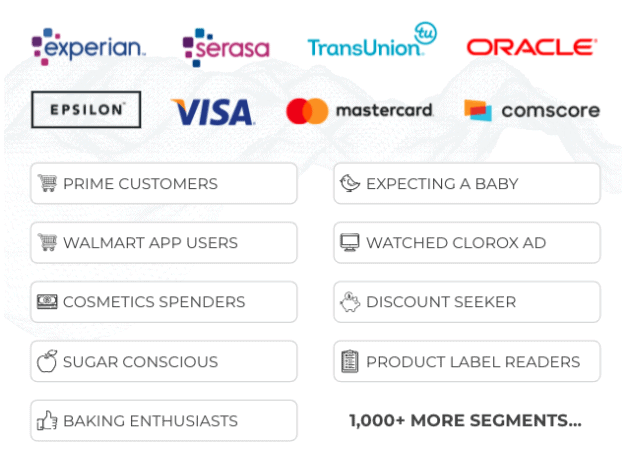
Third-party audiences have numerous benefits:
- Create WCA via third-party data providers. Third-party data providers can anonymously track users to websites and apps and then build retargeting pools to reach those people on social networks. It’s not the exact same thing as using a social retargeting pixel, but it enables a very similar functionality.
- Reach people you never reach. Using some of the retargeting methods listed in the previous section, social marketers are pretty good at getting back to users who have already engaged with them. In addition, third-party audiences help marketers target ads to people that haven’t yet done that.
- Find the narrowest audiences. Some brands cater to the most niche of audience segments. For example, if you just want to reach snowboarding fans, that might be a pretty small audience from native social targeting.
- Reduce waste. Sometimes, what’s more, valuable for marketers is not to target to reduce wasted impressions and dollars. Third-party data can help make sure social marketers don’t waste money on the kinds of people they don’t need to reach so that they can invest those budgets correctly.
Leverage your tech for maximum results
As part of Skai’s intelligent marketing platform, our Paid Social solution has unique, best-in-class capabilities to automate, optimize, and scale your ads at an enterprise level. In a privacy-first world, Skai offers integrated solutions to reach consumers on all the platforms that matter and drive powerful growth no other independent social platforms can achieve.
Client results include:
- 135% increase in Facebook leads for BYJU’s Future School
- 600% increase in Facebook leads for Inova
- 60% decrease in cost per conversion for Mercedes-Benz Vans Turkey
To learn more or to see our cutting-edge functionality for yourself, schedule a brief demo today.