ShopAble 2026 brought together more than 300 commerce media leaders in New York City on May 14, 2026 for a full day of sessions on what marketing actually looks like in the agentic era. From AI-driven discovery to measurement gaps, organizational readiness, and the future of retail media, here are the key takeaways from every session.
Skai’s annual ShopAble event was built around one central question: what does it actually take to win in the agentic era? The answer is a combination of data, measurement, human judgment, and organizational readiness. Across eight sessions, speakers from Amazon, Microsoft, PepsiCo, WPP Media, Tinuiti, Danone, and dozens of agencies and brands shared what that looks like in practice. If you missed our product announcements from the day, you can catch up on those here.
Here is what we learned.
AI, Consumers & Commerce: A Reality Check
Speaker: Debra Aho Williamson, Founder & Chief Analyst, Sonata Insights
Debra Aho Williamson opened with a story the room could relate to. Standing in front of her bathroom mirror one Saturday morning, she spotted an Instagram ad from Gwyneth Paltrow’s brand Goop, took the question to ChatGPT, and walked away with two products from The Ordinary in her Amazon cart. She had never heard of the brand and never saw a single ad from them. ChatGPT ran the entire journey, and none of those signals went anywhere outside that conversation.
1. The consumer AI adoption curve is steeper than most marketers realize.
Having covered digital disruption since the late 90s, Aho Williamson called this moment unlike anything she has seen in terms of speed.
- Nearly 2.5 billion people will use generative AI on a monthly basis this year, up 141% from last year (DataReportal)
- US adults using platforms like ChatGPT, Claude, Gemini, or Copilot have roughly doubled in one year (Ipsos)
- 62% of US adults now trust AI to provide honest and reliable information, up from 50% the year before (TD Bank Second Annual U.S. AI Insights Report, February 2026)
2. The discovery window has moved inside a conversation your media cannot see.
The path is no longer search, browse, compare, buy. It is now prompt, answer, shortlist, decide, all inside a single conversation your ads never touch. As Aho Williamson put it: “The signals that I sent to ChatGPT didn’t go to your ads, to your media, to your retail media networks, to anywhere outside of ChatGPT.”
- 45% of worldwide consumers who use AI use it to get help with their shopping journey (IBM Institute for Business Value / National Retail Federation)
- 64% encounter a brand new product in that same session (IAB / Talk Shoppe, October 2025)
3. AI media is a structural shift, not a new channel.
Aho Williamson coined the term to describe experiences inside AI assistants and AI-native interfaces where decisions are made and can be monetized. OpenAI expects to generate $100 billion in ad revenue by 2030 (Axios, April 2026), a milestone that took Alphabet 18 years and Meta 14 years to reach.
According to Aho Williamson, “The genie is not going back in the bottle. People are using AI to research, to make decisions, and to make purchases. And eventually there will be agents involved as well. This consumer behavior is not changing.”
She continued: “Watch the consumer. Pay attention to what they’re doing. Learn along with them. They are evolving as we are evolving in the industry. So, if you evolve your systems along the way, you will be able to reach them in the next phase of advertising.”
The View from Inside

Moderator: Jeff Cohen, Chief Business Development Officer, Skai
Panelists: Sue Oh, Sr. Product Marketing Manager, Amazon Ads; CP McBee, North American AI Advertising Director, Microsoft Advertising; Simon Poulton, EVP of Innovation & Growth, Tinuiti
1. The web has split into three.
CP McBee laid out the framework every brand needs right now: the human web of blue links, the LLM web of conversational AI, and the agentic web where AI acts on behalf of consumers. Each requires a different strategy, and most brands are still building primarily for the first.
2. Amazon just changed the game.
Mid-session, Sue Oh confirmed that Amazon had officially launched Alexa for Shopping, merging Rufus and Alexa+ into a single search bar synced across all devices. More than 300 million customers used Rufus in 2025 (Amazon Q4 2025 Earnings), with monthly users up 115% year over year.
“It’s not about people searching, it’s about people asking,” Sue said. “You have to be part of that conversation from the get-go, otherwise you’re missing out on this whole product discovery journey.”
3. Observability is the honest challenge nobody is solving yet.
Simon Poulton raised the concern few others were willing to say out loud: every consumer experience is becoming more personalized, making it increasingly hard to determine how your brand was surfaced in any given moment. The panel’s collective advice: get your catalog data right, find your AI problem solvers, and stop optimizing before you know what you are measuring.
The Human Face of AI

Moderator: Shirley Grill-Rachman, Chief Operating Officer, Skai
Panelists: Dee Fitzgerald, VP Head of Data & Analytics, Danone; Jamie Roller, Senior Director, Marketplaces, Dr. Squatch; Rory Foster, Chief Marketing Officer, Stephens Direct; Samantha Bukowski, Global Head of Commerce, WPP Media
1. The mindset has already changed.
Teams have moved from “is my job going to end?” to “how is my job going to be different?” That evolution in framing, as Dee Fitzgerald put it, has changed everything about how teams approach adoption.
2. Encouragement drives adoption faster than mandates.
Rory Foster described using AI to build a startup on top of a 45-year-old company without adding headcount, while Samantha Bukowski called AI the fastest silo-breaking tool she has seen.
Jamie Roller added: “When someone on your team finds a new way of doing things using AI, just really encourage them. In my experience, that has been the most helpful. Show that this is not just for their job right now. It is important for their careers going forward.”
3. The marketer role is upgrading, not disappearing.
As AI handles reporting and repetitive work, humans get to focus on judgment, taste, and strategy.
“AI will do a good portion of the work, but the human will be the one to make the decision, land the impact, and drive the value,” said Dee Fitzgerald.
Will Retail Media Survive the Agentic Era?
Moderator: Matt Vignieri, Chief Growth Officer, Skai
Panelists: Caroline Giegerich, VP of AI & Marketing Innovation, IAB (Team AI); Garrett Dale, Chief Media Officer, Kepler (Team AI); Briana Finelli, VP Commerce Media, Goodway Group (Team Retail Media); Kelly Spehar, Global Retail Media Strategy Director, Mars Snacking (Team Retail Media)
A live Oxford-style debate with one question: in 2036, will retailers still capture the majority of commerce media ad dollars, or will AI platforms take them over? Team Retail won the vote, but both sides made the room think.


1. Team Retail: retailers own the data, the walled gardens, and the dollars.
Whether it is called an Amazon ad or an AI ad, the brand is still paying for it. And a large portion of those sales still happen in store.
2. Team AI: the front door is already changing.
Caroline Giegerich pointed to 270% more AI traffic through Adobe results and argued that AI now controls the discovery moment retailers once owned: “It’s not going to be us that are owning the consumer shifts. It’s going to be AI natives [Generation Z and Generation Alpha] that literally grew up with conversational AI.”
3. Both sides agreed: retail media is already broken.
No AI layer on top is going to fix it. And as AI takes over the awareness and consideration phases, a considerable amount of measurement signal is already being lost.
Unpacking Upfronts with Amazon Ads
Host: Lauren Corby, Principal Strategic Partnerships, Amazon Ads
Panelists: Cara Kramarchuk, Business Lead Commerce, Code 3; Ben Jurist, Founding Partner, Grain Group; Chelsea Cicilioni, Commerce Marketing Senior Manager, PepsiCo
1. Amazon is no longer just a retail media network.
With 300 million households globally and partnerships across Netflix, Roku, and Fire TV, it is a full-funnel media partner. Chelsea Cicilioni of PepsiCo described how Amazon Marketing Cloud has fundamentally changed how her team measures and executes media end-to-end.
2. Brand love drives bottom-funnel performance.
Ben Jurist argued that brands just fighting over sponsored ad auctions are missing the bigger opportunity: “Brands can fight over the demand in sponsored ads, but the question is: are you building a brand that people care about, that they love, that they’re excited about? We’ve been able to see that incrementality is actually generated when we invest in video, invest in discovery, we invest in brand love, and it trickles down and makes that bottom of the funnel work that much harder.”
3. Upper funnel does not have to be expensive.
The myth that streaming TV is only for the biggest brands is over. Small tests can prove the value and give brands the story they need to bring back to their finance teams.
Retail Media Room 101: Reimagining the Playbook

Moderator: Ashley Jenkins, EVP Sales Direct, Skai
Panelists: Megan Conahan, EVP, Direct Agents; Katie Daleo, GM of CPG Ads, DoorDash; Molly Hop, Managing Partner, Havas
Several things got thrown into Room 101 including:
1. Inventory-first thinking.
Brands are still funding the storefront instead of the customer. Start with the business KPI and work backwards to the right customer experience across every touchpoint.
2. Fragmentation and misuse of the term “incrementality”.
With 250 retail media networks in the market and brands managing five to seven on average, the only fix is one single-threaded owner and one clear North Star KPI everyone marches toward.
As Megan Conahan noted: “Retail media is at this inflection point. It’s become increasingly complex and challenging to operate in. And if we want to win in this next retail media moment, we have to be sophisticated. We just can’t sound sophisticated. Any one of us could walk into a meeting tomorrow and talk about incrementality and nobody would question it. But hiding behind that word is doing us all a disservice.”
3. PDP obsession as a purely consumer-facing strategy.
Your product detail page is also a data training layer for LLMs. ChatGPT and other LLMs drove 20% of Cyber Week traffic in 2025. If your content is not structured for AI, your brand does not show up.
Last Call: Where Brands Win in the AI Era
Host: Michelle Urwin, Chief Marketing Officer, Skai
Debaters: Gal Zohar, Chief Data Officer, Skai; Caroline Ballard, VP Commerce Media, Profitero; Dan Kartcher, CRO, Detail Page; Alex Juday, SVP Revenue & Commerce, Incremental; Rosaria Alfano, Chief Marketing Officer, Crealytics; Judges: Nicole Reich, Chief Growth Officer, Blue Wheel; Chelsea Monaco, SVP Commerce Media, Digitas
Five experts. Five minutes to pitch where brands win in the AI era. Every argument landed.
1. Agent-ready data is the foundation.
Gal Zohar argued that bad data in agentic hands compounds bad outcomes at machine speed. Data must be correct, clean, connected, and contextualized. “The brands that will win will be the ones whose data teaches AI how to represent them best.”
2. Content and digital shelf are the eligibility criteria.
Dan Kartcher shared only 4% of brands are fully optimized across their PDPs on Amazon. Caroline Ballard added that 44% of retail media campaigns direct to unoptimized PDPs, and only 18% of page one search results surface in Rufus. If you cannot be indexed, you are not eligible.
3. Social proof is the one lever you cannot buy.
Rosaria Alfano closed with the argument that data, content, and measurement assume you are already in the consideration set. Social proof is what gets you there: “Social proof is the one lever you cannot fully control and that is exactly why it is so powerful.”
Closing Keynote
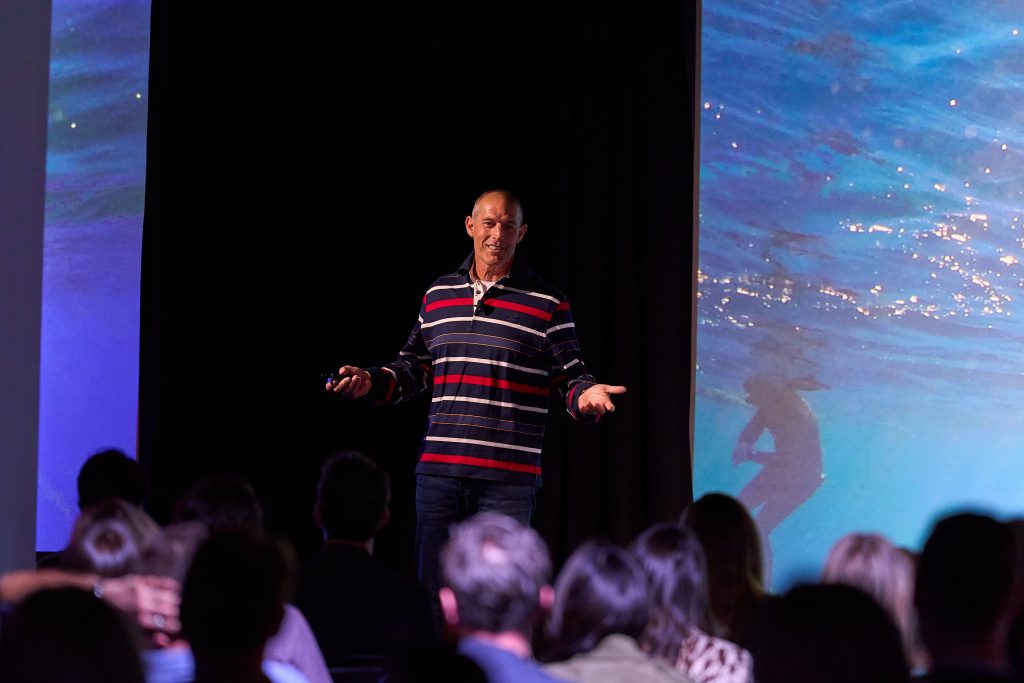
Speaker: Yoav Izhar-Prato, CEO, Co-Founder & Chairman, Skai
Yoav Izhar-Prato closed with a reminder grounded in human biology. Survival mode, the state we enter when things feel uncertain or threatening, shuts down everything that makes us human: creativity, imagination, and the ability to grow.
The agentic era is triggering that state for a lot of people in marketing right now. His argument: the answer is not to avoid the discomfort but to choose it deliberately, step outside your comfort zone gradually, and build the muscle to grow through change rather than just endure it.
As he summed it up: “Choose it. Mean it. Explore it. It will develop all of us. Agentic is about machines becoming more human. And more human is what we all need to be.”
Thank you to every client, panelist, guest, partner, and member of the Skai team who made ShopAble 2026 what it was. The conversations, debates, and ideas from this year will carry us forward as we continue our mission to help brands reach their full potential in the agentic era. We can’t wait to see what next year brings.
Read about Skai’s industry-first agent-native operating system for marketing and more announcements from ShopAble 2026.
More like this
-

From Software Engineer to AI Engineer: 8 Lessons From Under the Hood at Skai
-

Prime Big Deal Days 2026: How One Month Paid Off in Two Days for Amazon Ads
-

Who Owns AI Agent Strategy Now? Meet the New Buying Committee
-
From AI Assistance to Agentic Execution: Skai’s Take on Amazon Ads unBoxed 2026
-
Ready for AI Agents to Do More? Inside Skai’s 34-Tool Agent Connect Launch
-
The Road to Agentic Marketing: Skai at Amazon Ads unBoxed 2021-2025