AI agents have made building commerce media technology faster and more accessible than ever. The question is no longer whether teams can build, but what they should build and how. These eight considerations cover the data infrastructure, governance, operational support, and technical requirements needed to make agentic AI solutions reliable at scale.
AI agents have dramatically lowered the cost of building software. Workflows that once took months can now come together in days. It’s no wonder that teams are building more internally than they could before.
Building commerce media technology is becoming much more accessible. The question is no longer whether teams can build. It’s what they should build themselves, what foundations they need underneath it, and what they’re prepared to own over time.
But while agents really do produce working code quickly, they don’t automatically produce everything that turns that code into something you can run for years without it breaking under you. Governed data, workflow coordination, testing, observability, human review, and operational support all need to be carefully thought through.
That’s where many teams discover they’ve traded one bill for several others: a database, an agent deployment platform, token spend, and a human-in-the-loop process to keep it all safe.
Here are eight things to consider to ensure you’re building the best possible solutions, and where a partner like Skai can help:
Eight considerations before you build with AI agents
1. Plan for consistency, not just output
Agents are non-deterministic (the same prompt won’t always produce the same output), so consistency isn’t guaranteed. Run the same task twice and you can get back different structures, formats, or interpretations. Imagine an agent generating your weekly campaign performance summary: one week it labels a metric “conversion rate,” the next it’s “CVR,” and a few weeks later the underlying calculation has changed too. Nothing errors out. The dashboard just stops meaning what it used to.
Ask your builders: How are we enforcing a consistent schema and logic across every run, and how would we even notice if that consistency slipped?
2. Plan for what happens when two agents touch the same thing
Getting agents to run reliably in production is its own problem, and most tooling hasn’t fully caught up to it yet. Agents are good at generating code; making sure multiple runs don’t collide, lose track of where they are, or step on each other is the harder part, and none of that happens automatically. Picture two agents both adjusting the same campaign budget pacing at once, with no coordination between them. One overwrites the other, and nobody notices until the campaign’s already live and the numbers don’t add up.
Ask your builders: What happens when two agent runs touch the same data at the same time, and does a failed workflow have a way to pick back up where it left off?
3. Plan for what happens at real data volume
Models operate within bounded context windows. At real data volume, agents therefore need reliable data infrastructure and tools to query, aggregate and validate information rather than attempting to reason over the entire dataset directly.
An agent asked to reconcile a full quarter of cross-channel spend needs that infrastructure to hand it the right totals to begin with. Without it, someone ends up manually batching the data through the agent instead. That’s easy to get subtly wrong. Miss a batch or double-count one, and the ROAS number that lands in front of leadership is simply off, with nothing in the system flagging it.
Ask your builders: Is real data volume getting queried and aggregated through dedicated infrastructure, or is the agent trying to reason over the raw dataset itself, and what does that cost in latency and tokens as volume grows?
4. Plan for correctness as its own workstream
Output is probabilistic, so it needs to be checked, not assumed. That means automated checks, testing, and a record of what the system did, each built and maintained as their own piece of work. An agent-built attribution model might look convincing in a demo. Without checks in place, a subtle miscalculation in channel weighting can steer budget in the wrong direction for a full quarter before anyone catches it at the next QBR. Gartner projects more than 40% of agentic AI projects will be cancelled by 2027 over exactly this kind of weak risk control (Gartner, 2025).
Ask your builders: What’s our system for catching bad output before it reaches a real decision, and who owns keeping it up to date?
5. Plan for the unglamorous upkeep
Login credentials and API tokens expire. The tools you’ve connected to change how they work behind the scenes. Software versions break. Schedulers need constant babysitting. Multiply that across a dozen connected ad tech vendors, and consolidating those integrations into something one person can actually keep track of becomes its own project.
It also takes a team built for it: people who know both the agentic tech and the marketing side well enough to monitor and support it around the clock, not a task bolted onto someone’s existing role. None of that is the interesting part of the build, and all of it is required to keep the system alive. The day an ad platform changes its authentication method, someone has to notice and fix it, or automated reporting goes dark in the middle of a campaign with no warning.
Ask your builders: Who’s responsible for this maintenance long after launch, and what’s the plan for when it’s not top of mind anymore?
6. Plan for “done” to keep moving
Because agent behavior is emergent (you can’t fully predict everything it will do ahead of time), new edge cases tend to force a redesign rather than a quick patch, and fixing something properly often means reprocessing what’s already run. A pipeline built for standard campaign structures may need real rework the moment a new channel or ad format launches, and that work lands back on whoever built it the first time.
Ask your builders: When a new edge case shows up, are we set up to patch it, or are we looking at a redesign, and do we have the time budgeted for that?
7. Plan for cost that scales with usage, not features
Every agent run, retry, verification pass, and reprocess uses tokens. A pilot can look nearly free. A production workload running continuously against real data costs real money every day, and that cost tracks volume, not the feature list. That runs counter to how most software economics work: scale usually drives cost per unit down.
Agent costs often scale with usage, retries and verification, so pilot economics may not reflect production economics. Reliability tends to push teams toward the most capable, most expensive models too, since the cheap ones that make a demo look affordable often aren’t consistent enough for production. A lightweight reporting tool that costs a few dollars a day in testing can become a genuinely unpredictable line item once it’s running across every account and channel, and that’s the retail media platform ROI math a lot of pilots skip until the bill actually arrives.


Ask your builders: Have we modeled the token cost at real production volume, including the model tier and retries reliability actually requires?
8. Governance is what holds the other seven together
Consistency, correctness, and coordination all assume someone can see what an agent did and step in before it causes damage. Treating governance as a separate checkbox misses that: it’s the layer that makes the other seven answerable to anyone outside the room where the agent was built.
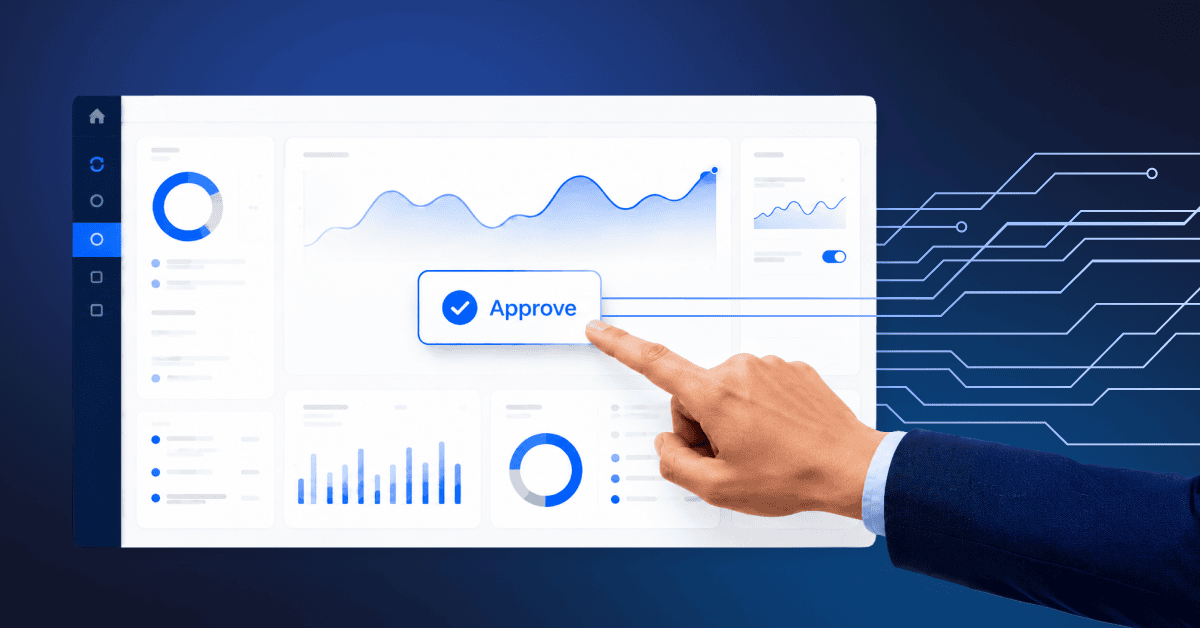
In practice, that means an approval step before a budget change goes live, a log of every action an agent took and why, and a way to trace a bad recommendation back to the input that caused it. Skip it, and the two agents from consideration #2 that overwrote each other’s budget pacing becomes impossible to explain to a client or your boss, let alone reverse. Skip it, and the correctness checks from consideration #4 have nowhere to report to.
Ask your builders: If an agent makes a change that turns out wrong, who gets alerted, what’s the audit trail, and how fast can it be rolled back?
The takeaway
AI agents make the initial build dramatically cheaper and faster, which is exactly why the opportunity is so compelling. What often gets missed is that the consistency checks, coordination logic, and correctness layers required to make those systems reliable still need to be built, tested, and maintained.
Without that foundation, teams can end up spending their early savings recreating the infrastructure needed to trust the outputs, validate decisions, and keep workflows running over time. That effort takes focus away from the innovation those builds were meant to unlock.
Skai has that foundation in place today, tested and maintained by a team whose job is making these systems work. Building with Skai means starting from a foundation that already supports the complexity of agentic workflows, so teams can focus on creating new capabilities instead of rebuilding the underlying infrastructure.
Questions to bring to your builders
To ensure the best possible output, it’s worth walking your builders through these questions directly:
- Consistency. How are we enforcing a fixed schema and deterministic logic across every agent run, and how would we detect it if that slipped?
- Coordination. What keeps two agent runs from corrupting the same data, and what happens when a long workflow fails halfway through?
- Scale. How are we processing full data volume through a bounded context window without missing rows, double counting, or blowing up cost?
- Correctness. What’s our system for verifying agent output is right, and who owns maintaining it?
- Operations. Who keeps credentials, connectors, dependencies, and schedulers running, indefinitely?
- Maintainability. When an edge case forces a redesign and a full reprocess, do we have the bandwidth to absorb that?
- Cost. Have we modeled the real monthly token bill at production volume, including the model tier and retries reliability requires?
- Governance. Who approves a change before it goes live, and how far back can we trace it if something goes wrong?
- Ownership. Which of these do we want our team building and owning long-term, and which would we rather build on top of a foundation that already handles it?
Where Skai already has this covered
Most teams can’t answer these questions with absolute confidence, since these problems take real time to solve well, and that time tends to get spent twice: once to find out what’s missing, and again to fix it. That’s the work Skai has done already.
Connect Skai to your AI ecosystem
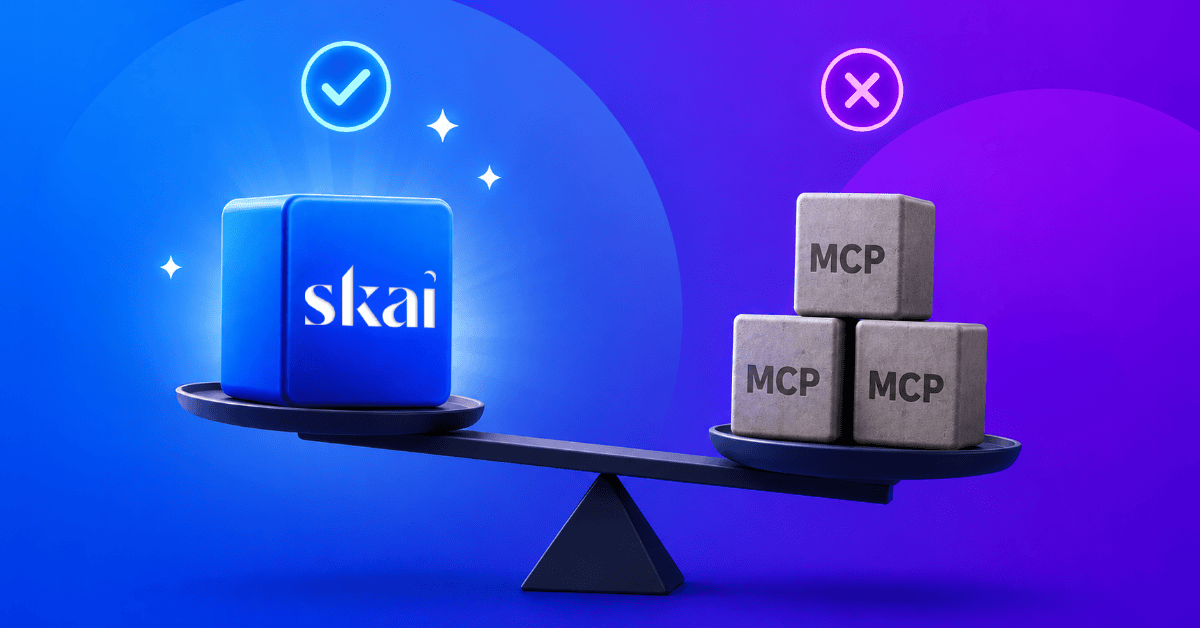
Use Skai Data Hub, tools and MCP to give your agents access to unified, AI-ready commerce media data, proven marketing capabilities and workflows without maintaining hundreds of individual publisher connections.
Build your Agentic Marketing OS in Skai
Use Studio to create, orchestrate and govern agents, skills and workflows around your own goals, rules and processes.
Build with Skai expertise
Use Skai Services for strategy, architecture and hands-on support to move from prioritization to production.
At Skai, governance runs underneath all our capabilities. Every action through Skai is logged, traceable, and bound by the approvals and rules you set, the same standard from the considerations above, not a special mode you switch on later.
Ultimately, the goal is not to avoid building. It is to focus your builders on the workflows, goals and business logic that differentiate your organization, while using a proven foundation for the data, tools, governance and operational infrastructure every build requires. Building with Skai means your team spends its time on the workflow and logic that’s actually specific to your business, instead of rebuilding what Skai has already solved.
Already a Skai customer? Contact your success team to get started.
New to Skai? Schedule a demo.
Frequently Asked Questions
For a lot of teams, it’s the decision that’s replaced the build vs. buy question for retail media technology. Agents have made a first version cheap enough that most retail media and ad tech teams are choosing to build some of their own tools. The real question is where you build it: entirely from scratch, or on top of a foundation, like Skai’s, that’s already solved the consistency, scale, and maintenance problems most teams haven’t gotten to yet.
Not necessarily. Agents cut the cost of writing code. They don’t cut the cost of consistency, correctness, or long-term upkeep. Building those on top of a platform that’s already solved them still saves the same effort. It just gets spent on the workflows that are specific to your team instead of on infrastructure every build eventually needs.
Most of the early effort in a build goes into what’s visible on day one: the interface, the first workflow, the first data pull. What keeps a system reliable over time tends to get built later, if it gets built at all. That’s usually why a tool ends up doing a fraction of what it could, whether it was built from scratch or bought off the shelf. The unglamorous work covered in the eight considerations above is usually the actual shortfall.
More like this
-

From AI Assistance to Agentic Execution: Skai’s Take on Amazon Ads unBoxed 2026
-
Ready for AI Agents to Do More? Inside Skai’s 34-Tool Agent Connect Launch
-
The Road to Agentic Marketing: Skai at Amazon Ads unBoxed 2021-2025
-
Who’s Accountable When AI Agents Buy Media?
-
From Insights to Action: A Practical Framework for Governed AI Agent Execution
-
Skai Reporting Connector vs. Publisher MCPs: Test Results Reveal Up to 90% in Cost Savings