
Summary
With retail media Connected TV (CTV) ad spending projected to grow three times faster than retail media search in 2025, brands are leveraging advanced targeting and retail media’s commerce signals to deliver personalized, measurable campaigns. Skai’s the State of Retail Media 2025 report reveals key opportunities in enhancing brand awareness, driving engagement, and using data-driven targeting, positioning CTV as a crucial channel for future retail media success.
Last updated: December 20, 2025
The move from traditional linear TV to streaming platforms is reshaping how people engage with media and how advertisers reach their audiences. Consumers are rapidly abandoning traditional broadcast and cable television, increasingly choosing Connected TV (streaming and on-demand video services) that offer more personalized, flexible viewing experiences. According to eMarketer, CTV average daily viewing in the U.S. is projected to nearly double by 2026, clearly highlighting the declining relevance of traditional TV. According to Nielsen 2025, most U.S. TV viewing time is ad-supported and a substantial share of that viewing is streaming—reinforcing why streaming-first planning has become table stakes for modern advertisers.
As commerce media evolves, its goal is to surround consumers with relevant, data-driven touchpoints that drive them to shop—and television has always been a key part of that equation as a foundational role in product discovery. Now, with the advanced targeting and measurement capabilities of CTV, it can go beyond upper-funnel awareness to also support mid- and bottom-funnel objectives, making it a more versatile tool for commerce-driven strategies. This shift accelerates when teams run CTV alongside an omnichannel marketing platform that unifies planning, activation, and measurement across walled gardens and retail media networks.
Brands are seizing the opportunity with retail media CTV ad spending projected to grow about three times faster than retail media search in 2025. According to IAB 2024, CTV ad spend surpassed $20B in 2023 and was projected to keep growing in 2024—supporting why advertisers are prioritizing scalable video strategies as budgets migrate from linear to digital video.
Today we explore recent insights from our 2025 State of Retail Media report, which surveyed retail media marketers to better understand their challenges, strategies, and perspectives—including valuable insights on the role of CTV within retail media.
Micro-answer: Streaming reach, retail data, measurable commerce outcomes.
How do retail media commerce signals create the new CTV?
- Retail media commerce signals make CTV targeting shopper-specific.
- CTV becomes “retail media CTV” when first-party retailer behaviors (search, browse, buy) inform who sees ads and how success is measured. This combination blends TV-scale storytelling with commerce-grade accountability—turning streaming into a full-funnel, audience-addressable channel tied to real purchase intent.
Retail media uniquely leverages powerful commerce signals such as purchase history, browsing activity, product searches, and other first-party retailer data points. These signals are invaluable because they enable marketers to precisely target and personalize their advertising efforts around shopping behavior, significantly boosting campaign effectiveness and efficiency. That’s why many brands treat retail media solutions as the operating layer for translating retailer data into addressable audiences across channels like CTV.
One of the hallmarks of commerce media is the broader application of these signals to help other channels—like social media, search engines, and now CTV—target shoppers across the entire funnel.
The power of retail media’s commerce signals combined with CTV’s reach and engagement is shaping the future of television advertising, with eMarketer forecasting ad spending to triple by 2028, reaching $10.28 billion.
And here’s the silver lining: CTV, powered by retail media, goes beyond merely replacing linear TV budgets. Marketers are particularly excited about the advanced functionality CTV offers. According to a consumer poll by Skai, consumers are willing to engage with retail media CTV in new ways that will create more interactive and measurable outcomes for brands once unimaginable with traditional television.
For example, when asked about interacting with Prime Video ads:
- 86% of consumers are willing to watch a product video
- 89% are open to saving products to wishlists for later
- 91% actively review prices and product options
- 79% express willingness to click “Buy Now” directly from video ads
Jeffrey Bustos, SVP of Retail Media Analytics at Merkle, emphasizes, “Retail media data should make CTV unstoppable.”
This investment signals a fundamental shift towards more accountable, data-driven television advertising, essentially defining the future of TV as we know it. Let’s now dive deeper into the key findings and insights captured from our report.
How can brands unlock CTV’s strategic potential through retail media?
- Retail media-powered CTV expands beyond awareness into measurable action.
- Brands unlock strategic value by pairing streaming storytelling with commerce signals that improve targeting, personalization, and performance measurement. In practice, that means using retail audiences to drive brand lift, interactive engagement, and conversion-ready reach—while keeping reporting tied to real shopper behaviors, not just impressions and clicks.
Our 2025 State of Retail Media report reveals that the majority of consumer goods brands, agencies, and manufacturers recognize substantial opportunities in leveraging CTV within their retail media strategies. These opportunities go beyond traditional awareness-building, offering ways to enhance engagement, refine targeting, and drive measurable performance outcomes.
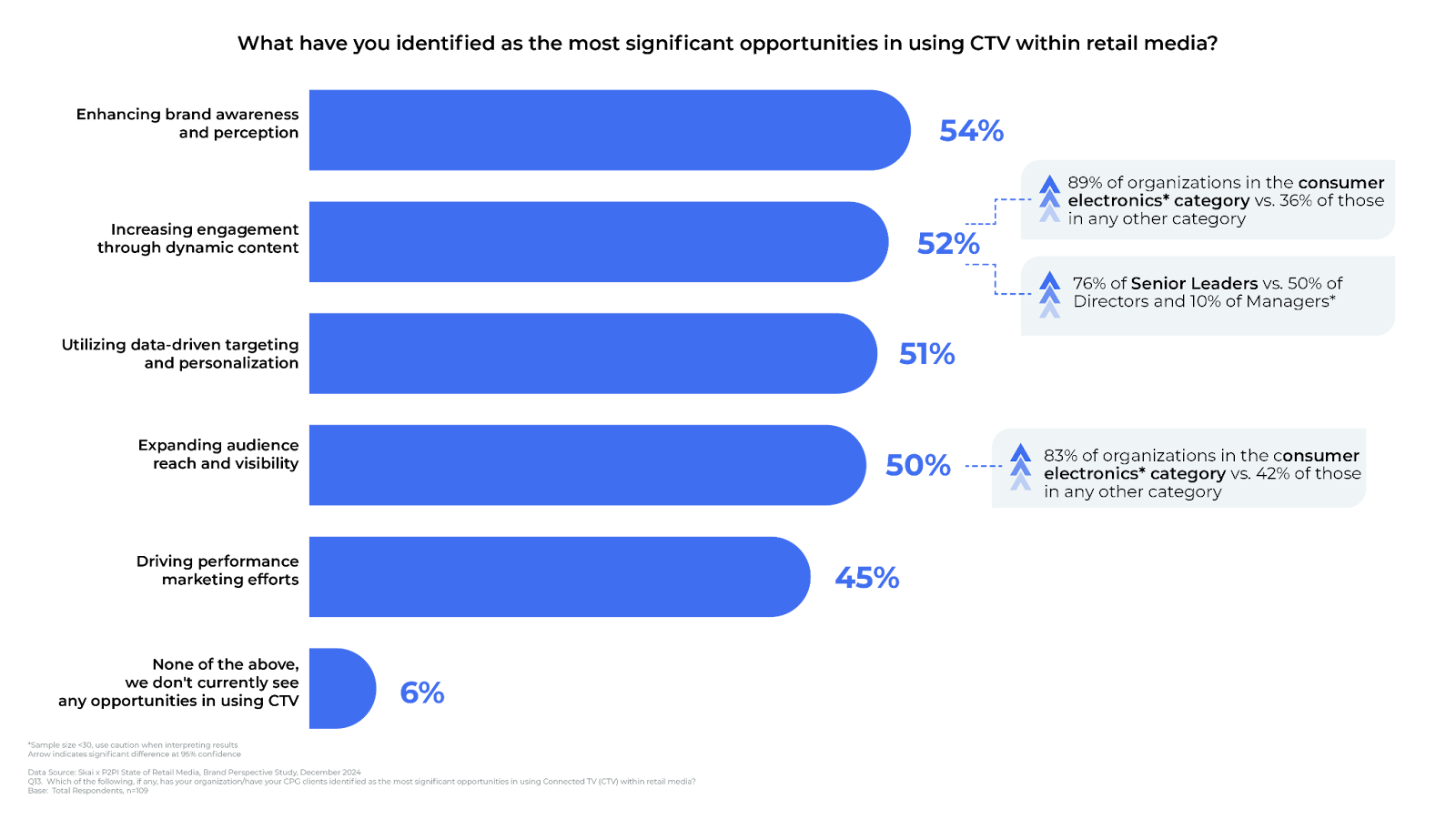
Three primary opportunities stand out. First, enhancing brand awareness and perception remains a core strength of CTV. With its mass reach and dynamic formats, CTV allows brands to make stronger, more memorable impressions on consumers.
Second, increasing engagement through dynamic content is becoming a differentiator. CTV ads can offer interactive formats that encourage deeper consumer interaction, from product videos to clickable offers. These experiences help bridge the gap between awareness and action, making CTV a more versatile channel for retail media strategies.
Finally, utilizing data-driven targeting and personalization is where retail media CTV excels. By leveraging first-party data like purchase history and browsing behavior, brands can serve more relevant ads to audiences that are likely to engage and convert. Michele Giliberti, Co-founder & CEO of XPN, noted, “CTV is emerging as a powerful force in retail media. 50% of marketers view CTV data-driven targeting as a key driver for accelerating retail media investments.”
Marketers who capitalize on these opportunities early will be well-positioned to differentiate their campaigns and drive stronger performance outcomes. The strategic alignment of retail media data with CTV’s capabilities not only enhances immediate campaign effectiveness but also positions brands for long-term advantages as the channel matures.
How do leaders see beyond today’s CTV challenges?
- Early CTV friction is normal—and solvable with intent.
- Leaders move faster by treating budget, measurement, and integration hurdles as near-term build tasks rather than permanent blockers. Teams that standardize measurement frameworks, tighten identity and audience governance, and operationalize integrations early can turn “growing pains” into compounding performance advantages as retail media CTV scales.
No emerging advertising channel is without its hurdles, and retail media CTV is no exception. Yet, these early obstacles are a common part of the growth curve for any transformative opportunity. What sets successful brands apart is their ability to confront these challenges early, turning them into long-term competitive advantages.
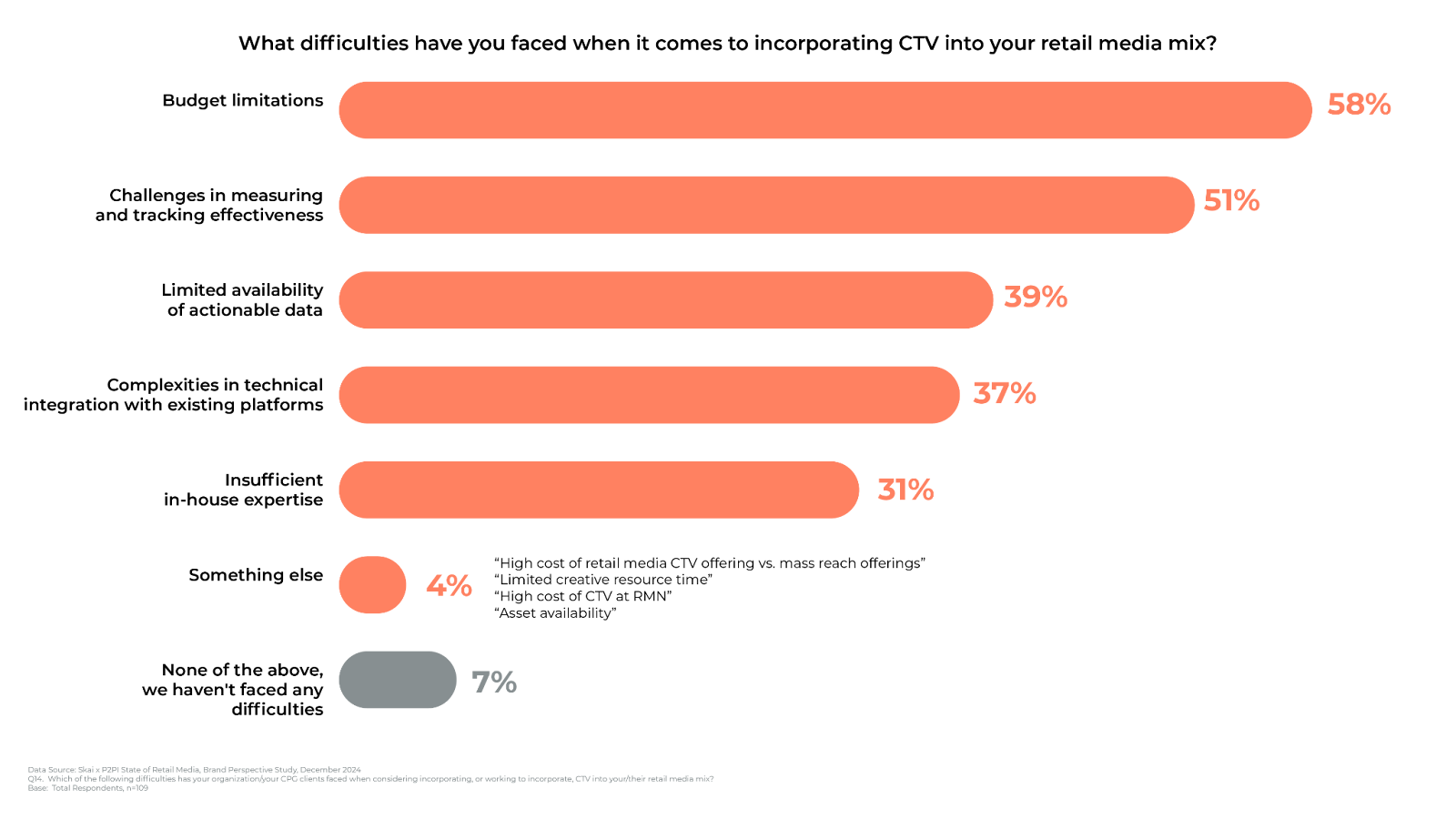
According to our 2025 State of Retail Media, budget limitations (58%) and challenges with measurement (51%) are the most common obstacles marketers face when incorporating CTV into their retail media strategies. Complexities around technical integration (37%) and data availability (39%) are also cited as key hurdles. However, these barriers are familiar. Retail media itself faced similar growing pains in its early days, with brands that invested early reaping the strongest long-term rewards.
The current challenges reflect CTV’s position as an emerging channel, but they also highlight opportunities. Marketers who solve these hurdles first—particularly around measurement and integration—will be better positioned to shape the future of retail media CTV. As platforms and partners continue to refine attribution models and integration solutions, these obstacles will naturally diminish, opening the door for faster adoption.

Notably, senior leaders already show stronger confidence in overcoming these challenges. Leaders are more likely to recognize the importance of addressing data availability and measurement complexities early. For example, 57% of senior leaders identified measurement as a key challenge, compared to lower levels among managers and directors. This signals that brands with longer-term strategic vision are already leaning into CTV, expecting the early hurdles to be short-lived.
Challenges don’t just slow progress—they create opportunities to stand out. Marketers who tackle measurement and integration now will be the ones shaping the space as CTV scales. As Bustos explains “We need better integration, not just more ad placements. If we get this right, CTV could finally deliver brand + performance in one.”
Ultimately, the path forward is clear. The brands willing to solve these challenges first will unlock CTV’s full potential and position themselves as leaders in retail media innovation.
Why does CTV’s current standing signal untapped growth potential?
- CTV’s smaller share today signals runway—not weakness.
- Untapped growth appears because many marketers are still learning how to operationalize commerce audiences, measurement, and creative formats on streaming. As teams build playbooks and partners improve integrations, CTV budgets can accelerate quickly—especially for advertisers seeking full-funnel impact that connects brand exposure to downstream retail outcomes.
While CTV may not yet top marketers’ priority lists, its current position reflects an emerging opportunity rather than a lack of potential. Being lower on the list today signals that the greatest growth is still to come—especially as more brands recognize CTV’s ability to blend brand awareness with measurable performance outcomes.
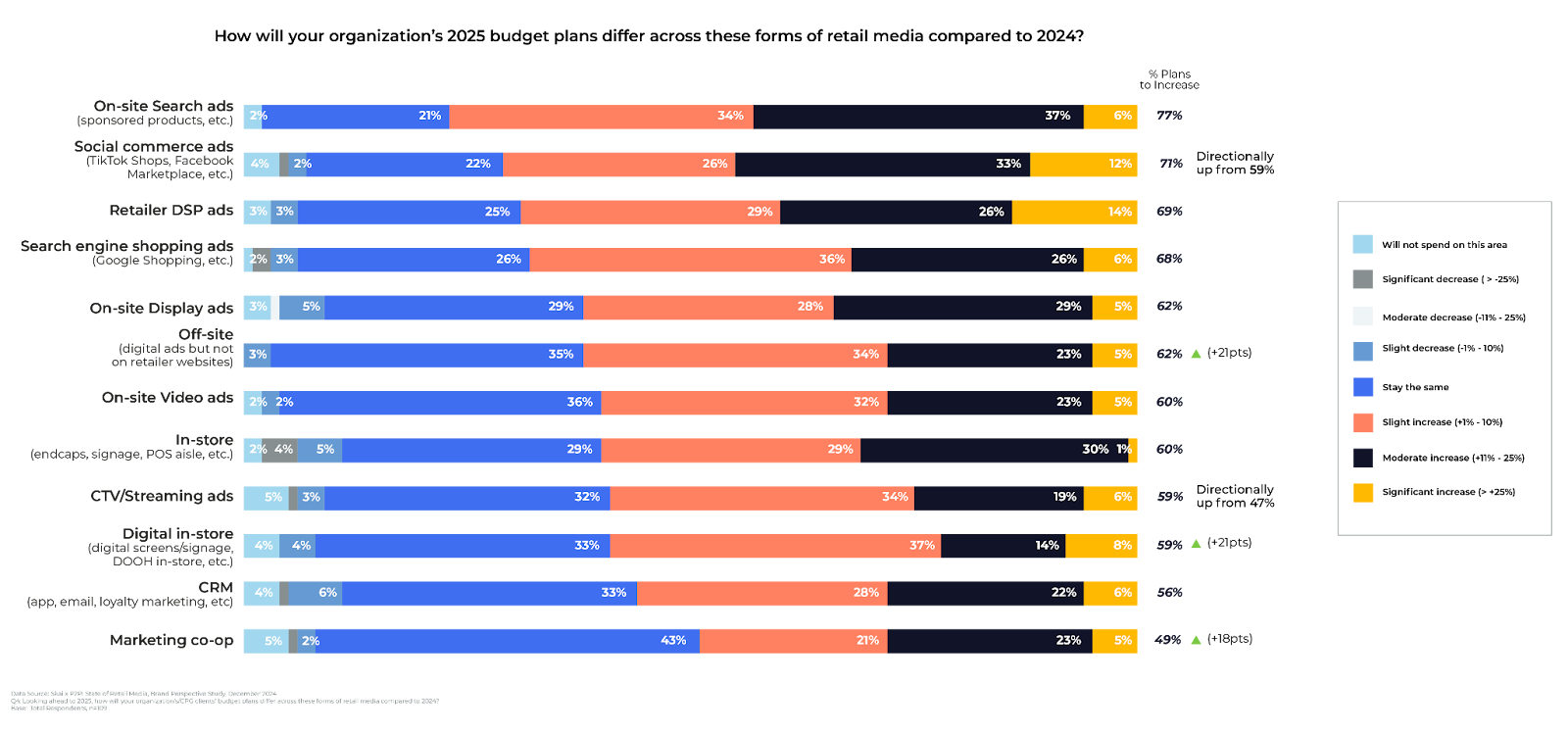
Current budget allocations show that CTV is still in its early stages of investment. This isn’t surprising for a developing channel, but it does signal a window of opportunity. As marketers gain a better understanding of CTV’s capabilities, investment is likely to accelerate. Early adopters will benefit from experimenting and refining strategies while competition is still limited, positioning themselves for stronger performance as CTV scales.
Colin Lewis, Editor-in-Chief for Retail Media at InternetRetailing, highlights this momentum, noting, “Those in organizations allocating more budget to retail media are more likely to say they haven’t faced any challenges with incorporating CTV. More money, less problems!” This perspective suggests that CTV’s investment levels may rise faster than anticipated as its value becomes clearer.
When asked how meaningful this emerging opportunity is to them, 40% of respondents said CTV was very important, second only to social media and programmatic display.
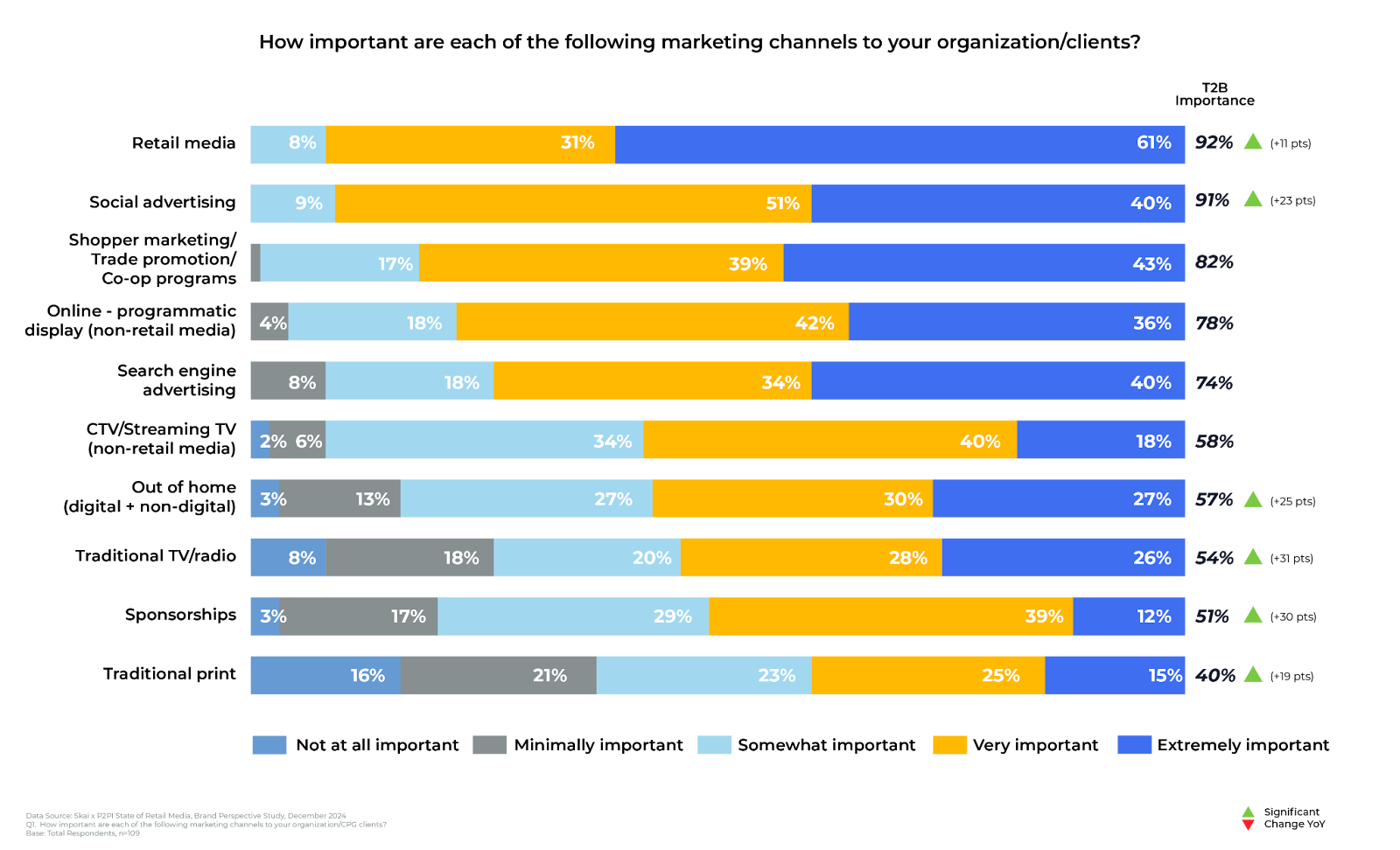
CTV’s current ranking in perceived channel importance also suggests untapped potential. While marketers may be more focused on channels like search and social today, CTV’s capacity for engaging audiences in new, interactive ways sets it apart. As more marketers realize CTV’s role in full-funnel strategies—delivering mass reach while also driving consideration and conversion—its importance is expected to rise.
Kaitlyn Fundakowski, Sr. Director of E-Commerce at Chomps, noted, “The one area that I was surprised didn’t pop even more is CTV. With retargeting and measurement abilities across some channels now, I am bullish on this front, for brands in the right growth stage.” This perspective reflects growing optimism about CTV’s role in the near future and the opportunity it presents for retail media marketers to stand out.
How can marketers pave the way for retail media CTV in the future of commerce media?
- Retail media CTV is where brand meets performance on streaming.
- The path forward is to operationalize commerce signals, tighten measurement, and scale creative formats that reduce friction from view to purchase. Marketers who build these capabilities now can create durable advantage—because as investment rises, the winners will be those who already know how to plan, activate, and prove outcomes end-to-end.
CTV is emerging as a transformative force within retail media, offering marketers new ways to blend brand-building with measurable performance outcomes. While challenges such as budget and measurement persist, the strategic opportunities presented by CTV are compelling and actionable.
Marketers ready to embrace CTV’s unique advantages—particularly its ability to personalize campaigns using retail media data—will be well-positioned to lead the evolution of advertising strategies. Prioritizing this approach can drive more effective, impactful campaigns as the landscape matures.
To stay competitive, it’s time to explore CTV’s full potential within retail media strategies. The opportunity is here, and early adopters will be the ones to shape its future.
Related Reading
- PepsiCo unlocks over 80% new-to-brand ROAS with Skai capabilities for Amazon DSP – One clear example of using audience-level optimization to drive measurable incrementality and new customer growth—exactly the kind of proof retail media CTV teams aim to replicate.
- Channel Bakers Turns Snowfall Into A Marketing Superpower And Increases ROAS by 165% – Shows how automating real-world signals into programmatic activation can improve relevance and efficiency—an adjacent playbook for commerce-signal-driven CTV.
- Camelot lifts ROAS 150% for Michaels with Skai’s Budget Navigator, Custom Metrics, and omnichannel activation tools – Demonstrates how omnichannel measurement and custom outcomes help justify upper-funnel investment while still proving performance impact.
Frequently Asked Questions
What is CTV in retail media?
CTV in retail media uses retail media networks’ first-party commerce signals to target and measure streaming TV ads. Instead of relying on broad demographics, advertisers activate audiences built from product views, searches, carts, and purchases, then evaluate outcomes like new-to-brand, sales lift, and incrementality across the funnel.
How do commerce signals improve CTV targeting and measurement?
Commerce signals connect ad exposure to shopper intent and downstream outcomes. When CTV uses retailer behaviors (search, browse, buy), campaigns can reach in-market audiences, personalize creative by category interest, and optimize toward business KPIs—like new-to-brand customers or incremental revenue—rather than only video completion rates.
Why is retail media CTV measurement challenging?
Measurement is hard because identity, data access, and attribution differ across platforms. Common issues include inconsistent reporting windows, limited cross-device visibility, and fragmented clean room or partner integrations. The fix is to align KPIs upfront, standardize incrementality tests, and centralize reporting so learnings scale across campaigns.
CTV in retail media vs. traditional linear TV: Which is better?
CTV in retail media is better when you need addressability and commerce-linked measurement. Linear TV can still be effective for broad reach and high-impact moments, but it typically offers less precise targeting and slower feedback loops. Many brands use both: linear for scale, and retail media CTV for accountable full-funnel performance.
What’s new with retail media CTV in 2025?
In 2025, more advertisers are pairing streaming reach with retail media audiences to prove outcomes beyond awareness. Key developments include richer interactive ad formats, improved partner integrations for measurement, and growing investment as budgets migrate from linear to digital video. The net effect: more experimentation—and faster maturity—for commerce-driven CTV playbooks.
Glossary
Connected TV (CTV): Internet-enabled television viewing on smart TVs and streaming devices; in retail media, it becomes a commerce channel when it’s activated with retailer audiences and measured against shopping outcomes.
Retail Media Network (RMN): A retailer’s advertising business that monetizes on-site and off-site inventory using first-party shopper data; RMNs supply the commerce signals that power retail media CTV targeting.
Commerce Signals: Shopper behaviors (product views, searches, carts, purchases) used to build and optimize audiences; these signals connect streaming exposure to measurable retail outcomes.
Incrementality: The lift a campaign causes beyond what would have happened anyway; incrementality frameworks are essential for proving whether retail media CTV is driving true new demand versus capturing existing intent.
More like this
-
The 2026 State of Retail Media: Building the Foundation for AI-Driven Commerce
-

Content Optimization in the AI Shopping Era: The DetailPage POV
-

2026 CPG Industry Preview: Beauty Marketing Guide
-

2026 CPG Marketing Formula #5: Operational Strength Is Your Competitive Advantage
-

2026 CPG Marketing Formula #4: Preparing for Agentic Commerce
-
Retail Media in 2026: Predictions From Industry Leaders