
Summary
Retail media is surging, with U.S. advertisers set to spend over $62 billion in 2025. However, measurement—especially incrementality—remains a major challenge. Marketers struggle to prove the true impact of their investments, with many citing difficulty measuring incrementality as a top concern. While the industry agrees on its importance, there’s little consensus on how to define or measure it effectively. To unlock retail media’s full potential, advertisers must adopt better tools, standardized methodologies, and cross-channel integration to ensure accurate, actionable insights.
Last updated: December 20, 2025
In Skai’s 2025 State of Retail Media report, 92% of CPG marketers affirm that retail media is now their most important digital channel. Projections indicate that U.S. advertisers are expected to spend over $62 billion on retail media in 2025, reflecting a $10 billion increase from the previous year. Despite this growth, retail media remains relatively young, facing significant challenges that could impede its continued expansion. According to eMarketer 2025, U.S. retail media ad spending is projected to exceed $62B in 2025.
One of the most significant barriers to continued investment is measurement. The survey of retail media marketers also found that both the top investment accelerators and decelerators centered around measurement capabilities, reinforcing just how crucial this aspect is to the channel’s continued growth and success. Many teams reduce measurement fragmentation by consolidating activation and reporting with retail media solutions that support consistent testing and incrementality workflows across retailers.
Andrew Criezis, President at NielsenIQ, underscores the challenge: “As instant decision-making opportunities increase in retail media, the quality of underlying data is more critical than ever. Accurate digital shelf signals directly influence media investment efficiency, but more importantly, comprehensive data coverage is essential for measuring true sales impact.”
Incrementality has become the industry consensus for retail media measurement, and as commerce media continues to expand, the need for accurate, actionable measurement only intensifies. While the industry is making strides in understanding and applying incrementality insights, there is still a long way to go. Today’s analysis will break down the latest data on how marketers are approaching incrementality—and where obstacles remain.
It’s clear that incrementality is more than just a buzzword—it’s a business imperative. Let’s explore what the latest data reveals about this critical measurement and how marketers can leverage it for success.
Micro-answer: Causal lift beyond organic sales.
How does measurement impact the growth of the channel?
- Measurement constraints slow retail media budget growth when lift isn’t proven.
- Prove causal lift or spend stalls.
- When incrementality isn’t provable, brands hesitate to scale budgets, even if performance looks strong. A clear measurement stack (clean inputs, transparent methods, and repeatable testing) turns “ROI claims” into defensible evidence—helping unlock investment, improve optimization, and support cross-channel expansion.
Proving incrementality remains a primary hurdle in retail media. According to the 2025 State of Retail Media report, 36% of marketers identified difficulty proving investment incrementality as a top challenge that could lead to decreased investment in retail media. Lower ROI compared to other advertising channels (32%) and analytics/reporting limitations (29%) followed closely behind, emphasizing that measurement concerns are far from solved.
Additionally, the report also highlights that the most significant investment accelerators include improved insights from data analytics, better integration with other marketing channels, and enhanced measurement capabilities—further reinforcing that measurement is at the core of retail media’s growth trajectory. Industry measurement standards are advancing—IAB 2024 outlines advanced approaches for incrementality, data collaboration, and cross-partner measurement to improve decisioning.
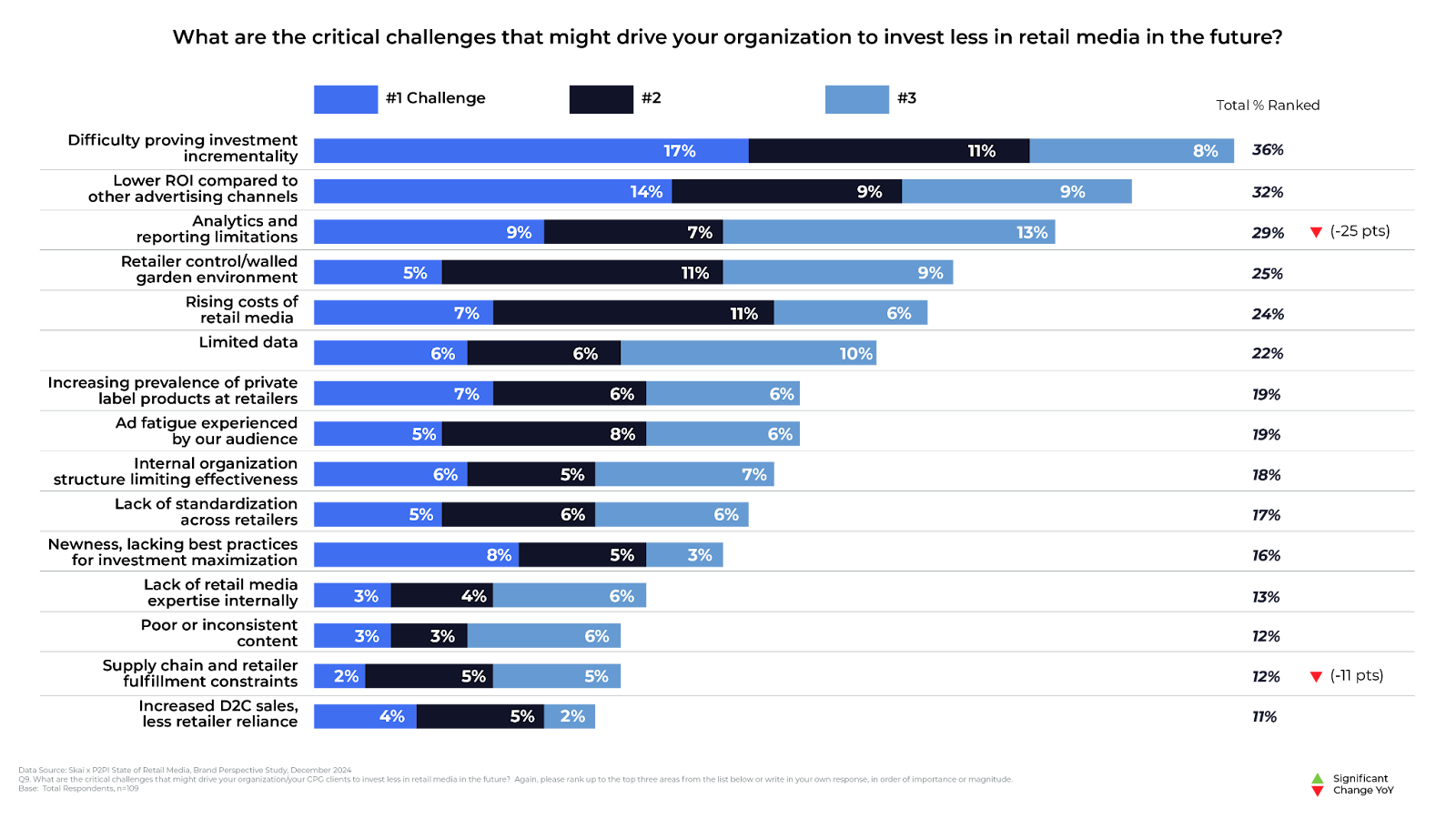
As Colin Lewis, Editor-in-Chief for Retail Media at InternetRetailing, points out: “When asked the question about what would cause a reduction in spend on retail media, there should be no surprises that ‘difficulty proving investment incrementality,’ ‘lower ROI compared to other channels,’ and ‘analytical limitations’ are the biggest challenges. This is the familiar lament from retail media conferences the world over—how can ROI be proven correctly and how can the tools show these results.”
The implications are clear: marketers want to invest more in retail media, but they need better proof that their advertising is driving incremental growth. The solution will require better tools, standardized methodologies, and increased collaboration between advertisers and retail media networks to ensure transparency and actionable insights.
Why can’t marketers agree on what incrementality means?
- Definition confusion creates misalignment and weak benchmarking across teams.
- No shared definition means inconsistent measurement.
- When “incrementality” varies by stakeholder, results become hard to compare, defend, or operationalize. Aligning on a single definition (e.g., incremental sales vs. proxy metrics) improves executive confidence, enables consistent testing, and helps teams translate lift into clearer budget and optimization decisions.
While incrementality is widely recognized as essential, there is little agreement on how to define it. Skai’s report found that when marketers were offered 10 potential concepts of incrementality, rather than a clear few preferences emerging, votes were spread across many definitions nearly equally.
The most common definitions included ad-attributed conversions of new-to-brand customers (48%) and serving ads where products aren’t already showing in organic results (48%), but several other definitions—such as multi-touch attribution models (39%), correlating advertising to improved organic rank (38%), and targeting competitors’ product detail pages (38%)—were not far behind. This lack of consensus underscores the industry’s struggle to align on a single, reliable measurement framework and further complicates how incrementality is evaluated in different organizations.
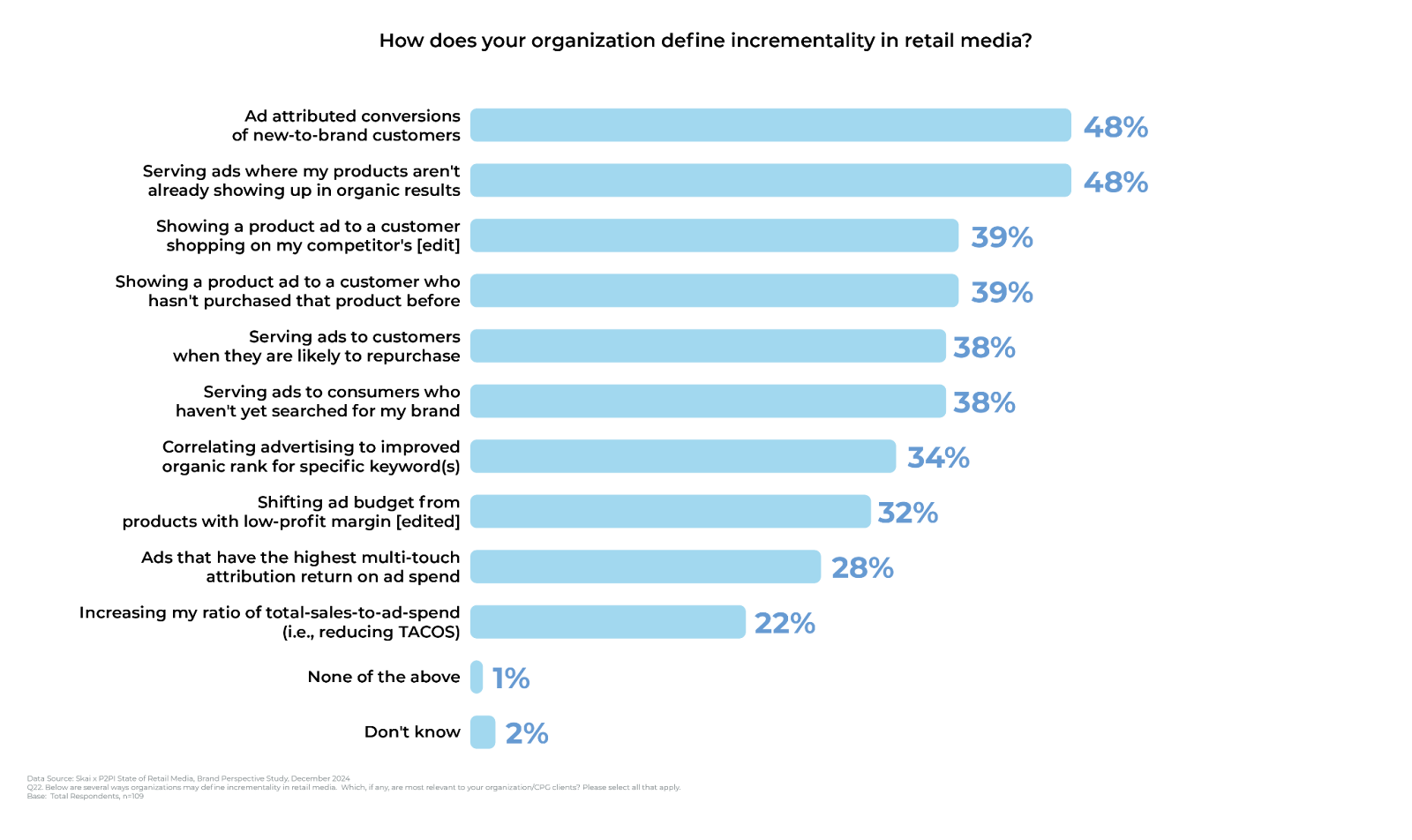
Mike Black, Chief Growth Officer at Profitero, captured the industry’s struggle: “As an industry, we throw the word ‘Incrementality’ around a lot, but do any of us EVEN AGREE on what it means? While it’s possible for there to be many tactics that influence incrementality, ultimately there needs to be a uniform measurement definition in the industry, or we’ll confuse the heck out of our C-Suite and be laughed out of the room.”
This fragmentation in definition complicates internal decision-making and benchmarking efforts. For brands and agencies alike, a clearer, standardized framework for incrementality measurement is needed to establish credibility with executives and ensure that retail media investments are being optimized for true growth.
What are the roadblocks to measuring incrementality effectively?
- Measurement breakdowns come from data gaps, weak methods, and siloed teams.
- Correlation isn’t causation and teams know it.
- Even when marketers measure incrementality, issues like unreliable data, unclear best practices, and difficulty separating organic vs. driven demand reduce confidence. Addressing these roadblocks typically requires better experimentation design, stronger governance, more consistent definitions, and infrastructure that supports repeatable holdouts or controlled lift tests.
Even among those who attempt to measure incrementality, major challenges remain. The 2025 State of Retail Media report highlights that 44% of marketers express concerns about the accuracy and reliability of their results. Another 43% struggle with a lack of clear methodologies or best practices, while 41% cite difficulty distinguishing between organic and driven sales. Limited tools and technology to support measurement (37%) and aligning internal teams around incrementality metrics (36%) add further complexity to the issue.
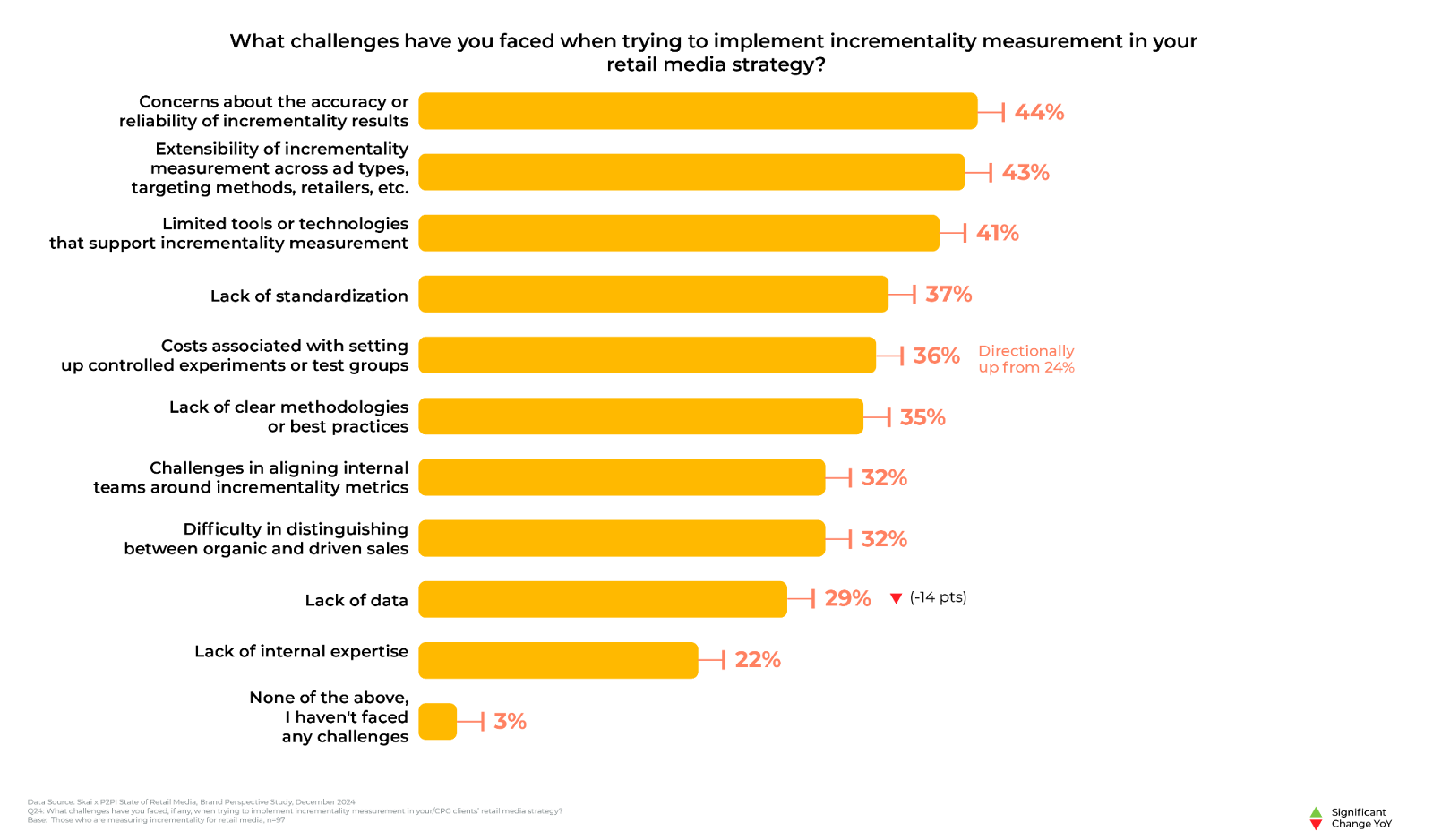
Jack Lindberg, Head of Product Marketing & Innovation at Shalion, critiques the current state of measurement: “Incrementality measurement in retail media is broken. We call it incrementality while using methods that do not capture the true causal impact of our ads. The State of Retail Media report from Skai and the Path to Purchase Institute shows that 42% of organizations say they are good at measuring and applying incrementality insights and 14% claim to be excellent. Yet every definition provided by respondents relies on correlations, proxies, or heuristics rather than a rigorous causal framework.”



For marketers, overcoming these roadblocks requires investment in better measurement infrastructure, greater alignment across teams, and more sophisticated analytics that can distinguish correlation from causation.
Why is measurement even more critical as retail media evolves into commerce media?
- Commerce media expansion raises the bar for cross-channel measurement.
- More channels mean harder incrementality.
- As retail media broadens into commerce media (on-site, off-site, social commerce, and in-store), incrementality measurement must account for cross-channel interactions and offline effects. Teams that unify signals, standardize methods, and operationalize testing will be better positioned to defend spend and optimize holistically.
As retail media expands into commerce media, the need for a holistic measurement framework is more urgent than ever. The report found that 56% of marketers say they are proficient in measuring incrementality for retail media. However, as commerce media grows to encompass search shopping campaigns, social commerce, and in-store measurement, incrementality will become even more challenging.
Organizations that allocate more of their budgets to retail media are already using incrementality to track the correlation between advertising and organic rankings, and this complexity will only increase as commerce media becomes more interconnected. As measurement spans more touchpoints, an omnichannel marketing platform can help unify retail, search, and social signals so incrementality learnings carry across channels.

Mario Watson, Sr. Director, Ad Products at Roundel, explains: “Retail media is evolving into a full-funnel strategy, seamlessly integrating on-site, off-site, and social commerce to enhance the consumer experience. As the industry prioritizes incrementality and measurement, the ability to prove real business impact while providing advertisers with flexible, data-driven solutions will be key to driving future investment.”
A more comprehensive approach to incrementality measurement will allow marketers to understand not just how retail media influences sales, but how it interacts with other digital and offline touchpoints. The future of commerce media depends on breaking down silos and ensuring that measurement keeps pace with evolving consumer behavior.
How is incrementality progress happening—and what work is still left to do?
- Incrementality progress is real, but standardization still lags.
- Momentum is building but gaps remain.
- Retail media opportunity is growing quickly, yet measurement maturity is uneven. Teams are adopting incrementality as a core KPI, but challenges in definitions, methodology, and organizational alignment still limit confidence. The fastest movers will invest in clearer standards, stronger experimentation, and transparent partner collaboration.
So, what did we learn from this deep dive into the 2025 State of Retail Media report? Retail media presents a massive opportunity for brands and advertisers. However, measurement—particularly incrementality—remains a critical challenge. The industry has made strides in adopting incrementality as a core measurement approach, but gaps in standardization, methodology, and alignment persist, preventing many marketers from fully capitalizing on retail media’s potential.
Skye Frontier, EVP at Incremental, highlights the progress being made: “While proving incrementality remains the top challenge, it is positive to see the report show that organizations are building greater capabilities in this key area and becoming more proficient at measuring incrementality and leveraging the insights with 42% now saying they are good at it. Signaling that we may be moving from early adopters to the early majority as incrementality measurement becomes more widely available.
And marketers are trying. They are testing new platforms, attending conferences, and engaging in industry discussions to better understand and implement incrementality measurement. Kaitlyn Fundakowski, Sr. Director, E-Commerce at CHOMPS, emphasizes the importance of continued improvement: “At Chomps, we continue to balance the ROI and NTB validation and measuring incrementality. We are continuing to think creatively about new solutions and leaning heavily on learning agendas where offered to supplement.”
You must take a proactive approach to incrementality. Whether that means refining your attribution models, investing in better measurement tools, or collaborating with partners to ensure more transparent data, now is the time to act. The brands that solve for incrementality first will gain a competitive edge in retail media and commerce media alike.
The insights in this blog post come from the 2025 State of Retail Media report—a must-read for marketers looking to stay ahead with data-driven strategies, uncover key challenges, and seize new opportunities in retail media. Download the full report now.
Related Reading
- PepsiCo unlocks over 80% new-to-brand ROAS with Skai capabilities for Amazon DSP – Shows a test-and-learn approach focused on measuring incremental sales from optimizations.
- RBC Optimizes Spend on Google and Facebook with Skai’s Impact Navigator – Demonstrates incrementality-based measurement that revealed channel undervaluation and synergy lift.
- Skai Experiments Allow Quick, Data-Driven Decisions in Unpredictable Times – Highlights practical A/B testing to accelerate confident optimization decisions under volatility.
Frequently Asked Questions
What is retail media incrementality?
Causal lift driven by retail media ads.
Retail media incrementality measures the sales or profit that happened because ads ran, beyond what would have occurred organically. It typically uses holdouts or controlled tests to isolate impact, helping teams defend spend, prioritize tactics, and optimize toward true growth instead of attribution-only signals.
How do I measure incrementality in retail media?
Start with a clear definition (e.g., incremental sales), then choose a method: retailer holdouts, geo experiments, or matched exposed/unexposed cohorts. Keep test periods long enough to capture purchase cycles, lock budgets and targeting rules during the test, and report lift plus confidence—not just point estimates.
Why isn’t incrementality measurement working?
Common issues include inconsistent definitions across teams, weak control groups, short test windows, and noisy or delayed data. Fixes usually involve tighter test design (holdouts/geo), better governance (one KPI definition), and clear documentation of assumptions so results can be repeated and trusted over time.
Retail media incrementality vs ROAS: Which is better?
Neither is universally “better”—they answer different questions. ROAS is useful for directional efficiency and optimization, but it can over-credit ads that capture existing demand. Incrementality is best for budget defense and growth decisions because it isolates causal lift. Many teams use ROAS for in-flight tuning and incrementality for planning.
What’s new with incrementality in retail media in 2025?
In 2025, more advertisers are prioritizing incrementality, but the focus is shifting to standardization, repeatable test frameworks, and cross-channel measurement as commerce media expands. The push for better data collaboration and clearer methodologies is growing, helping teams move from ad hoc lift tests to always-on learning agendas.
Glossary
Incrementality (Retail Media): The causal lift in sales/profit attributable to ads, typically validated with holdouts or controlled experiments; it’s the “why” behind measuring true performance beyond ROAS.
Holdout Test: An experiment design that withholds ads from a control group to estimate incremental lift; a common way to separate organic demand from ad-driven outcomes.
New-to-Brand (NTB): A customer classification used to understand acquisition impact; NTB can be a component of incrementality, but it isn’t the same as incremental sales lift.
Commerce Media: The broader ecosystem that extends retail media into additional touchpoints (off-site, social commerce, and in-store); it increases the need for consistent incrementality methods across channels.
More like this
-

5 Reasons Full-Funnel Commerce Media Needs Social
-

The 2026 State of Amazon Ads: What’s Working, How Advertisers Are Leveling Up, and What the Industry Can Learn
-

The 2026 State of Retail Media Fragmentation: 7 Challenges Brands Must Solve to Scale
-

The 2026 State of Retail Media DSP, CTV, and Social Commerce: Accelerating Beyond the Shelf
-

2026 CPG Industry Preview: Food & Beverage Marketing Guide
-

AI, Automation, Authenticity: The Three Trends Redefining Social Commerce