The 2026 State of Retail Media Report reveals that Amazon Ads remains the benchmark for retail media performance, driven by its advanced measurement, closed-loop attribution, and connected full-funnel infrastructure. As advertisers mature, many are shifting from ROI-only optimization toward profit discipline, new-to-brand growth, and lifetime value strategies. The findings show that Amazon’s evolving ecosystem—spanning shopping, streaming, and AI-assisted commerce—is not just sustaining its dominance but raising the standard for the entire retail media industry.
Download the 2026 State of Retail Media Report
Amazon doesn’t just dominate retail media budgets. It has built the infrastructure that defines what every other network gets measured against.
For the 2026 State of Retail Media, Skai partnered with Stratably to survey 166 retail media advertisers spanning CPGs, non-CPGs, agencies, and brands of all sizes. The findings tell a story that goes beyond market share. Amazon has built the measurement, self-service, and data infrastructure that brands now treat as the baseline for what a retail media network should deliver. Meanwhile, the most sophisticated Amazon advertisers are evolving beyond basic efficiency plays into a more connected, profit-disciplined approach. And Amazon itself continues to expand what the platform can do.
Here is what the data shows about the state of Amazon Ads in 2026, what the best advertisers are doing differently, and what the broader retail media industry can learn from both.
The infrastructure moat no one has matched
Amazon’s position at the center of retail media budgets is well documented, with the majority of investment going into this channel. But the State of Retail Media data reveals something specific about why those budgets stay put: it comes down to infrastructure.
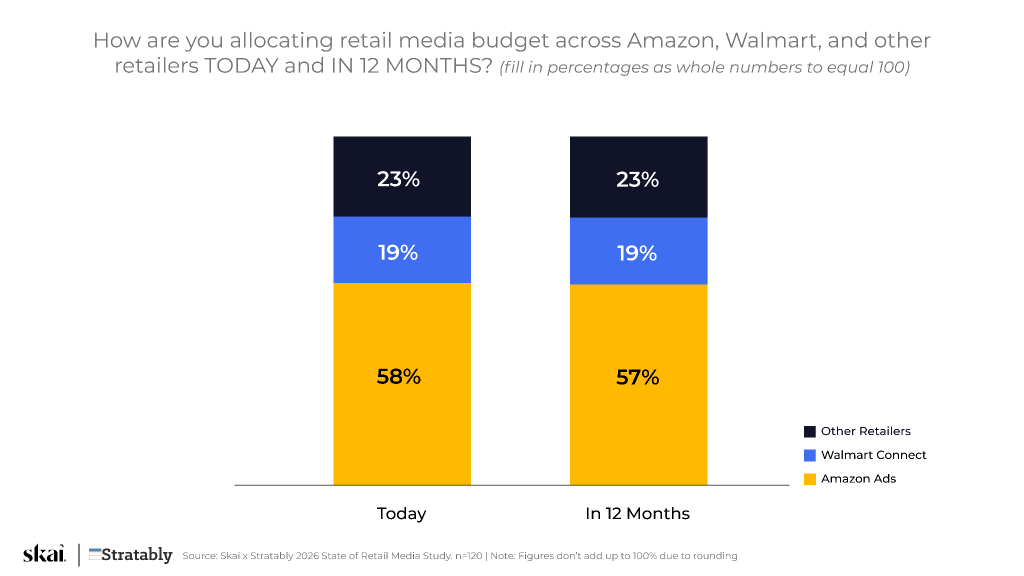
When respondents were asked what would accelerate their investment in retail media, the top answers pointed directly at capabilities Amazon has already built: better measurement, stronger attribution, and more transparent data. Closed-loop attribution, mature self-service tools, and deep audience signals have set a standard that other networks are still working to reach.
As Megan Conahan, EVP of eCommerce at Direct Agents, puts it: “Amazon has effectively set the standard for what brands now demand from retail media.”

Amazon is building connective tissue between upper-funnel activations like streaming and entertainment and lower-funnel shopping behavior. That ecosystem is increasingly difficult to replicate.
Erin McGee, Director of Global Partner and Advertiser Growth Marketing at Amazon Ads, describes how the platform continues to extend that advantage: “Amazon Ads helps advertisers connect brand-building and commerce activation through our authenticated graph that brings together verified signals from Amazon shopping, streaming, and entertainment properties, along with select identity integrations, to support consistent audience recognition across premium streaming TV partners and the open internet.
“Using privacy-safe, aggregated insights, advertisers can understand how media across the customer journey contributes to brand and purchase outcomes, supporting more integrated, full-funnel planning where retail signals inform brand investment decisions.”
This is the bar for today’s retail media networks to reach if they want to challenge Amazon for more share of the budget.

ROI is the wrong north star
Increasing ROI is the top stated priority for Amazon retail media in the next 12 months, according to the State of Retail Media data. On the surface, that makes sense. But several industry leaders push back on what that priority actually means in practice.
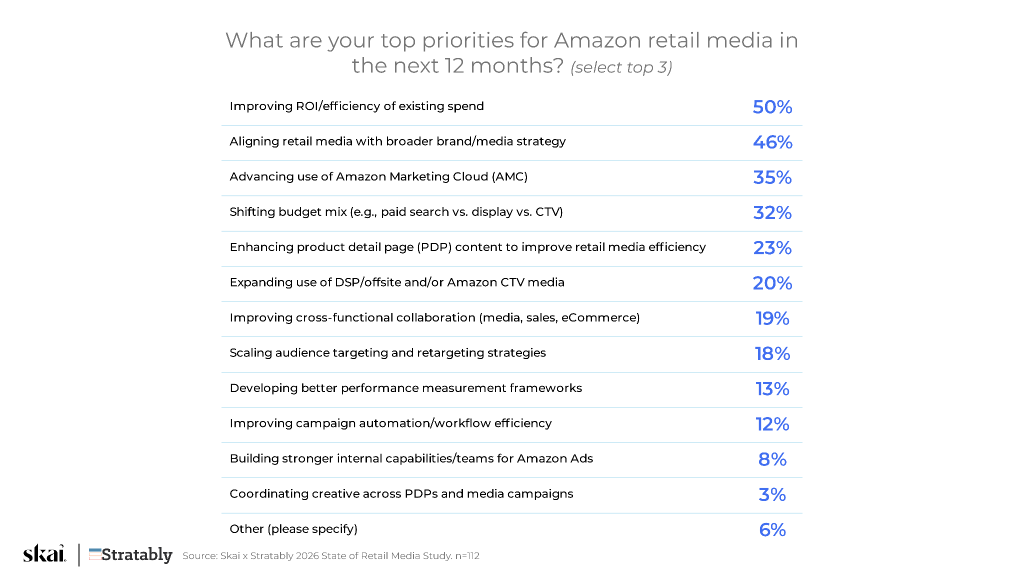
Conahan challenges the ROI-first mindset directly: “Increasing ROI is often treated as the top priority for Amazon, but it’s the wrong north star. ROI is shorthand for getting more efficient at capturing existing demand, not for growing the business. When brands optimize solely for ROI, they tend to over-index on lower-funnel activity, which often results in flat sales and declining incrementality. The real priorities should be New-to-Brand acquisition and lifetime value, because that’s where Amazon media actually drives durable growth.”
The obstacles data tells an important part of the story. Budget constraints top the list, not because brands lack funds, but because CPCs keep rising, competition intensifies, and brands spend more just to maintain their position. CJ Pendleton, Chief Strategy Officer at Matrixx, frames the dynamic clearly: “Increased spend will more likely translate into higher CPMs and CPCs, not incremental reach or sales.”

This is why chasing ROI as a standalone goal can be counterproductive.
Enrico Babucci, Chief Strategy Officer at OmniShopper, frames the broader shift: “Amazon is entering its efficiency era. The priority stack is clear: profit discipline first, strategy alignment second, then AMC maturity and smarter allocation. This is the shift from ‘spend to grow’ to ‘optimize to win.'”
The most mature Amazon advertisers are connecting media to organic rank, PDP quality, and lifetime value rather than treating ads as a standalone demand-capture tool. They are building paid-organic flywheels where media fuels brand strength and long-term demand, not just short-term returns.
The ceiling keeps rising
While advertisers mature their strategies, Amazon continues to expand the platform opportunity. Amazon Marketing Cloud, AI-assisted shopping, and the authenticated graph connecting shopping, streaming, and entertainment signals all mean the ceiling for what brands can accomplish on Amazon keeps going up.
Babucci sees this acceleration continuing: “Over the next two years, audience signals and PDP quality will matter more as shopping becomes more AI-assisted and automation increases. Brands that connect AMC, retail readiness, and content to margin will pull ahead.”
This is not a static platform. Amazon is actively building new capabilities that reward the advertisers who invest in sophistication, creating a virtuous cycle where platform innovation and advertiser maturity reinforce each other.
Conclusion: The Amazon playbook is the industry’s blueprint
The State of Retail Media data paints a clear picture. Amazon’s attractiveness is built on measurement infrastructure, self-service maturity, and full-funnel signal connectivity. This platform focus reflects the stated goals and desires of marketers.
For the broader retail media industry, the capabilities Amazon has built are the new baseline. Better measurement, stronger attribution, transparent data, full-funnel signals: these are what brands now demand from every retail media partner. The RMNs that adopt these principles will earn more investment. The advertisers who build these capabilities on Amazon will be best positioned wherever retail media goes next.
Skai’s Retail Media solutions enable marketers to plan, activate, and measure campaigns across 200+ retailers, including Amazon, Walmart, Target, and Instacart, as part of a broader commerce media strategy. AI-powered pacing, product intelligence, and keyword tools help teams meet shoppers across the journey and tie spend to sales with confidence.
Ready to elevate your Amazon retail media strategy and apply those learnings across your entire portfolio? Schedule a quick demo to see how leading brands are building the infrastructure for sustained growth.
Download the 2026 State of Retail Media Report
Frequently Asked Questions
The 2026 State of Retail Media Report shows Amazon Ads sets the standard for measurement and attribution. Advertisers value its closed-loop data and self-service tools. The report highlights how Amazon’s infrastructure keeps budgets steady while competitors work to catch up.
Focusing only on ROI limits long-term Amazon Ads growth. ROI often prioritizes lower-funnel demand capture over new customer acquisition. Leading advertisers instead prioritize new-to-brand growth, lifetime value, and profit discipline to drive sustainable performance.
Advertisers are connecting Amazon Marketing Cloud, PDP quality, and audience signals to profit. They align media spend with organic rank and retail readiness. The 2026 State of Retail Media Report shows this full-funnel strategy drives stronger long-term results.
More like this
-

From Software Engineer to AI Engineer: 8 Lessons From Under the Hood at Skai
-

Prime Big Deal Days 2026: How One Month Paid Off in Two Days for Amazon Ads
-

Who Owns AI Agent Strategy Now? Meet the New Buying Committee
-
From AI Assistance to Agentic Execution: Skai’s Take on Amazon Ads unBoxed 2026
-
Ready for AI Agents to Do More? Inside Skai’s 34-Tool Agent Connect Launch
-
The Road to Agentic Marketing: Skai at Amazon Ads unBoxed 2021-2025