AI is transforming retail media from a buzzword to a business driver. According to Skai’s 2025 State of Retail Media report, marketers are leveraging AI to streamline campaign optimization, boost personalization, and drive ROI. While adoption is still uneven, AI’s role in real-time insights, smarter spend, and creative automation is accelerating investment and redefining what’s possible in this fast-moving channel. This shift marks a pivotal moment in the state of AI in retail media.
Last updated: December 19, 2025
AI is getting a lot of airtime in marketing right now, and retail media—more broadly, commerce media—is right in the thick of it. As these channels get more complex—more formats, more partners, more data flying around—marketers are leaning on AI to help manage the sprawl. To boost performance, stay agile, and bring some clarity to the chaos.
The excitement is real. But turning that into consistent, real-world results? Still a work in progress.
Some teams are already seeing impact—faster insights, smarter decisions, better outcomes. Others are still figuring out where (or if) AI fits into their workflow. Because it’s not just about having the tools. It’s about team readiness, internal alignment, and a culture that’s willing to test and adapt.
Now in its fourth year, Skai’s annual 2025 State of Retail Media report and survey of retail media marketers reveals the trends, challenges, and opportunities shaping the future of this essential marketing channel. It also provides some insight into where AI is gaining traction inside retail media—what’s moving the needle, what’s earning exec attention, and what barriers are still in the way.
The shift from experimentation to execution is underway. And the gap between testing and full-scale adoption? It’s finally starting to close.
Explore Skai’s retail media solutions for marketplace advertising at scale.
See how Celeste AI supports AI-powered marketing workflows across commerce media.
Micro-answer: Smarter retail media decisions, faster.
Is AI adoption still early—and uneven?
- Retail media AI maturity is fragmented.
- Most teams are still experimenting.
- Adoption varies sharply by category, budget, and role, so results range from meaningful gains to stalled pilots. Moving from “testing” to repeatable impact requires process, data readiness, and cross-functional buy-in—not just new tools.
The potential is obvious. According to IAB 2025, commerce media revenues rose 23% in 2024 to $53.7B. But most retail media orgs are still in the early innings when it comes to actually using AI in a meaningful way. “I am especially excited about the AI capabilities rolling out everywhere,” says Kaitlyn Fundakowski, Sr. Director, E-Commerce, Chomps. “I know we have just scratched the surface, and I am excited to see what we can leverage in the years to come.”
According to the 2025 State of Retail Media report, only 2 in 5 marketers say their team is highly mature in AI usage. And the spread is wide—maturity varies by category, budget, and role, which speaks to how fragmented the landscape still is.

That said, the long-term belief is strong. 75% of retailers expect AI agents to be essential to compete in the future. So the mindset is shifting. AI isn’t being treated as a nice-to-have anymore—it’s becoming core to the strategy.
But getting there? That takes more than tools. It takes process, patience, and real buy-in across the org.
Is optimization where AI’s showing up first?
- Optimization is AI’s clearest early win.
- It improves decisions at speed.
- Budgeting, bidding, forecasting, and real-time campaign adjustments are where AI’s strengths map cleanly to daily retail media work. Teams get value fastest when AI augments human judgment—compressing analysis cycles and helping operators act confidently amid constant marketplace change.
Right now, the clearest role for AI in retail media is optimization. Think: smarter budget recommendations, real-time campaign tweaks, sharper performance forecasts. It’s where AI’s strengths—speed, pattern recognition, scale—map cleanly to day-to-day needs.
In fact, 55% of decision-makers expect AI to deliver better insights and recommendations. Nearly half are leaning on it for real-time campaign optimization. These aren’t future-state hopes—they’re practical, measurable use cases that are already gaining traction. According to McKinsey 2024, organizations report measurable value as gen AI adoption accelerates—especially when use cases are tied to clear business outcomes.

As Briana Cifelli, Senior Director of Retail Media at Jellyfish, puts it: “The integration of AI into retail media is accelerating, with marketplaces developing their own creative AI studios and insight generation tools. Learning and leveraging these rapid advancements is crucial in this dynamic landscape.”
What’s interesting is the shift in mindset. AI isn’t being framed as a replacement for human judgment—it’s becoming a decision-accelerator. A way to cut through the data noise and act faster, with more confidence. No need to rebuild the whole team structure—just plug in a smarter layer of intelligence where it counts.
Is personalization what’s getting the C-suite to lean in?
- Personalization is moving from hype to impact.
- Executives are funding it fast.
- Personalization has become the most visible, defensible AI use case in retail media because it shows up in both results and boardrooms. Leaders are prioritizing AI that can tailor experiences using commerce signals—driving stronger performance while strengthening differentiation in crowded network ecosystems.
Creative and personalization use cases are climbing to the top of the executive agenda—and fast. Since the release of ChatGPT, mentions of AI and retail media on earnings calls have surged, peaking in mid-2023 and picking up again into 2024. This isn’t just curiosity. It’s conviction—backed by real investment.
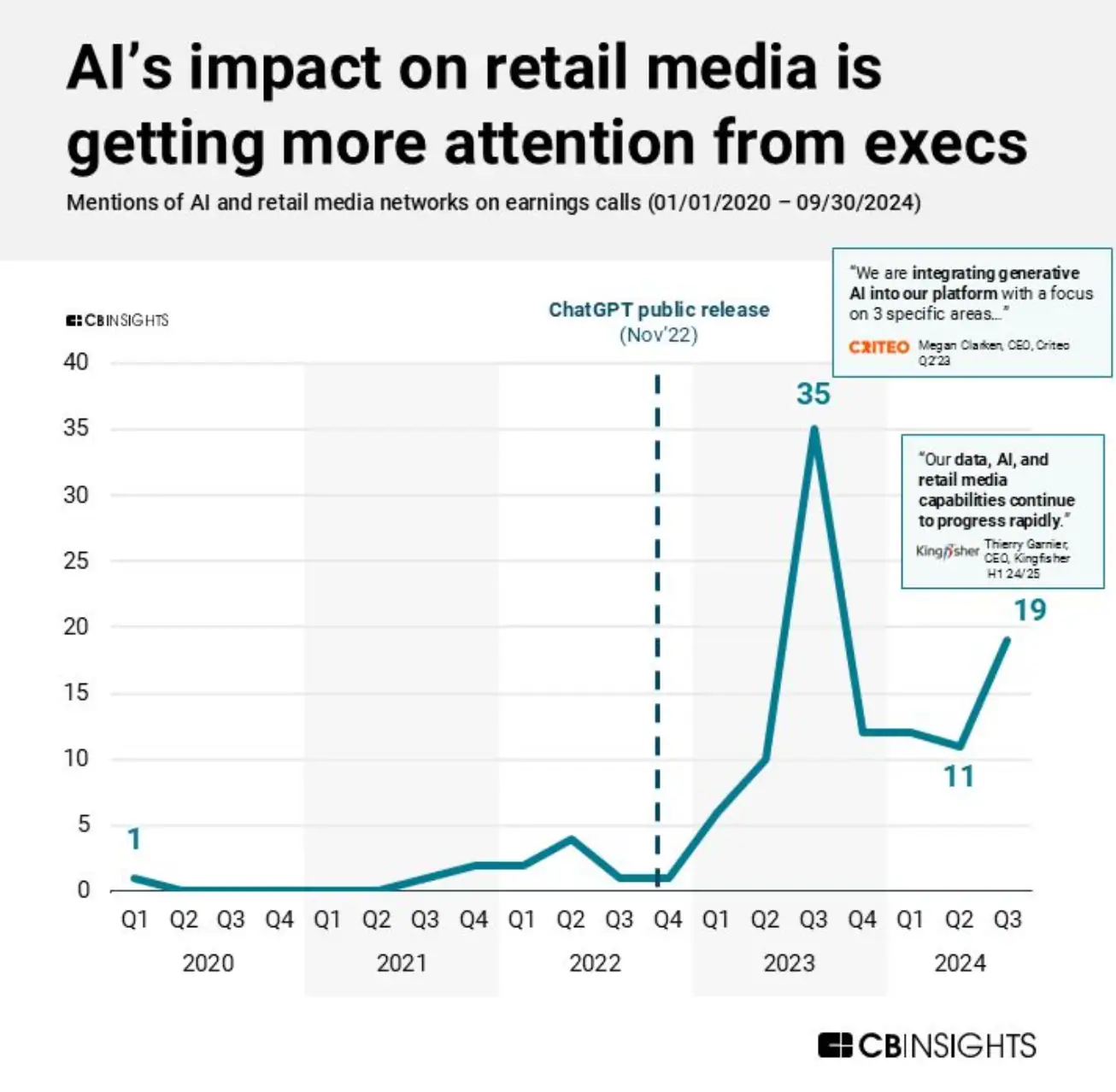
Why the sudden urgency? Because personalization is finally moving from theory to impact. 46% of marketers say they expect AI to boost personalization capabilities. And brands using AI-driven personalization are already seeing a 1.3x lift in incremental ROAS, according to data from 84.51°. According to McKinsey 2025, smarter use of gen AI can unlock more cohesive personalization across touchpoints when people, processes, and platforms are integrated.


It’s become the most visible—and arguably the most defensible—use case for AI in this space. It shows up in the results and the boardroom.
Roger Dunn, Global Lead, Retail Media & Performance Media, Diageo: “Generative AI could supercharge retail media, with AI potentially helping extend retailers’ digital advertising networks’ reach across hyper-personalized content and new search platforms.”
The signal is clear: personalization isn’t just a feature. It’s a wedge.
Is AI accelerating the top retail media investment drivers?
- AI is pushing investment drivers forward.
- It strengthens proof and ROI.
- Better insights, clearer measurement, and stronger ROI are the top reasons marketers invest more in retail media—and AI improves all three. By speeding analysis and connecting signals to actions, AI shortens the time between spend and proof, making budgets easier to justify and scale.
When marketers were asked what would actually get them to invest more in retail media, the answers weren’t surprising:
- Better insights
- Clearer measurement
- Stronger ROI

AI directly impacts all three. According to Skai’s 2025 State of Retail Media report, these aren’t abstract priorities—they’re real friction points. And AI helps relieve them by doing what most teams don’t have the time or tools to do well: isolating what’s working, connecting insights to action, and finding pockets of efficiency that stretch spend further. According to IAB/PwC 2025, ongoing growth in commerce media underscores why measurement and performance proof remain central to budget allocation.
It’s not just about automating analysis—it’s about compressing the time between spend and proof. In a media landscape where everyone’s under pressure to justify every dollar, AI isn’t just a tool in the stack. It’s becoming the reason the stack performs at all.
The takeaway? What used to slow investment down is starting to push it forward.
Is the future of AI in retail media already here?
- Retail media AI must be commerce-trained.
- Generic models won’t keep up.
- Retail media changes hourly—inventory, pricing, promos, and regional demand shift constantly—so AI value comes from models trained on commerce-specific signals. The next differentiation wave will come from AI that can act on real-time nuance (not averages) and operationalize recommendations inside workflows.
AI isn’t plug-and-play. Not in retail media.
The landscape shifts by the hour—inventory fluctuates, promos rotate weekly, shopper behavior swings with the season or even the weather. Generic AI models don’t stand a chance.
The real unlock? AI trained on commerce-specific signals.
Not just what’s happening in aggregate, but what’s happening right now on a Tuesday afternoon, when a brand is low on inventory in the Midwest and running a regional BOGO. That’s where the performance lies. And where the next wave of differentiation begins.
Skai is already moving in that direction—embedding AI into the guts of campaign management in a way that actually gets the nuances.
- Adjusting bids based on incremental ROAS
- Forecasting performance across specific retail channels
- Recommending budget shifts in real-time
Caroline Ballard, VP Commerce Media, Profitero agrees that technology partners will play a significant role in the future of retail media/commerce media. “Open ecosystems are crucial in today’s reality to predict and proactively address market trends… Integrated solutions with a custom partner set across media, content, and others is what increases speed to innovation and ultimately, achieving and exceeding business goals.”
You can feel the shift coming. More sophisticated tools, better training data, and a sharper sense of where AI—especially generative AI—fits into the workflow.GenAI’s influence is undeniable, reshaping everything from creative optimization to insight generation. Over the next 12 months, the curve steepens, and marketers who are already laying the foundation won’t just keep pace—they’ll set it.
Related Reading
- How Acosta Group Streamlined Reporting and Empowered Its Team with Celeste AI – One example of GenAI accelerating insights by cutting reporting from hours to minutes.
- Tinuiti Drives 24% Revenue Growth Through AI-Powered Amazon Optimization for Full Moon Pet – A practical model for using AI optimization to improve revenue and ROI without increasing spend.
- ROAS jumps 113% YoY as Lewis Media Partners Scales Walmart Connect for Sauer Brands – A clear look at scaling retail media with smarter bid/budget management and measurable ROAS gains.
Frequently Asked Questions
What is AI in retail media?
AI automates optimization, targeting, and measurement.
AI in retail media applies machine learning and generative AI to improve bidding, budgets, targeting, creative, and measurement across retailer ad networks. The highest-impact approaches use commerce signals—like inventory, pricing, and promotions—to generate faster insights and more profitable optimization decisions.
How do I implement AI for retail media optimization?
Start with one workflow (bidding, budget pacing, or search term management), define success metrics (ROAS, iROAS, NTB, margin), and ensure the model can access timely commerce signals. Pilot on a contained set of campaigns, operationalize governance and QA, then expand once the team trusts recommendations and can act quickly.
Why isn’t my AI-driven retail media program improving results?
Common issues include limited data freshness, missing commerce signals (inventory, pricing, promos), unclear success metrics, or teams that can’t operationalize recommendations quickly. AI tends to underperform when it’s added on top of fragmented processes—align stakeholders, tighten measurement, and start with repeatable use cases.
AI in retail media vs manual optimization: Which is better?
AI is best for speed, scale, and pattern detection across large datasets—especially for pacing, bidding, and forecasting. Manual optimization is strongest for strategy, nuance, and brand context. Most high-performing teams use AI to accelerate decisions, then apply human judgment for priorities, guardrails, and creative direction.
What’s new with AI in retail media in 2025?
In 2025, more teams are shifting from experimentation to execution—especially in optimization and personalization. Market momentum is also visible in commerce media growth and increasing executive focus on AI-driven personalization. The next wave is commerce-trained AI that can act on real-time signals, not just historical averages.
Glossary
AI agents — A type of AI system that can take actions (not just generate text) to support tasks like optimization, monitoring, and reporting within retail media workflows.
Commerce media — A broader category that includes retail media plus other commerce-driven ad placements tied to shopping and transaction signals.
Retail media — A type of digital advertising sold by retailers (and their networks) that uses first-party shopper data to target audiences and measure performance.
Generative AI (GenAI) — A type of AI used to generate content or recommendations (e.g., creative variations, insights, summaries) that can accelerate decisions in retail media operations.
Incremental ROAS (iROAS) — A measurement approach that estimates the additional revenue driven by ads beyond what would have happened organically, helping justify investment.
First-party data — Customer or shopper data collected directly by a retailer or brand (e.g., site/app behavior, purchases) used for targeting and measurement in privacy-conscious ways.
Digital shelf — The product discovery environment across retailer search, category pages, and product detail pages where visibility and conversion are won or lost.
Budget pacing — The practice of distributing spend over time to avoid early depletion while maximizing outcomes during high-opportunity periods.
More like this
-

Who’s Accountable When AI Agents Buy Media?
-
From Insights to Action: A Practical Framework for Governed AI Agent Execution
-
Skai Reporting Connector vs. Publisher MCPs: Test Results Reveal Up to 90% in Cost Savings
-
Data Ownership in the Age of Agentic AI: What To Ask Before Signing
-
Ask the Experts: What Makes Agentic AI Work for Agencies?
-
Meet Skai’s Forward Deployed Engineer: Your Partner for Building With Agentic AI