
Summary
Retail media spending soared by 92% on Black Friday 2024, nearly doubling from last year and reshaping holiday advertising. Brands transformed increased budgets and higher CPCs (+71%) into steady conversion values, proving the strength of meeting shoppers where they buy. Paid search also surged, with spending quadrupling early November levels to drive visibility during the peak shopping season. Read the full analysis to uncover how targeted strategies in retail media and paid search shaped Black Friday 2024’s success.
Last updated: December 23, 2025
Black Friday 2024 delivered $10.8 billion in online sales, up just 1% from last year. But the real story isn’t the steady sales — it’s how retail media advertisers ensured they captured those dollars.
With retail media ad spending nearly doubling year-over-year (92%) and conversion rates holding steady, advertisers effectively turned their increased budgets into proportionate sales growth. This proves that brands embracing retail media are gaining a competitive edge on peak shopping days by meeting consumers exactly where they make decisions. Brands can operationalize this approach with retail media solutions embedded into always on workflows.
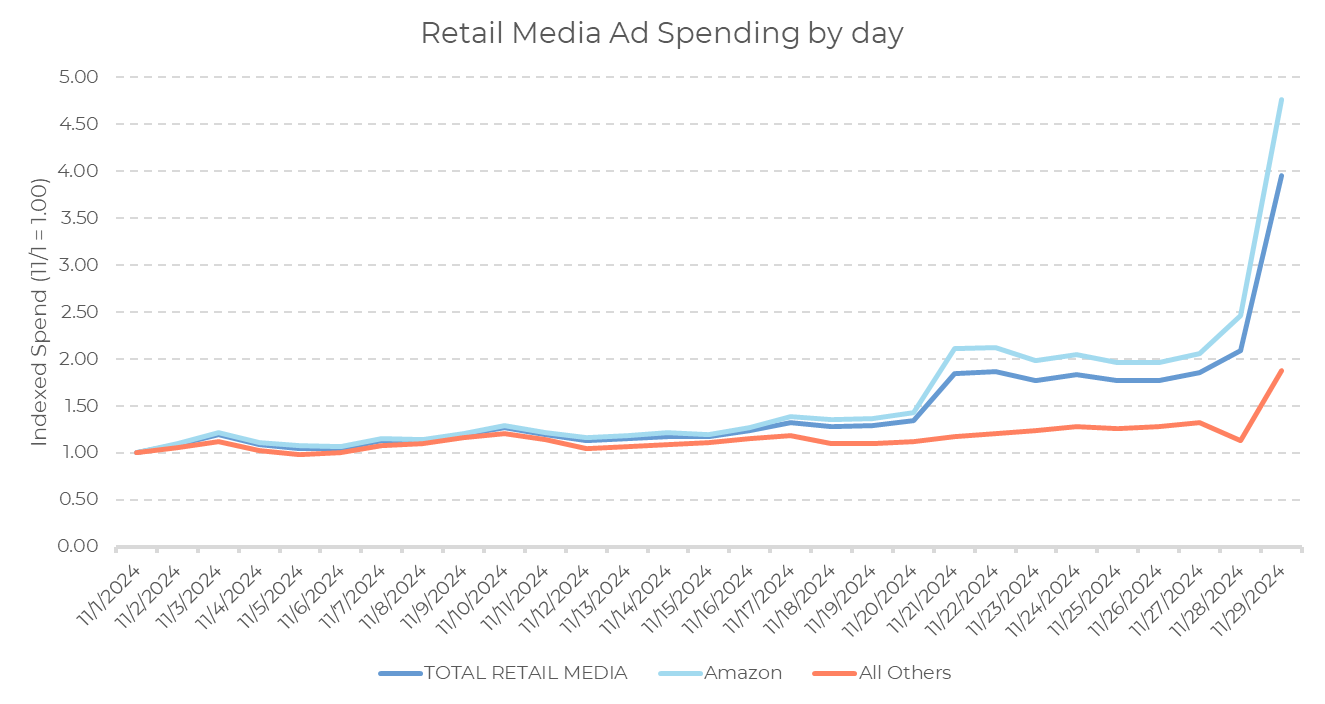
The surge in retail media spending reflects how this channel has become a cornerstone of holiday advertising. Amazon alone saw ad spending spike 4.8X on Black Friday compared to the pre-Thanksgiving period (November 1-28), underscoring how today’s brands strategically leverage retail platforms to drive incremental growth. Despite higher CPCs, advertisers successfully maintained conversion value, showing that retail media continues to deliver returns even in a high-stakes environment. Independent forecasts also show retail media accelerating, with Nielsen 2025 noting outsized growth expectations versus the broader ad market.
This was also the Black Friday that cemented the increasing importance of social commerce. Ad spend on social media was up 35.1% from last year, the channel’s first double-digit growth during Cyber Week since 2019 — evidence of how social platforms (from Meta to TikTok) are capturing more and more commerce spend.
Finally, paid search also played a critical role in Black Friday’s success, with spending increasing 4X compared to early November. Commerce advertisers drove measurable results by using paid search to maintain visibility throughout the holiday period, complementing retail media’s spikes in performance.
Together, retail media, social, and search proved indispensable for brands looking to capture demand and convert shoppers during one of the biggest shopping days of the year.
Let’s dive into the data to uncover the strategies and insights that defined Black Friday 2024.
Micro-answer: Retail media spend surged, value held.
Why did retail media ad spend surge on Black Friday 2024?
- Retail media became the primary battleground for holiday conversion capture.
- Spending nearly doubled year over year.
- Advertisers leaned into retailer ad inventory to win high intent traffic, absorbing higher CPCs to maintain presence at the digital shelf. The net effect was a sharp spend jump with comparatively modest click growth, signaling intensified auction competition during the most valuable shopping sessions.
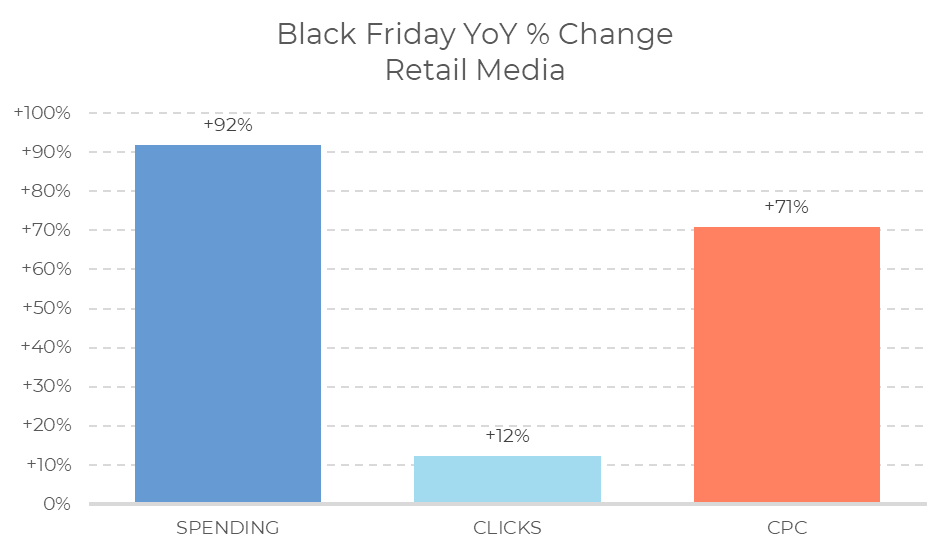
Retail media advertising solidified its position as the leading driver of holiday ad performance this year. Spending in this channel was up 92% year-over-year, with much of this growth fueled by increased CPCs, which rose 71%. Although clicks only grew 12% compared to Black Friday 2023, this highlights how retail media captured the most critical shopper moments with precision targeting.
By Black Friday, ad spending on Amazon surged to 4.8X the pre-Thanksgiving daily average, further emphasizing the role of retail media in influencing purchase decisions.
The average daily performance leading up to Thanksgiving saw a notable boost this year, likely influenced by the later timing of the holiday. With extended promotions and a condensed shopping window, many consumers took advantage of early deals before the big weekend. This behavior matches what McKinsey 2025 describes as consumers actively hunting early value and pacing purchases across the season.
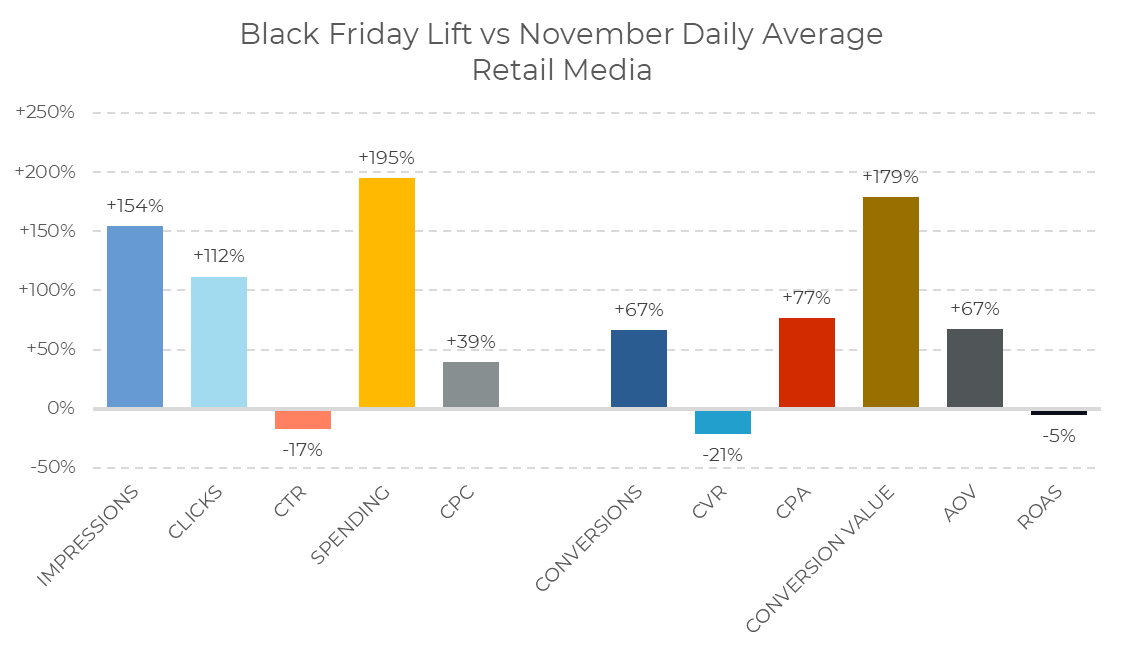
Key Takeaway: Retail media’s nearly double year-over-year spending growth highlights its role as a must-have channel for advertisers capturing high-intent shoppers. The sharp rise in CPCs reflects fierce competition, but the steady click growth shows that the investment is paying off.
Why did conversion value hold steady despite rising costs?
- Stable conversion value signals that targeting quality offset higher auction prices.
- Higher CPCs did not erode outcomes.
- Even as cost per click increased, advertisers kept conversion value level by aligning bids, budgets, and messaging to in market audiences at the point of purchase. This suggests retail media efficiency can persist when brands prioritize relevance, assortment, and retail readiness during peak demand windows.
Higher CPCs typically put pressure on ROAS, but retail media proved resilient. Conversion value remained stable year-over-year even as costs increased, showing how brands effectively used retail media to generate incremental sales.
This trend highlights the sophistication of retail media platforms, which allow advertisers to meet consumers directly at the point of purchase with tailored messaging.
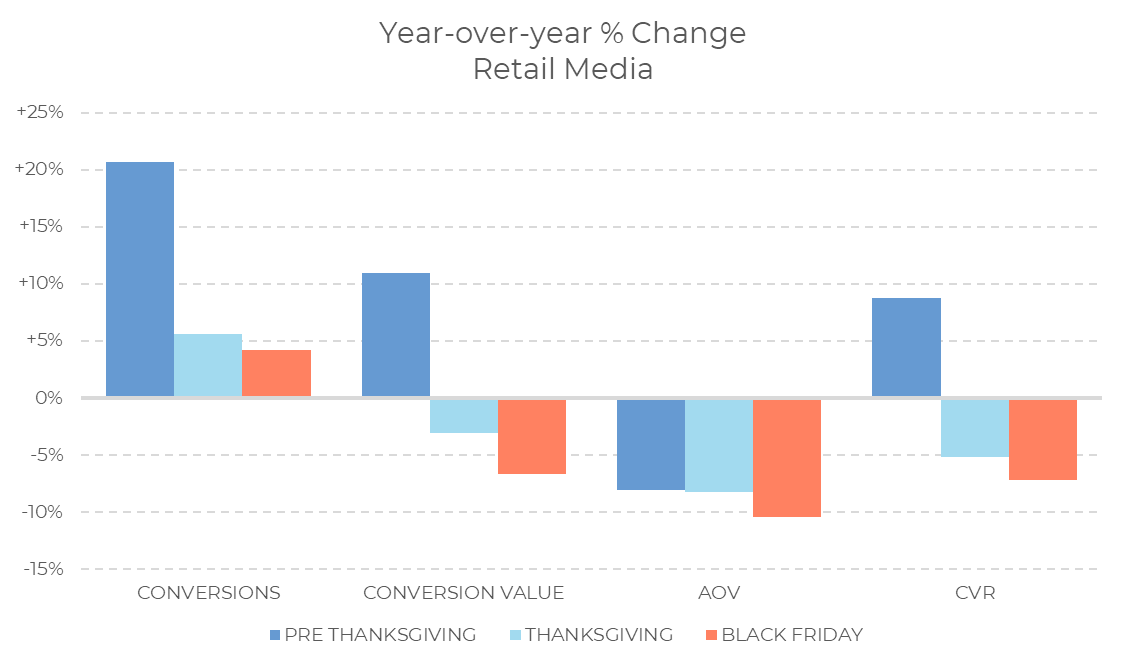
Key Takeaway: Retail media continues to deliver strong conversion value, demonstrating that higher costs don’t necessarily mean lower efficiency when strategies are executed well.
Paid search shows strong growth with a Black Friday peak
Search spending started to pick up for commerce advertisers on or around November 17 before showing a larger spike on Thanksgiving and then again on Black Friday, ending the period 4X higher than it started for that segment and 2.4X overall.
CPCs rose 48%, reflecting intense competition, but advertisers continued to invest as paid search proved its ability to drive traffic and conversions. Category level projections reinforce this momentum, with eMarketer 2025 outlining continued growth and concentration of retail media budgets.
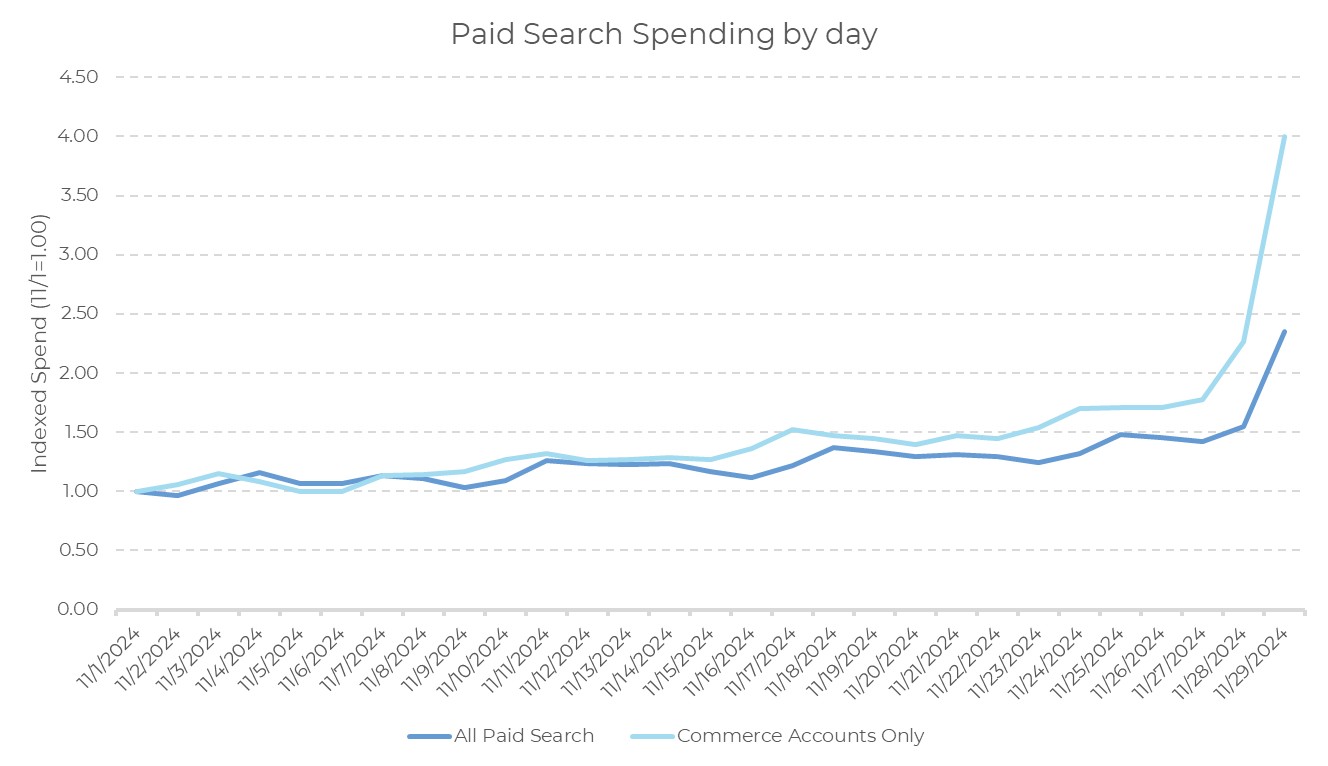
Key Takeaway: Paid search’s strong performance highlights its continued reliability for driving both traffic and conversions, with its steady ramp-up proving critical during the peak shopping season.
Why did paid search show strong growth with a Black Friday peak?
- Search expanded reach and captured demand that started earlier in November.
- Spend ended the period sharply higher.
- Commerce advertisers increased paid search investment as the holiday ramp intensified, using search to protect visibility and harvest demand across the season. Rising CPCs signaled competition, but budgets still flowed because search remained reliable for driving traffic and supporting conversion paths.
On Black Friday, commerce advertisers spent more on paid search compared to the overall paid search channel. Spending in this segment increased 200% (or 3X) above the November daily average, significantly outpacing the 94% lift seen across all paid search advertisers. This strong performance highlights the focus on retail-specific strategies driving holiday sales.
CPC premiums were also higher for commerce advertisers, rising 48% compared to a 29% increase for the overall channel. These higher costs reflect intense competition for search traffic during the peak shopping period, particularly for commerce-related queries.
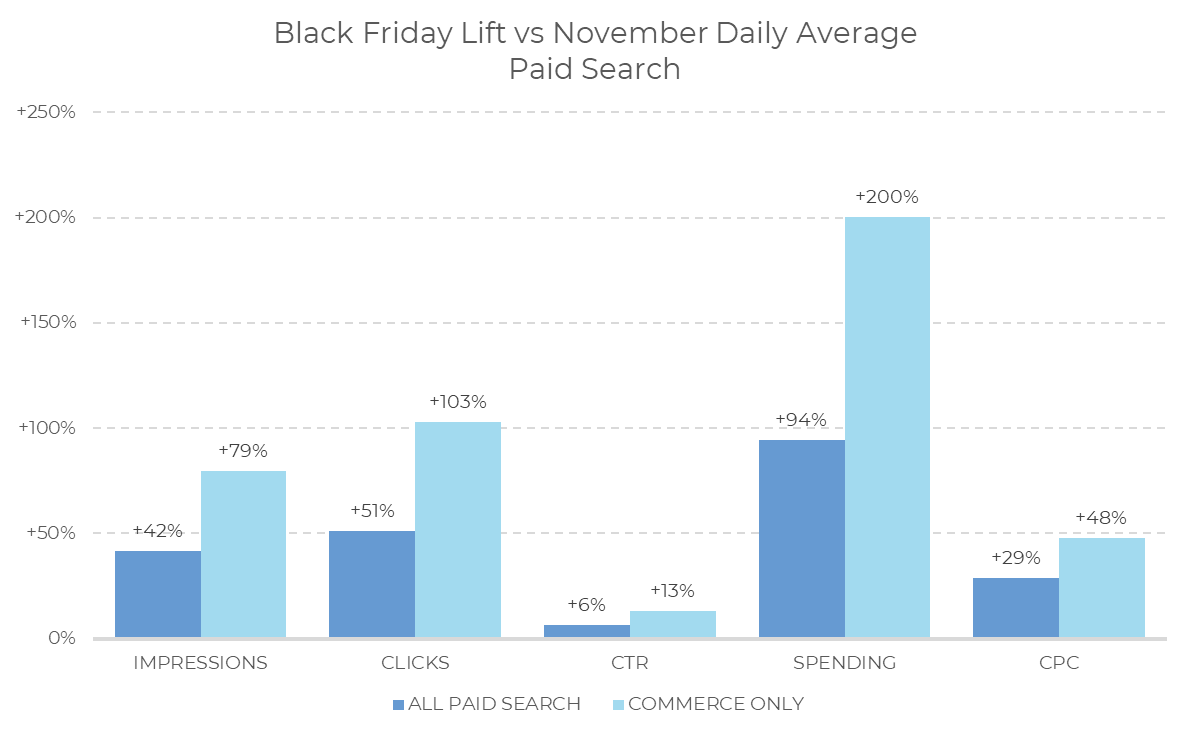
Key Takeaway: Commerce advertisers leaned heavily into paid search during Black Friday, with spending and CPC growth outpacing the overall channel. Their investment underscores the value of search as a performance channel during high-stakes shopping periods.
Why did commerce advertisers outperform the overall paid search channel?
- Commerce specific intent drove heavier investment and steeper CPC premiums.
- Commerce spend rose far above average.
- On Black Friday, commerce advertisers scaled search budgets more aggressively than the broader market, prioritizing retail queries where purchase intent and urgency were highest. The result was higher spend lift and higher CPCs versus the overall paid search baseline, reflecting intense competition for shoppers.
By category, typical gifting categories saw the biggest lift on Black Friday. Computers & Consumer Electronics once again led the way in terms of both spending and conversion value, while Food & Groceries saw the least impact.
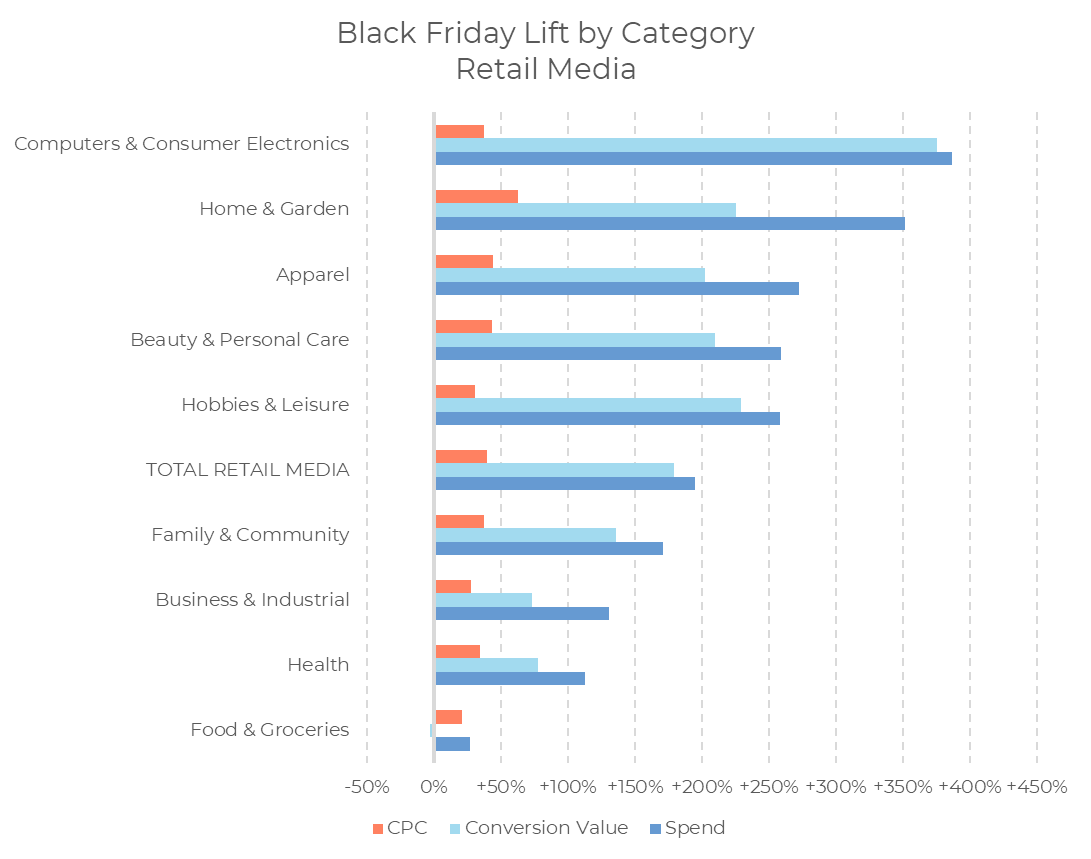
What did the industry breakdown show for paid search?
- Paid search category winners differed because some verticals include non commerce intent.
- Category performance varied by intent.
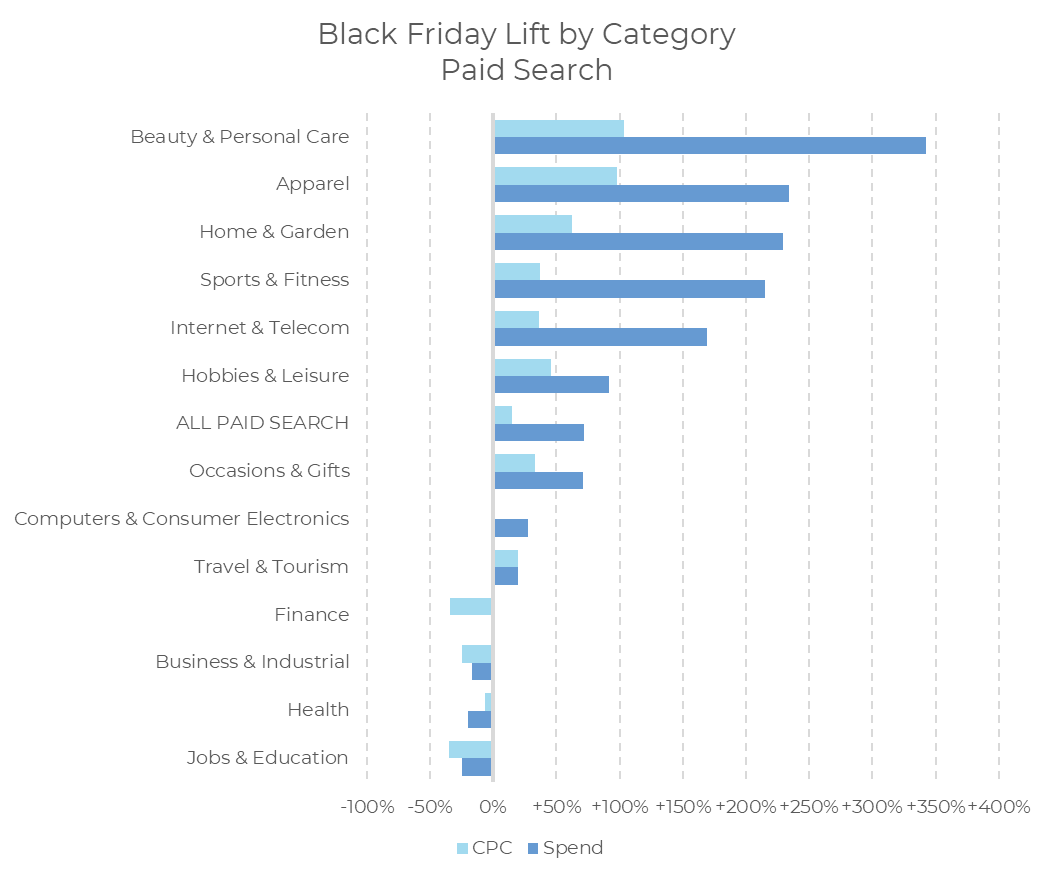
- In paid search, some categories overlap with research and services behaviors, which can dilute pure commerce signals. While gifting categories still stood out, the distribution differed from retail media because search captures broader query intent beyond immediate add to cart behavior.
On a category basis, the standouts for Black Friday are both similar and different from retail media. Several industry verticals could be considered gift categories, but in paid search, categories like Computers & Consumer Electronics can have non-commerce components that result in that category lagging behind the overall channel.
Why did the combination of retail media and paid search drive 2024 Black Friday success?
- The winning mix paired point of purchase targeting with broad demand capture.
- Retail media and search worked together.
- Retail media delivered high intent activation at the digital shelf while paid search provided consistent visibility across the broader journey. Brands that managed rising costs with disciplined execution and measurement were better positioned to convert peak demand, with social commerce emerging as a growing complement.
Black Friday 2024 wasn’t just about rising sales—it was about how brands used retail media and paid search to capture those dollars. The nearly 92% increase in retail media ad spend shows how advertisers are prioritizing targeted, shopper-specific strategies to influence buying decisions. Meanwhile, paid search provided a steady foundation, complementing retail media’s spikes in performance, while paid social demonstrated the exponentially growing interest in social commerce. To benchmark performance beyond a single day, teams can reference ongoing advertising benchmarks and seasonal trend reporting.
As the holiday shopping season progresses, these strategies will remain critical. The brands that can balance rising costs with data-driven execution will be the ones that win—not just on Black Friday, but throughout the rest of the year.
Note: Our analysis is based on spending from Skai clients only and should not be interpreted as a fully accurate representation of channel or individual publisher performance.
Related Reading
- Wavemaker and GroupM Nexus deliver 114% increase in conversions on Prime Day for Hill’s Pet Mexico: Shows how event pacing and forecasting can scale results during peak demand.
- ROAS jumps 113% YoY as Lewis Media Partners Scales Walmart Connect for Sauer Brands: Demonstrates retail media budget expansion and efficiency gains during competitive periods.
- Publicis LeOne unlocks 61% ROAS increase for Haleon during tentpole event with help from Skai: Highlights pre event preparation and automation that sustains performance under auction pressure.
Frequently Asked Questions
What is Black Friday 2024 retail media spending analysis?
It explains spend, cost, and value shifts.
Black Friday 2024 retail media spending analysis reviews how advertiser budgets, CPCs, clicks, and conversion value changed during the peak shopping day. It helps teams understand what drove performance at the digital shelf and how retail media and paid search worked together to capture demand.
How do I plan retail media budgets for Cyber Week?
Start by mapping tentpole days to inventory and promo depth, then set daily pacing guardrails by retailer. Align bids to priority categories and in stock assortments, and pre build rules for reallocating spend when CPCs spike. Use historical benchmarks to validate targets before launch.
Why isn’t my Black Friday ROAS improving even when I spend more?
Common issues include chasing high CPC placements without improving retail readiness, sending traffic to weak product pages, or spreading budgets too thin across categories. Also check for stockouts, promo mismatches, and delayed measurement. Rebalance toward high intent queries and proven ASINs before scaling further.
Black Friday retail media vs paid search: Which is better?
Retail media is often strongest at point of purchase because it reaches shoppers where they buy, while paid search can capture broader demand and support discovery earlier in the journey. Retail media tends to win when digital shelf execution is strong. Search can win when category intent is high and coverage is needed across engines and queries.
What’s new with retail media in 2025?
Retail media continues to grow faster than the overall ad market, with more budget shifting toward retailer owned audiences and closed loop measurement. Recent outlooks such as Nielsen 2025 highlight accelerating investment and increasing pressure on efficiency, which raises the value of stronger pacing, automation, and incrementality approaches.
Glossary
Retail media: Advertising sold by retailers that targets shoppers using retailer data and placements near shopping moments.
Paid search: Search engine advertising that captures demand through keyword driven placements and auction based bidding.
CPC: Cost per click, a pricing metric that reflects how expensive it is to earn a click in an ad auction.
Conversion value: The revenue or order value attributed to ads, used to evaluate whether spend is translating into sales impact.
ROAS: Return on ad spend, calculated as revenue generated divided by ad spend, used to assess efficiency.
Social commerce: Shopping that happens directly within social platforms or through social driven purchasing experiences.
Cyber Week: The core holiday window spanning Thanksgiving through Cyber Monday, when promotions and traffic peak.
Digital shelf: The online merchandising environment where shoppers discover, compare, and purchase products across retail sites.
More like this
-
The 2026 State of Retail Media Measurement and Incrementality
-

The Four Shifts Redefining Retail Media for Brands and Retailers
-

How AI Is Redefining Search, Creative, and CTV for Marketers
-

2026 CPG Industry Preview: Health & Wellness Marketing Guide
-
2026 CPG Industry Preview: Food & Beverage Marketing Guide
-
Skai’s Q4 2025 Digital Advertising Trends Report: Key Takeaways for Planning 2026