Summary
AI Overviews and LLMs are not a crisis for marketers but a sign that search behavior is evolving. Axel Rosar from Haworth Media shares his expert thoughts on how assistant-style search is redistributing, not destroying, traffic. Brands with strong SEO, clear content, and credible sources are already benefiting from referrals via tools like ChatGPT and Perplexity.
Last updated: October 15, 2025 – Updated with 2024–2025 data
Today’s guest marketer post is by Axel Rosar, Director of Commerce and Search at Haworth Media. Haworth is an independent, full-service media agency based in Minneapolis, Minnesota, that delivers data-driven, omnichannel media planning and activation, offering strategic growth planning, customer data strategies, creative services, analytics and reporting, and strategic services tailored to drive measurable brand results.
AI is changing Search quickly. While there are many LinkedIn posts out there about how the sky is falling right now, the truth is this: if you just keep doing the right things, you should be fine.
Yes, Google’s AI Overviews and assistant-style answers from tools like ChatGPT, Claude, and Perplexity are significantly pushing down organic search results. But that is only half the story. At Haworth Media, we are already seeing a growing stream of referral traffic from these assistants, especially on long-tail and comparison queries that sound like how real people shop. Below, we lay out the data, what we are observing across clients, and how to win in this new era. According to Pew Research Center 2025, AI summaries appeared on ~18% of searches in March 2025, usually citing 3+ sources. Google notes in its own Search documentation (2025)
that AI Overviews aim to surface helpful links and diversify visits on complex queries.
Add an AI-ready stack with our paid search platform and on-top guidance from Celeste AI.
Micro-answer: Treat AI referrals as a channel.
What does the data say about AI Overviews and traffic?
- Assistants produce some traditional clicks but redistribute intent.
- AI-Powered summaries now cite multiple sources; referral visits from assistants are rising across long-tail, comparison queries.
Pew Research analyzed 68,879 Google searches from 900 U.S. adults in March 2025 and found:
- An AI summary appeared on 18% of searches. 88% of summaries cited three or more sources.
- When an AI summary appeared, users clicked a traditional result 8% of the time versus 15% without a summary. Links inside the AI summary were clicked in ~1% of visits.
- Sessions ended more often when a summary appeared, 26% vs 16%.
- The most frequently cited sources were Wikipedia, YouTube, and Reddit. Longer, question-style queries triggered summaries far more often.
Google has publicly pushed back on broad interpretations of the study, stating that overall “quality clicks” have remained stable, which is worth noting as the ecosystem shifts. According to the Pew Research Center 2025,
summaries appeared on ~18% of searches and usually cited 3+ sources. Google states in a May 2025 update that AI Overviews has increased usage for queries that trigger the feature.
Our take: Some blue-link clicks are compressing, but intent is not disappearing. Instead, it is redistributing, often into assistant-provided answers that cite and link to PDPs, buying guides, and honest comparison content. Adobe reports a tenfold rise in U.S. AI-driven referrals from July 2024 to February 2025, indicating meaningful downstream value from assistant clicks.
Bottom line, assistant-provided answers are redistributing intent-driven traffic from blue links into referrals from LLMs like ChatGPT, Claude, and Perplexity driving qualified visits to PDPs, guides, and comparisons that still convert into sales and leads.
Across ecommerce, we are now seeing more source / medium traffic like:
perplexity.ai / referral, claude.ai / referral, and chatgpt.com / referral, among others.
The patterns are consistent:
- Queries look like real questions and comparisons. For example: Product A vs Product B for a small patio and Service 1 or Service 2 for regulated industry use.
- Results skew towards PDPs, comparison tables, FAQs, and buying guides.
- We are seeing sales and qualified leads from these sessions.
For example, here’s the response from ChatGTP-5 to What are the best modern smokeless fire pits? Solo Stove is listed as the “Best Overall,” but in the highlighted portion, we see that Breeo and Tiki Brands have links to their respective PDPs.
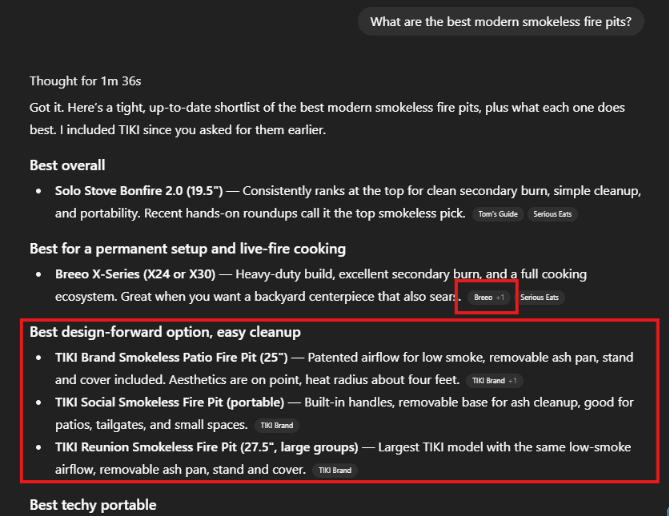
search traffic isn’t going away in the AI era, just shifting
How should you position your brand for LLM-driven demand?
- Optimize for clarity, truth, and utility—not secret AI tags.
- Build for questions and comparisons so assistants can cite your content.
You do not “optimize for AI” with a secret tag. You optimize for clarity, truth, and utility. Here’s how:
What technical SEO foundations matter most?
Keep the basics tight and machine-readable.
Maintain structured data so assistants can recognize entities and cite clearly.
Keep the basics tight: clean crawl paths, canonicalization, and strong internal linking. Maintain structured data across PDPs and help pages (Product, Review, FAQ, HowTo), since assistants and new search features rely heavily on clear, schema-backed entities. Google’s guidance underscores well-structured pages with helpful links for complex queries.
What content wins assistant referrals?
Authorotative PDPs with specs, “best for” use cases, and FAQs.
Honest comparison tables and buyer’s guides that cite credible sources.
Focus on authoritative PDPs with full specs, clear “best for” use cases, FAQs, and calls-to-action. Build honest comparison tables (size, materials, warranty, use-cases) or broader buyer’s guides if direct head-to-head feels risky. Cite credible sources; assistants often surface content from Wikipedia, YouTube, and Reddit, so aligning with these signals boosts trust.
How should you go beyond owned properties?
Treat Reddit strategically with authentic answers and proof.
Polish marketplaces PDSs because assistants surface them frequently.
Reddit deserves a strategy: engage in relevant subreddits with authentic answers and helpful comparisons. Keep marketplace PDPs polished; titles, bullets, A+ content, reviews all influence what assistants surface. Finally, track impact by setting up a GA4 custom channel for AI Assistant Referral, trending conversions over time, and filling measurement gaps with surveys. Industry tracking shows AI referral sources (ChatGPT, Claude, Perplexity) growing quickly in 2025.
How cautious should you be with Google’s AI Max for Search?
- Isolate budgets, add URL exclusions, and monitor terms.
- Tread AI Max like a test until proven incremental.
Google’s AI Max for Search is rolling out as a powerful automation suite, but advertisers should approach with caution. While framed as a one-click layer for reach expansion, its behavior mirrors Broad Match combined with Dynamic Search Ads, often prioritizing scale over precision. This means search-term expansion, dynamic copy adjustments, and URL routing can unintentionally dilute strategy, introducing cannibalization of existing campaigns rather than driving true incremental lift.
For Haworth Media and similar advertisers, the risk lies in overextension without guardrails: ad spend being siphoned into queries or landing pages that don’t align with intent, reducing efficiency. Despite Google’s claims of “similar CPA with more conversions,” early patterns suggest the gains are often reallocated rather than net-new. To optimize, treat AI Max less like a growth lever and more like a test: confine it to isolated budgets, layer on URL exclusions, and monitor search term reports with discipline.
The core principle remains the same as ranking for organic or LLMs clarity, truth, and utility but with AI Max, protecting relevance is the difference between smart discovery and runaway inefficiency.
Why is this a mindset shift?
- Information retrieval is fragmenting across AI and web layers.
- Brands with durable SEO + honest comparisons already benefit.
If you open LinkedIn right now, It would seem as if the sky is falling related to AI content stealing traffic. But of course, hot takes posted on LinkedIn tend to be reactive. The practical view is calmer. Information retrieval is fragmenting. Some answers stop at the AI layer; others click through. A meaningful slice now arrives as LLM referrals. Brands that invested early in durable SEO fundamentals and credible, comparison-friendly content are already benefiting as assistants cite them.
If you keep your house in order with technical SEO, product truth, useful comparisons, credible third-party signals, and clean measurement, then AI search will not “kill” your traffic.
It will reroute it.
Related Reading
- How Jellyfish streamlines optimizations across clients and global markets – Automation + AI dayparting improved ROAS and budget use during sales events.
- Rakuten Advertising Boosts CVR by 40% and ROI by 31% with Skai’s AI-driven Paid Search Insights – Negative harvesting + intent messaging increased conversions and ROI.
- MinsterFB experiences 40% ROAS growth with Skai’s AI Dayparting for Amazon – Intraday bid recommendations lifted ROAS during peak hours.
Frequently Asked Questions
AI Overviews are summaries shown above search links from tools like Google. They pull from trusted sources to answer user questions quickly.
AI Overviews reduce some clicks on traditional links. But they also drive referral traffic from assistants like ChatGPT when your content is cited.
Yes. Focus on structured data, helpful product content, and contributing to trusted sources. Assistants reward clarity and credibility.
Glossary
- AI Assistant Referral Traffic — A type of acquisition used for capturing clicks that originate inside generative answers (AI Overviews, ChatGPT, Claude, Perplexity) and land on your PDPs, guides, or FAQs. Track as a distinct GA4 channel and trend conversions over time.
- Citeability — A type of content quality signal used for increasing the odds assistants reference your page. Comes from clear entities, sourced claims, and structured data (Product/Review/FAQ/HowTo) that make answers easy to quote and link.
- Structured Data (Schema.org) — A type of machine-readable markup used for helping search/assistants understand products, reviews, FAQs, and how-tos so they can surface you in summaries and link out confidently.
- Comparison Content — A type of mid-funnel content used for answering real “A vs. B” queries with specs, pros/cons, “best for” scenarios, and pricing/warranty details—often the formats assistants elevate.
- Share of Voice (SOV) for Priority Terms — A type of competitive visibility metric used for monitoring how often your brand appears in assistant-influenced SERPs and marketplaces on must-win queries.
- AI Max for Search (Google) — A type of automation bundle used for expanding reach via broad match + dynamic elements; best run in isolated budgets with URL exclusions and tight term reviews.
More like this
-

2026 CPG Marketing Formula #5: Operational Strength Is Your Competitive Advantage
-
2026 CPG Marketing Formula #4: Preparing for Agentic Commerce
-
Retail Media in 2026: Predictions From Industry Leaders
-
2026 CPG Marketing Formula #3: Building Always-On Incrementality
-
Retail Media in 2026: Predictions from Skai Experts
-
Cyber 5 2025: A Huge Week for Consumers and Commerce Media