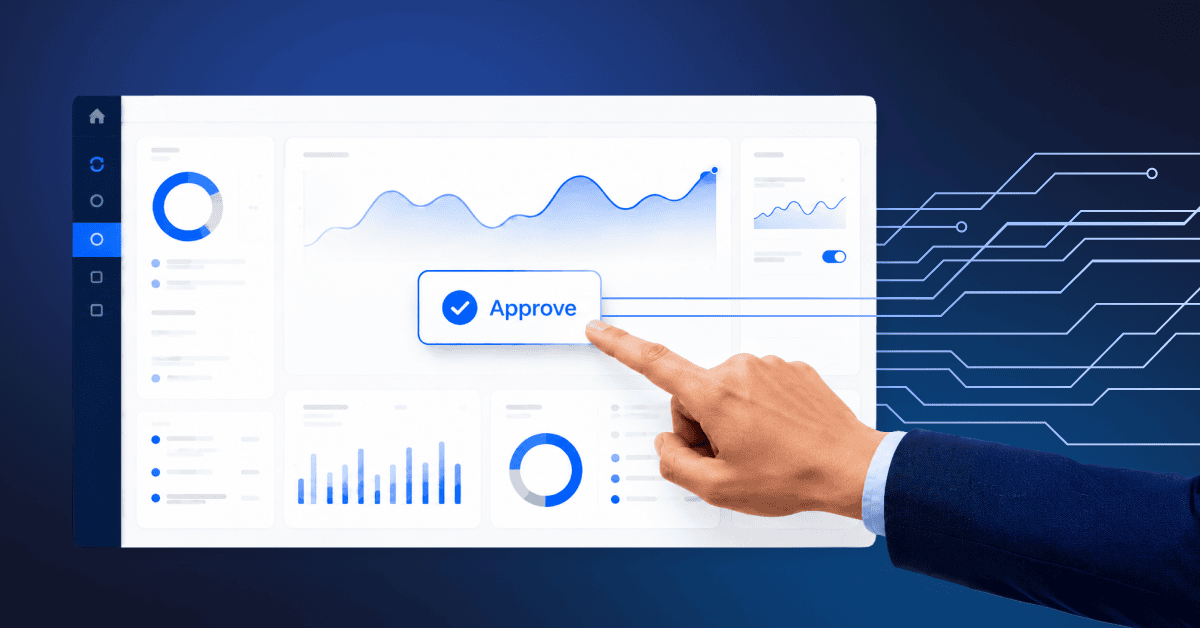
As AI agents move from recommendations to real media buying decisions, brands and agencies need to determine who is ultimately responsible for their actions. In this article, Jason Wolfson, VP, Product Marketing and Enablement at Skai, explores accountability across teams, clients, platforms, and budgets, and what organizations need to put in place as agentic AI scales.
Key takeaways
- Every AI agent needs a clearly defined owner. Organizations need to establish who is responsible for its actions, especially when agents operate across teams, clients, and platforms.
- Guardrails don’t replace accountability. Permissions and spending limits define what an agent can do, but organizations still need to determine who owns the outcome.
- Accountability gets more complex as agents scale. Teams need visibility into which agents are active, where they operate, and what authority they have across campaigns and budgets.
- AI agent decisions need to be traceable. Organizations should be able to reconstruct what an agent did, what informed the decision, and who was responsible for it.
Agentic AI is already in real media execution. Agents plan, optimize, and coordinate work across campaigns, accounts, and channels. That forces one question: When an AI agent makes a media decision, who is accountable for it?
The stakes rise as agents gain more authority. A recommendation still leaves a person with the final decision. An agent that reallocates budget, changes bids, or pauses campaigns can move real money before a person reviews the decision. IAB describes agentic AI as systems that can plan, decide, and act autonomously to achieve defined goals, with human oversight and guardrails.
As execution becomes more autonomous, accountability can’t stay implicit.
Why does agentic AI change the accountability question?
Media organizations have used automation for years. Rules-based bidding, budget pacing, and automated recommendations are already part of everyday campaign management. Agents introduce something different: greater independence across a broader sequence of decisions.
An agent can interpret a goal, decide which actions to take, execute across multiple systems, evaluate the result, and choose the next move. That expands the accountability surface, and the blast radius when something goes wrong.
If an agent makes an incorrect budget adjustment, who owns the outcome? If multiple agents participate in a workflow, can the organization determine which system made which decision? These become operational questions once agents participate in live media execution.
Why aren’t guardrails alone enough?
Guardrails are necessary, but they don’t solve accountability.
My colleague Gal Zohar recently outlined a practical approach for moving agents from read-only insights into campaign execution, starting with narrow tasks and expanding autonomy as agents demonstrate consistent performance.
That defines what an agent can do. It doesn’t define who owns what it does.
An organization can have technically sound controls while lacking clear accountability. An agent might have appropriate permissions and spending limits without anyone clearly owning the outcome when something goes wrong.
Who should own an AI agent?
Every production agent needs a named human owner. That gets complicated fast when agents cross organizational boundaries. A campaign manager owns the campaigns. An operations team configures workflows. IT controls access. An agency runs the agent against a client’s budget.
Each party owns part of the environment, but that does not establish who owns the agent.
A designated owner should understand what the agent can do, what systems and data it can access, how its performance is evaluated, and what happens when its behavior falls outside expectations.
Ownership also needs a lifecycle. When someone changes roles or leaves, their agents shouldn’t keep running on stale permissions and unclear supervision.
What happens when organizations have dozens or hundreds of agents?
Forrester describes an emerging problem as “agentic sprawl”: autonomous systems proliferating faster than organizations can effectively govern them. More than half of enterprises report experiencing it.
For marketing organizations, the path there is easy to imagine. One team builds an agent for reporting. Another uses one for optimization. An agency creates its own workflow. Publishers and technology platforms introduce agents of their own. Soon, multiple agents may operate across overlapping campaigns, budgets, data, and systems.
Organizations then need visibility across the agent ecosystem: which agents are active, where they operate, and how they interact. As we explored in Build vs. Buy? The Real Question Is How to Build Better With Agentic AI, getting an agent to work is only the beginning. Governance, observability, coordination, and ongoing operational support matter once those systems reach production.
Without that foundation, autonomy can scale faster than accountability.

How should accountability work across brands, agencies, and technology partners?
Media buying already distributes responsibility. A brand may own the budget, an agency may operate the campaign, a technology provider may provide the agent and execution infrastructure, and publishers may execute the media actions. Agentic workflows can span all four.
Organizations therefore need to establish where responsibility sits when an agent crosses those boundaries.
Accountability also extends to the intelligence agents accumulate over time. As Courtney Crossley explored in Data Ownership in the Age of Agentic AI, brands need to understand where that learning lives and what they retain when an agency or technology relationship ends.
The level of accountability may also change with the workflow. An agent recommending an optimization carries different implications from one independently reallocating significant budget across channels. The more systems and money an agent can influence, the clearer those lines of responsibility need to become.
Why is accountability more complicated for agencies?
Agencies have to make these models work across many clients, teams, and workflows. One team creating an effective agent is an experiment. Dozens of teams operating agents across a client portfolio becomes an operating-model question.
In our recent Ask the Experts discussion on what makes agentic AI work for agencies, Gal Zohar and Courtney Crossley discussed why shared standards become more important as teams build their own workflows. The same applies to accountability.
Agencies need consistent standards for agent ownership and responsibility while still accommodating differences in client budgets, objectives, policies, and risk tolerance.
Can you explain what your AI agent did after it happens?
Accountability requires evidence. Whether an agent improves performance or makes a mistake, organizations should be able to reconstruct what happened.
That means knowing:
- Which agent took the action
- When it happened
- What information informed the decision
- What authority the agent had
- Who was responsible for the agent
For agencies, that record can support client accountability. For brands, it provides visibility into how autonomous systems influence media investment. The ability to reconstruct an agent’s decisions may eventually become as important as the ability to automate them.
What should you ask before adding another AI agent?
Before putting another agent into production, ask:
- Who owns this agent?
- Which systems, accounts, budgets, and data can it access?
- Who can change its authority?
- What happens if its owner leaves the organization?
- Can we reconstruct its decisions after the fact?
- How quickly can we stop it if something goes wrong?
- If it crosses an agency-client relationship, who owns the outcome?
Speed and automation matter. Being able to answer these questions is what makes them sustainable at scale.
What does the next phase of agentic AI require?
Agentic AI adoption will continue to accelerate. Gartner predicts that 60% of brands will use agentic AI to facilitate streamlined one-to-one interactions by 2028, while industry groups such as IAB are already preparing advertisers for autonomous systems influencing media decisions.
The organizations that scale successfully will need more than capable agents. They will need to know which agents are operating, what authority each one has, who owns them, and who answers for their decisions.
Once AI agents start participating directly in media execution, accountability cannot belong to “the AI.” It still belongs to us.
Ready to put agentic AI to work with the right controls in place?
See how Skai helps marketers bring AI agents into media workflows with the governance, visibility, and control needed to scale. Contact Skai to learn more.y.
Frequently Asked Questions
Responsibility should remain with a clearly identified person or organization, even when an agent acts autonomously. Brands, agencies, and technology partners should establish ownership before deployment so there is no ambiguity about who ultimately owns the outcome.
Organizations should establish clear ownership, defined permissions, oversight and escalation rules, activity records, and the ability to restrict or stop an agent when necessary. Governance should increase as an agent gains access to larger budgets, more accounts, or additional systems.
Agencies should establish shared standards for agent ownership and accountability rather than allowing every account team to create its own approach. Individual controls can then reflect each client’s budget, policies, objectives, and risk tolerance.
More like this
-

From Insights to Action: A Practical Framework for Governed AI Agent Execution
-
Skai Reporting Connector vs. Publisher MCPs: Test Results Reveal Up to 90% in Cost Savings
-
Data Ownership in the Age of Agentic AI: What To Ask Before Signing
-
Ask the Experts: What Makes Agentic AI Work for Agencies?
-
Meet Skai’s Forward Deployed Engineer: Your Partner for Building With Agentic AI
-
Why Forward Deployed Engineers Are Enterprise AI’s Newest, Fastest-Growing Role