Most marketers are comfortable using AI agents to retrieve data, analyze performance, and recommend next steps. The greater opportunity is governed execution: enabling agents to complete defined campaign work while people remain in command of the rules, approvals, exceptions, and outcomes.
In this article, Gal Zohar, Chief Data Officer at Skai, outlines how teams can progress from read-only insights to action-taking agents: starting with narrow workflows, proving reliability through testing, and expanding autonomy only when the evidence supports it.
Key takeaways
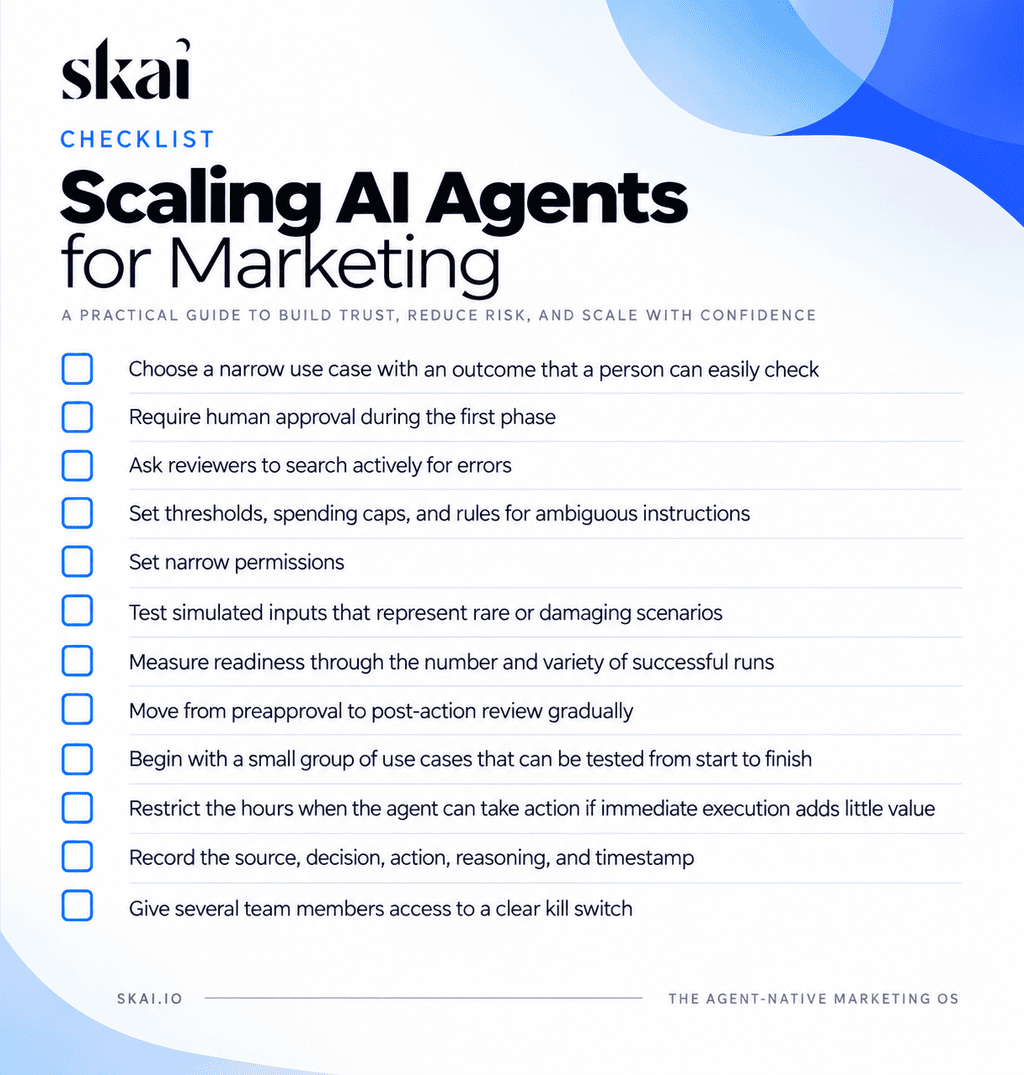
- Moving from AI insights to agent execution should happen in stages. Begin with human approval, progress to post-action review, and expand an agent’s independence after proving consistent results.
- Start with narrow campaign tasks that have clear outcomes. Budget updates from a trusted source, ad copy swaps, negative keyword additions, and similar actions make it easier to evaluate whether the agent completed the work correctly.
- Use completed tests as the measure of trust. Require at least 20 varied, consecutive successes to advance between stages, with a higher threshold for workflows that control large media budgets.
- Maintain human control after launch. Spending limits, failure tests, activity records, and a kill switch help teams identify unusual behavior and respond quickly.
AI agents have already become a familiar part of marketing reporting. Some teams use them to answer specific performance questions, while more advanced advertisers rely on agents to produce reports, generate visualizations, and recommend actions across hundreds of accounts.
That work feels relatively low risk because the agent stops at the recommendation. A human still decides whether to make the change.
The bigger opportunity begins when the agent can take action. It can apply a new budget, create a campaign, update targeting, or respond to a change in inventory or performance. At that point, the agent is working inside a live campaign where a mistake can affect millions of dollars in media.
Giving an agent that level of responsibility requires proof of concept. Teams need to start with actions that are easy to evaluate, test the agent across enough scenarios to build confidence, and keep human review in place as its responsibilities grow.
Before any of that can happen, teams also need a strong data foundation. As agents begin combining performance, inventory, pricing, competitive, and other signals, the quality of the underlying data becomes part of the control system. Shared definitions, normalized inputs, and a trusted source of record help ensure the agent is working from consistent and complete information.
This becomes even more important as agents take on greater responsibility. A straightforward budget update may rely on a relatively narrow set of inputs, while a more complex campaign decision may require the agent to interpret several signals at once. The quality and consistency of those inputs directly affect the quality of the decision.
Three recommendations can help marketers make that transition safely.
Which campaign tasks should AI agents take on first?
Start with narrow use cases where a person can easily determine whether the agent completed the task correctly.
Applying campaign budgets from a trusted source (if your budgets are managed that way) is a good example. Agencies receive budget instructions through emails, Asana tasks, spreadsheets, and internal planning tools. A person has to read the request, identify the campaigns involved, find those campaigns in the platform, and enter the correct numbers.
Traditional automation has struggled with this workflow because the inputs are open-ended. An email rarely arrives with a perfectly formatted campaign ID and budget field. Someone has to interpret what the client means.
Agents are much better at working with this type of unstructured input. Once the agent identifies the correct campaign, the remaining action is straightforward: take this number and put it there.
During this stage, the agent should explain what it found and what it plans to do:
I received this budget request. I matched it to this campaign. I plan to change the budget from this amount to this amount. Do you approve?
The human remains at the gate, and each action requires approval before the agent can complete it. Reviewers should actively look for problems, including:
- Did the agent misinterpret the request?
- Did it select the wrong campaign?
- Was the original instruction ambiguous?
Each error gives the team information it can use to improve the workflow, revise the agent’s instructions, or add another control. Trust grows as the agent completes the work correctly across different scenarios.
Once the team has established enough evidence across varied scenarios, it can consider expanding the agent’s permissions, always within defined guardrails and with clear escalation rules.
When should an agent move from human approval to post-action review?
After the agent has completed the same type of task dozens of times without requiring a correction, it can begin taking action before a person approves it. The human then reviews what the agent did after the action occurs.
Timing restrictions can reduce risk during this phase. Suppose a budget request arrives at 1 a.m. The agent may have the technical ability to make the change immediately. The workflow can require it to wait until 9 a.m. on a weekday, apply the new budget, and then notify the team.
For example: I received this request last night. I changed the budgets for these campaigns from these amounts to these amounts. This is how I interpreted the request.
The work continues without waiting for someone to approve each action. The human shifts from approving every action to governing the workflow: reviewing outcomes, managing exceptions, and refining the rules. If something looks wrong, the reviewer can step in.
As the agent continues to complete the work correctly, review can become more targeted, focused on exceptions, samples, and higher-risk actions. After roughly 100 successful actions, the reviewer may no longer need to inspect every result. The workflow should continue recording and reporting each action so the team can see what happened and investigate when needed.
When can agents handle more complex campaign decisions?
The final phase carries the most value and requires the most trust.
At this point, the agent begins combining signals from multiple sources and using them to make a decision. It might consider budget, inventory, pricing, share of voice, and campaign performance before recommending or applying a change.
The use cases in this category often include workflows that were never done at scale by humans – they were either theoretical or done only for the top-spending, most critical products, categories, or campaigns.
Since it’s much harder for a human to quickly see if the agent took the right action, the agent needs to explain its reasoning clearly. A recommendation without context gives the reviewer too little information to evaluate the decision.
The working relationship should resemble a junior employee presenting a recommendation to a more experienced colleague:
I recommend this action. These are the signals I reviewed and the reasoning behind my decision. This is the result I expect. Here’s my confidence level, the signals that shaped it, the assumptions I made, and the conditions that would change the recommendation.
That explanation allows the human to judge the quality of the decision and improve the agent’s instructions over time.
Campaign trafficking is another major opportunity. Creating a social campaign often starts with a spreadsheet and ends with someone clicking through dozens or hundreds of fields in Meta Business Manager. The person copies the campaign name, enters the budget and dates, builds the ad sets, and selects the appropriate audiences and creative assets.
Much of that work depends on accurately translating information between two systems. The spreadsheet contains the instructions, and the publisher interface contains the fields where those instructions need to go. An agent can learn that process.
For agencies, agent-run trafficking could shorten the time between receiving a brief and launching the campaign. A process that currently takes a week could eventually take hours. Teams could execute more consistently and give experienced marketers more time for decisions that require their judgment.
How long does it take to trust an AI agent?
Teams often want a timeline. They ask whether trust takes one month, six months, or a year. The number and variety of completed tasks provide a better measure.

An agent that performs a task every day may generate 30 examples in a month. A weekly workflow produces four examples during the same period. Those teams have collected very different amounts of evidence.
There is no universal threshold. These numbers are a rule of thumb; higher-impact workflows, especially those controlling substantial media spend, should require more evidence, stricter controls, and broader approval. The runs should cover meaningfully different scenarios because repeated versions of the same input reveal very little about how the agent will handle variation.
For workflows that affect millions of dollars in media, 50 successful runs may be a more appropriate threshold.
Teams should also concentrate on a small number of use cases. Using agents broadly for read-only reporting and recommendations presents less operational risk. Write access needs a narrower starting point.
Choose three to five use cases and take them through the full process. Managing 15 partially autonomous workflows at different phases makes testing and accountability harder. A smaller group gives the team enough focus to learn what works and apply those lessons to future agents.
How should marketers test agents before giving them write access?
Many teams begin with the inputs they expect the agent to receive. They gather several normal emails from the previous week, give them to the agent, and confirm that it interprets each one correctly.
This tests the standard workflow. Rare and flawed inputs require equal attention because they can create the largest problems:
- What happens when a decimal point is missing?
- How does the agent respond when two campaigns have similar names?
- What does it do when the request conflicts with an existing spending limit?
Teams should create simulated inputs for these cases before the workflow goes live. The test set might include an extra zero, a missing date, an unfamiliar request format, or a budget far outside the normal range. An unusual email may arrive once a year. Testing a simulated version now shows how the agent will respond before real money is involved.
This type of testing takes practice. Marketers usually define the outcome they want from a workflow. Agent testing also requires them to identify the actions the system must block and the conditions that require human review.
What controls should remain after an agent goes live?
Successful testing gives the agent permission to operate within defined boundaries. Those boundaries remain part of the live workflow.
Start by identifying changes that require human review. If a proposed budget is 70% higher or lower than the campaign’s previous budget, the agent should pause the action. A hard spending limit can block any budget above an approved amount. The workflow should also pause when required information is missing or when the agent cannot confidently match a request to the correct campaign.
These limits contain the damage an incorrect input could cause. If someone enters $10,000 instead of $1,000, the agent can flag the request before it reaches the campaign.
Every action also needs a paper trail. For a budget workflow, as an example, the record should include:
- The original email, Asana task, or source
- The instruction the agent interpreted
- The selected budget and campaign ID
- The reason for the action
- The date and time the change occurred
The record can begin as simple as a Google Sheet. The system matters less than the ability to reconstruct what happened and trace the action back to its source.
A live agent also needs a kill switch and reversibility. Team members should have a simple way to stop the workflow as soon as they notice an incorrect or suspicious action, and revert recent changes made by the agent.
Never give the agent more access than it needs. Agents think, and can get creative. If an agent is expected to touch some accounts but not others, take some actions but not others, limit its permissions and visibility to the accounts and tools it needs. Permissions to touch campaigns that it should not touch significantly increase risk of the agent taking liberties and going outside of its expected route.
Separation of duties, for humans and agents both. The person who’s building the agent should not be the only person testing and validating it. It is easy to miss something when you are the builder and you want it to succeed. And the same goes to the agents – if agent A takes the action, another agent should validate/check/oversee it that is not deep in the same logical path that may have caused a mistake.
Why should brands and agencies make this a priority now?
People who spend much of their day completing hands-on campaign work may view this change with concern. Agency leaders and brand marketers also have to consider how quickly their competitors can operate.
A brand using agents can respond faster to changes in price, inventory, share of voice, and performance. An agency can serve more clients with the same team, complete work more consistently, and turn a brief into a live campaign in hours instead of a days or weeks. Most organizations have yet to reach that point. Many still use agents primarily for read-only reporting and recommendations.
The learning process takes time. A company that waits until its competitors have reliable agent-run workflows will begin with less testing experience and fewer proven controls. Its competitors will already know which use cases work, which inputs cause problems, and how much human review each workflow needs.
Existing processes may continue to work well today. Competitive standards will keep moving as other teams make agents part of daily campaign execution.
If you wait too long to board that train, catching it becomes much harder.
How can Skai help teams move from read-only agents to execution?
The process described above requires a practical system for building, testing, and monitoring each workflow.
Skai Studio, announced earlier this year, brings that process into one framework. Teams can test a workflow before launch, begin with human approval, add layers of agent validation, and move to post-action review after the agent has produced enough reliable results.
The same framework supports operating-hour restrictions, action records, spending limits, and other controls around the workflow. Teams can focus on the use case and define the evidence required for each new level of autonomy.
Some organizations still need help deciding which use cases to start with and how much control each one requires. Skai’s Strategic Advisory Services can help teams create a roadmap, design the operating model, and establish the controls needed for wider adoption.
Reporting and insights gave marketing teams a logical place to begin using agents. Campaign execution is the next phase.
The value grows when agents can complete the manual work that delays campaign launches and pulls marketers away from higher-value decisions. Reaching that point requires focused use cases, repeated testing, clear records, and more autonomy only after the agent has earned it.
Ready to learn more? Skai is here to help you better understand what agentic transformation actually looks like inside your own operation. Contact us today.
Frequently Asked Questions
A read-only agent retrieves campaign data, creates reports, and recommends actions. An agent with write access can change campaign settings, apply budgets, or complete other tasks inside the platform. Write access requires stricter testing and ongoing monitoring because the agent’s decisions can affect live media.
Yes. Human involvement can move gradually from approving every action to reviewing actions after they occur. Teams may eventually inspect exceptions or samples, while the agent continues to produce a complete record of its activity.
A live campaign agent should operate within clear spending limits and rules for unusual inputs. It should record every decision and action, pause when confidence is low, and give the team an immediate way to stop the workflow.
More like this
-

From Software Engineer to AI Engineer: 8 Lessons From Under the Hood at Skai
-

Prime Big Deal Days 2026: How One Month Paid Off in Two Days for Amazon Ads
-

Who Owns AI Agent Strategy Now? Meet the New Buying Committee
-
From AI Assistance to Agentic Execution: Skai’s Take on Amazon Ads unBoxed 2026
-
Ready for AI Agents to Do More? Inside Skai’s 34-Tool Agent Connect Launch
-
The Road to Agentic Marketing: Skai at Amazon Ads unBoxed 2021-2025