Skai built a shared AI knowledge system called a Team Brain to help teams work faster and automate complex tasks. The approach has accelerated automation development by up to 10x, with applications extending beyond software engineering. Chief Data Officer Gal Zohar shares how his team developed the system, the technology behind it, and what they’ve learned about scaling AI productivity across the organization.
Key takeaways
- Organizational knowledge makes AI more effective. Giving AI access to internal processes, systems, and best practices enables more complex execution.
- Team Brains make collective expertise actionable. Shared documentation, connected tools, and continuous feedback help AI improve over time.
- Skai Labs is seeing productivity gains of 2x to 10x. Repeatable automation workflows deliver the largest improvements, alongside faster troubleshooting and maintenance.
- The approach extends beyond engineering. Skai Labs work with No-Code tools, and with this path, they managed to embed Claude Code in their core work. Other Skai departments are also beginning to adopt Team Brains, opening opportunities for greater productivity and automation.
About eight months ago, I found myself considering a question I never expected to face: Does my team still need to exist?
I lead Skai Labs, a group responsible for developing custom customer solutions. For years, our advantage was speed. We could deliver capabilities in days that might take months through traditional software development. Then our engineering organization embraced AI coding tools, doubling its development velocity and working toward 3x productivity.
We had hundreds of solutions running in production, deep customer expertise, and a proven methodology. Rather than abandon those strengths, we explored how to achieve similar gains using our existing tools and processes. We do not code – so the approach that our developers took was not a good fit.
Today, we’re developing custom solutions 2x to 10x faster. The breakthrough came from building a shared AI knowledge system we call a Team Brain.
Why did we need to rethink how Skai Labs worked?
When I joined Skai in 2009, we were a startup of about 50 people. As the company grew beyond 500 employees, maintaining the flexibility to respond quickly to individual customer needs became more challenging.
We established Skai Labs about seven years ago to address that need. Using Make, a visual automation platform, our team connects Skai’s APIs, external systems, and data infrastructure to build custom capabilities without modifying the core application. And without writing code, since coding used to be too slow for our needs.
Our five-person team has since developed approximately 300 solutions and contributed millions of dollars in revenue per year. Some projects that might require two or three months through traditional development can be delivered in three days.
When AI began accelerating engineering, we saw an opportunity to bring similar capabilities into our automation environment.
Why wasn’t connecting AI to our tools enough?
We connected Claude Code to Make through the Model Context Protocol (MCP), allowing AI to create and modify automation workflows directly.
The integration worked, but Claude lacked critical context. It understood Make’s functionality without knowing our custom applications, customer requirements, database structures, or internal standards. It needed too much guidance at every step, which became frustrating and time-consuming – the exact opposite of what we wanted.
An experienced professional joining a company faces a similar challenge. They may understand the technology but still need to learn how the organization operates and why certain practices exist.
We needed to give AI access to that institutional knowledge. That became the foundation of our Team Brain. But this knowledge did just sit somewhere waiting to be read by Claude. It was in our human brains.
How does a Team Brain work?
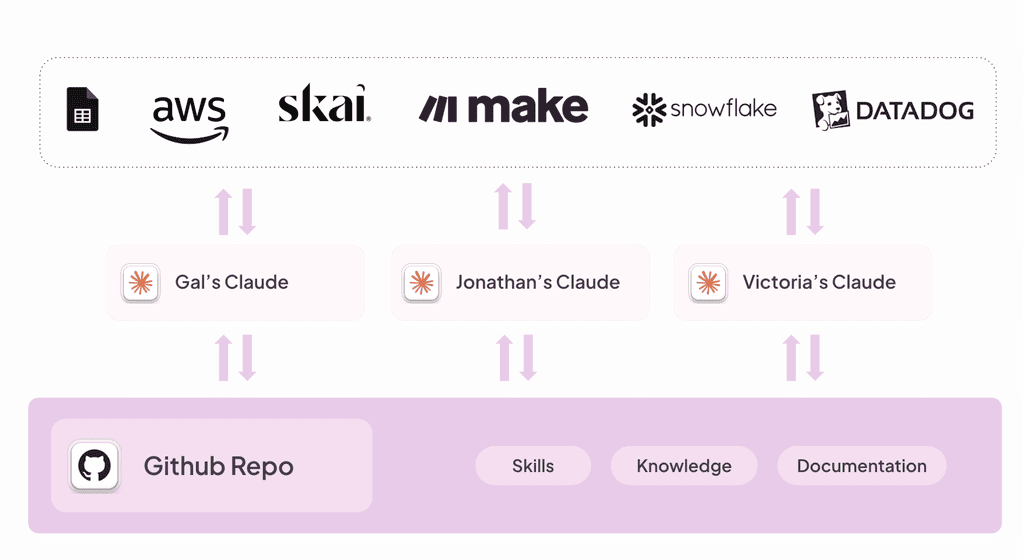
Our Team Brain is a GitHub repository containing structured Markdown files that document our team’s knowledge, processes, and technical standards.
The methodology combines three components:
1. Shared knowledge and skills
We organize documentation hierarchically so Claude can retrieve relevant information without loading the entire repository into its context. Files include API specifications, database schemas, customer workflows, and instructions for completing specific tasks.
We also document the reasoning behind technical decisions, giving AI the context needed to modify existing solutions appropriately.
2. Continuous learning through feedback
After completing a project, we capture lessons that could improve future work. We developed a retrospective skill that reviews the interaction and identifies updates to the Team Brain.
Changes are submitted through GitHub pull requests, with larger modifications receiving peer review. We also notify the team through Slack when new information is added.
This means a correction made by one employee becomes available to everyone.
3. Connections to business systems
Claude can interact with the tools involved in our workflows, including Make, Snowflake, Skai, AWS, and monitoring systems.
Instead of manually switching between applications to inspect data, review logs, modify configurations, and validate results, we can delegate much of that coordination to AI.
Our responsibility becomes defining objectives, providing guidance, and reviewing outcomes.

What does this look like in practice?
We recently needed to enhance an existing customer automation to support advertising data from Yahoo Japan. The customer already had integrations for Google and Microsoft advertising, but the additional publisher required changes to our ID mapping.
I directed Claude to two existing scenarios that solved similar problems. It examined their Make blueprints, reviewed our internal standards, analyzed the SQL, and validated the proposed changes against actual data.
The entire enhancement, including execution and validation in production, took approximately 15 minutes. Previously, the same work could have required several hours.
During the process, Claude suggested using CREATE OR REPLACE in a SQL operation. I corrected it because our team prefers INSERT OVERWRITE for such cases. I also explained why we prefer it, so Claude can recommend otherwise if that motivation is irrelevant.
Afterward, I ran our retrospective skill. Claude documented the correction, updated the appropriate knowledge files, and prepared a Slack notification.
We completed the customer request while capturing a technical lesson that could benefit future projects.
What productivity improvements have we seen?
We’re seeing measurable improvements across several areas of Skai Labs’ work:
- 2x to 10x faster automation creation: Repeatable workflows with established documentation deliver the largest gains. Unfamiliar requirements typically need more guidance.
- Faster troubleshooting: Claude can inspect logs, query databases, and investigate errors, reducing some investigations from hours to minutes.
- More consistent documentation: Technical records, implementation details, and decision histories are captured during execution.
- Easier maintenance: Shared knowledge helps employees understand and update existing customer solutions.
These improvements are especially valuable for a five-person team supporting hundreds of production automations.
How does AI-led work change the productivity equation?
Our experience revealed an important distinction between AI-assisted and AI-led work.
With AI assistance, employees use models to complete individual tasks, such as generating SQL or summarizing documentation. In our experience, this often produced incremental gains of around 10% to 20%, while employees continued coordinating the broader workflow.
With AI-led work governed by humans, we provide the objective, relevant context, and access to the necessary systems. AI coordinates multiple steps while employees guide execution, validate results, and intervene when needed.
This allows people to spend more time on requirements, technical decisions, and quality rather than managing every action.
For organizations evaluating AI productivity, redesigning complete workflows offers greater potential than optimizing isolated tasks.
Can Team Brains work beyond engineering?
After seeing the results in Skai Labs, we began introducing the methodology to other departments.
During our company-wide Agentic Week initiative, employees dedicated time to exploring AI productivity opportunities. Several teams started building their own Team Brains and connecting relevant tools.
Potential applications include:
- Customer success: Account history, customer requirements, and support processes.
- Onboarding: Implementation procedures, configuration standards, and recurring setup tasks.
- Expert services: Technical playbooks, specialized workflows, and lessons from previous projects.
- Operations: Internal procedures, approval requirements, and internal tickets.
We’re also exploring the possibility of connecting individual Team Brains into a broader company-level knowledge system. This could eventually allow departments to benefit from information collected across the organization, although that capability remains a future direction.
When does AI-led work become autonomous?
As our Team Brain has matured, we’ve identified workflows that Claude can perform reliably with minimal intervention.
One example involves a partner that submits customer setup requests through Slack. After repeatedly testing the process with Claude, we built an autonomous agent in Make that responds to those requests and completes the associated tasks.
Our approach follows three steps:
- Document the workflow. Give AI access to the knowledge and tools needed for execution.
- Validate through repeated use. Review results, correct mistakes, and capture lessons.
- Automate proven processes. Delegate suitable tasks once they can be performed reliably, with appropriate oversight.
This provides a practical path from AI assistance toward more autonomous execution.
What does this mean for the future of AI productivity?
Our work also reinforced the value of connecting AI to existing business systems. That principle is reflected in Skai Agent Connect, which makes Skai capabilities accessible to external AI agents through MCP.
For me, the broader lesson comes from what happened inside Skai Labs. We started with a team concerned about losing its speed advantage as software development accelerated. By making our expertise accessible to AI, we improved productivity while preserving the tools and practices we’d spent years developing.
We’re still learning, but our experience suggests that the productivity gains transforming software engineering can extend much further. Organizations that give AI access to their collective knowledge, connect it to real workflows, and maintain human oversight have an opportunity to fundamentally change how work gets done.
Ready to learn more? Skai is here to help you better understand what agentic transformation actually looks like inside your own operation. Contact us today.
Frequently Asked Questions
An AI Team Brain is a structured repository of shared knowledge, documentation, skills, and best practices that AI can reference while performing tasks. It learns more as it’s being used, just like a human brain. It helps models understand how a team operates and can be updated as employees capture new information.
A Team Brain supports AI execution. Beyond retrieving information, AI can apply documented procedures, interact with connected tools, and incorporate lessons from completed work through a controlled feedback process.
Yes. Teams in customer success, operations, and professional services can adapt the methodology by organizing their knowledge, connecting appropriate tools, and establishing processes for reviewing AI-generated work.
More like this
-

From Software Engineer to AI Engineer: 8 Lessons From Under the Hood at Skai
-

Prime Big Deal Days 2026: How One Month Paid Off in Two Days for Amazon Ads
-

Who Owns AI Agent Strategy Now? Meet the New Buying Committee
-
From AI Assistance to Agentic Execution: Skai’s Take on Amazon Ads unBoxed 2026
-
Ready for AI Agents to Do More? Inside Skai’s 34-Tool Agent Connect Launch
-
The Road to Agentic Marketing: Skai at Amazon Ads unBoxed 2021-2025