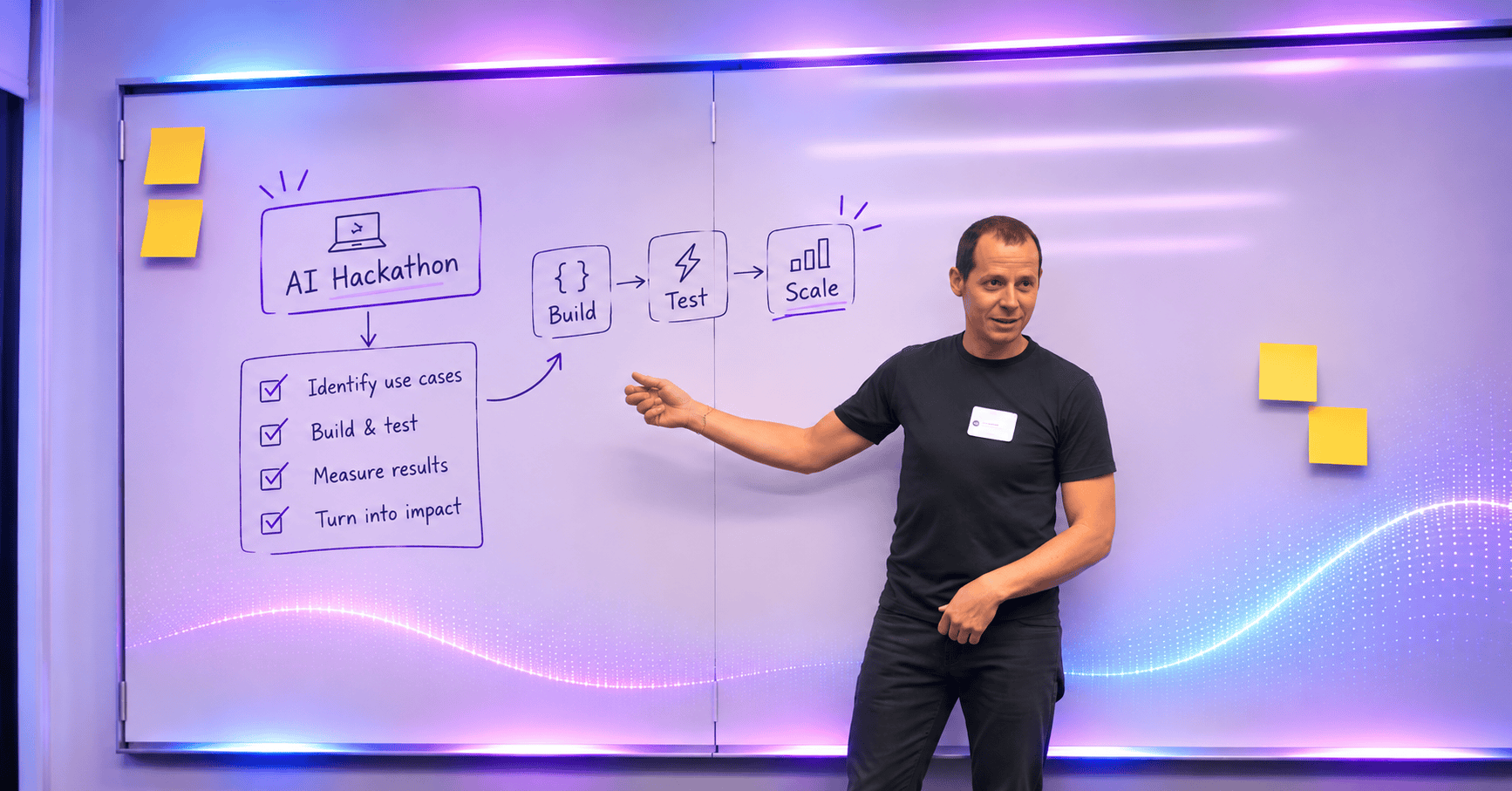
In 2027, agentic AI will reshape how marketing teams work, how agencies deliver value, and how organizations scale their operations. As AI agents move beyond individual tasks to manage increasingly complex workflows, marketers will take on new responsibilities involving strategy, oversight, and governance. Skai’s thought leaders share their predictions for the next phase of agentic marketing, from changing roles and business models to the infrastructure and organizational readiness needed to turn AI into measurable business value.
Key takeaways
- Marketing roles will evolve as agents take on more responsibility. Marketers will increasingly focus on setting objectives, directing workflows, reviewing results, and overseeing AI-driven execution.
- Operational transformation will become the real measure of AI success. Organizations will prioritize repeatable workflows and measurable business outcomes over feature launches and isolated experiments.
- Governance and infrastructure will determine how quickly agents can scale. Reliable data, clear permissions, connected systems, and human oversight will be essential for expanding agent autonomy.
- Agencies will need to rethink their services and business models. As agents handle more execution work, agencies will face new expectations around strategy, expertise, efficiency, and pricing.
- The gap between experimentation and production will become more apparent. Companies that invest in practical implementation, organizational readiness, and ongoing adoption will be better positioned to realize AI’s potential.
How Will Agentic AI Change Marketing in 2027?
Agentic AI is beginning to change how marketing teams operate. What started as experimentation with AI assistants is evolving into a new way of working, where agents can coordinate tasks, make recommendations, and increasingly execute workflows with human oversight.
In 2027, the implications will extend well beyond individual productivity gains. Marketing leaders will need to rethink how teams are structured, how work gets delegated, what capabilities they build internally, and how they measure the value of AI.
We asked Skai’s thought leaders to share their predictions for how agentic AI will reshape marketing workflows and business models in 2027. Here’s what they expect.
Michelle Urwin
Chief Marketing Officer, Skai
2027 will expose the gap between AI experimentation and operational transformation.
To predict where marketing is heading in 2027, I look at the journey my own team has been on.
2025 was about experimentation. People were figuring out how AI could improve their existing workflows, at different speeds and largely using it as an assistant. In 2026, we started delegating more responsibility, creating skills and automating recurring tasks. Now we’re putting the foundations in place for agents to take on complete workflows across marketing.
What I’ve learned is that building the agent is often the easy part. The harder work is connecting systems, making knowledge accessible and ensuring people and agents work from the same source of truth. We’re building what we call our “marketing brain”, connecting our knowledge, data, skills and systems so each new workflow builds on a shared foundation.
But the biggest shift is in how the team thinks about work. We’re getting people to realise they can use Claude as the starting point for everything they do, drawing on connected tools and knowledge. That changes an ingrained habit of opening dozens of tabs, gathering information and moving it between systems yourself. It means learning to brief, delegate, review and refine through AI.
That takes investment. Like onboarding a new employee, you have to provide context, guidance and feedback before delegation becomes reliable. We’re learning those lessons now, and they’re shaping how we build and lead the team.
My prediction is that 2027 will bring this reality into focus for many CMOs. As ambitions move towards end-to-end agentic workflows, the demands on data, systems and people will become much clearer. The leaders who invest in those foundations and bring their teams with them will turn AI adoption into a lasting advantage.
Gal Zohar
Chief Data Officer, Skai
Marketers will become managers of AI agents, just as developers have.
In 2027, I predict marketing will undergo the same fundamental transformation we’ve already seen in software engineering. AI will move from being a helpful assistant for individual tasks to something that can manage entire workflows, changing what marketers actually do every day.
At Skai, the way our developers work today is almost unrecognizable compared to a year and a half ago. We’ve moved beyond using AI to help write code. Engineers now oversee AI systems that handle the coding process, while they provide direction, define constraints, review results, and guide improvements. It’s a completely different way of working.
I believe marketers are next.
Today, many marketers still own every step of a workflow, using AI to assist with individual tasks along the way. But we’re moving toward a model where marketers define the desired outcome, establish the boundaries, and let agents determine how to get there. Those agents will coordinate multiple steps, make decisions within their permissions, and bring humans in when guidance or approval is needed.
That shift requires a different set of skills. Marketers will need to understand how agents operate, where they need oversight, and when giving them more freedom produces better results than prescribing every step. The role becomes more technical, strategic, and focused on governance.
We’re already seeing organizations move toward this vision at very different speeds. Some are cautiously evaluating what’s possible, while others are aggressively working to transform their operations within months. I believe today’s AI models are already capable of supporting this transition when paired with the right tools, architecture, and safeguards.
This isn’t necessarily about replacing marketers. In engineering, we’ve seen how the same team can dramatically expand its capacity by overseeing AI rather than performing every task manually. I expect marketing to follow a similar path, with people becoming the managers, architects, and decision-makers guiding increasingly capable agents.
Courtney Crossley
EVP, GTM & Client Experience, Skai
Marketers will stop operating campaigns and start supervising them.
The biggest shift in 2027 is that marketers stop operating campaigns and start supervising them. Agents already handle repetitive work. The change next year is that they chain those steps together, so one agent spots an issue, diagnoses it, proposes a fix and executes within guardrails.
Four shifts to expect:
- Roles change before headcount does. The value moves from pulling levers to setting goals, constraints and approval rules, and judging the agent’s output.
- Data readiness becomes the limiter. Agents are only as good as the data and governance behind them. Teams with messy taxonomies, unclear ownership or siloed channels will see agents amplify the mess.
- Adoption splits. Some teams will run agents across the full workflow, while others stay stuck in pilots because they never defined what the agent may do alone and what needs a human.
- Boomerang from building to partnering. As AI becomes an always-on way of working, management, governance, and upkeep will catch up with the owners. The benefits of partnering will likely win out for brands without the resources to manage these efforts internally.
The practical advice is to start with one workflow, define the guardrails, measure it against a human baseline, then scale. Teams that treat agents as a team member with a clear job will beat teams that treat them as a feature.
Jason Wolfson
VP, Product Marketing and Enablement, Skai
Agentic marketing will become an operating-model decision, not just a technology decision.
2027 will be the year agentic marketing becomes an operating-model decision, not just a technology decision. The biggest shift won’t be how many agents a team launches. It will be how much recurring work those agents can reliably own, and whether people know who is accountable for the result.
I expect the most durable adoption to follow a practical progression: let agents read, then recommend, then act within a defined scope. Cross-publisher reporting is a strong starting point because teams can inspect the sources, reconcile the numbers, and evaluate usefulness over repeated cycles. From there, they can expand into investigation, campaign preparation, and bounded execution. Success in reporting, however, won’t automatically qualify an agent to move budget. Every increase in authority will need its own evaluation.
My experience building AI workflows and enablement programs has shaped a second prediction: the adoption bottleneck will increasingly be organizational readiness rather than access to AI. Building a reusable agent system for product marketing, business development, and customer success has made this tangible for me. The opportunity is not simply generating more output; it is turning expertise into repeatable workflows that teams can use, inspect, and improve.
That will change the marketer’s day-to-day job. Less time assembling reports and making repetitive updates; more time defining objectives, testing recommendations, handling exceptions, and deciding which responsibilities an agent has earned. Training will need to cover delegation and verification, and not just prompting.
The teams that scale successfully will treat accountability as part of deployment: a named owner, explicit permissions, spending boundaries, traceable actions, and a clear intervention path. Marketing will define the business outcome, but IT, finance, legal, procurement, and agency leadership will help determine the authority agents receive. My prediction is that the competitive advantage won’t belong to the teams with the most autonomy. It will belong to the teams that can expand autonomy without losing control.
AI fluency will stop being a credential. Demonstrated judgment will become one.
In 2027, “AI trained” will stop being a meaningful measure of workforce readiness. Knowing how to prompt an agent is not the same as knowing when to trust its output, challenge its recommendation, or stop its execution.
I expect enablement to shift from course completion to demonstrated judgment. Certifications will increasingly test whether someone can spot a flawed recommendation, verify the evidence, and recognize when human approval is required. The most valuable skill won’t be getting AI to produce an answer. It will be knowing whether that answer deserves to become an action.
The AI launch date will matter less than the next 90 days.
In 2027, I expect companies to become much less impressed by an AI launch and much more interested in what changed afterward.
A successful launch won’t be defined by the announcement, demo attendance, or initial usage spike. It will be defined by whether a specific workflow becomes repeatable: who uses it, how often, what they no longer do manually, and whether the result improves.

Enablement teams will need to help define those adoption milestones before launch, and not arrive afterward with training. The question will shift from “Did we introduce the capability?” to “Did we change how the team works?”
Kevin Weiss
Forward Deployed Engineer, Skai
Software will be judged by how well it works as a tool for agents.
The SaaSpocalypse story gets this backwards. Platforms aren’t going away. They’re becoming the trusted layer agents work through. Most of my agentic work isn’t prompting. It’s the plumbing: defining architecture, setting up keys, authorizing access, approving scopes and transitioning local work into the cloud so it can run unattended.
Once agents become the interface, a new question shows up fast: “what are users asking their agents to do?” Recently an agency client’s IT team asked us what their dozens of users were actually asking their agents to do with our MCP tools. During our first meeting with their IT team, we handed them a 10-page analysis built from usage telemetry. It showed what their teams relied on, where they could cut usage and cost, and how we could partner to deliver a better experience to their own end-clients.
In 2027, the software that wins will be the easiest for an agent to plug into, the safest to let it act through, and the most transparent about what it’s doing.
2027 is the year companies pay to find out what’s real.
Every client’s stack is different: their own tools, approval chains and data quirks. “Can we actually do this?” is hard to answer until you’ve tested what’s possible in your own environment or worked with someone who knows how to navigate those challenges. So we stopped answering it with slides and started answering with working prototypes.
For one enterprise client, we built a working prototype before the first call. By the second call it was deployed, and we were confirming final scoping details for the next project. A working prototype on day one beats a roadmap every time.
Expect a lot of hands-on, last-mile building as teams stop debating the hype and start testing it.
The demo-to-production gap stays a mile wide, except where the plumbing already exists.
Connecting an agent to a platform is becoming table stakes. What closes the gap is what sits behind the connection: clean data, actions you can trust, and guardrails an enterprise will sign off on.
When those are in place, the gap shrinks dramatically. One of our internal teams showed AI-built mockups with synthetic data on a Friday that they planned to demo. By Monday they were demoing end-to-end flows on a live app with a variety of options for data (synthetic, upload, downloaded from server, etc.).
Teams that invest in that foundation will pull away from the ones still chasing demos.
Shirley Grill-Rachman
COO & CFO, Skai
Agentic AI will force agencies and brands to rethink how they operate.
In 2027, I expect agentic AI to fundamentally change how brands and agencies structure their operations, evaluate technology, and define the value of their services.
We’re already seeing companies across the market at very different stages of AI maturity. Everyone recognizes the need to become more agentic, but many are still figuring out how to get there. That’s why I believe the combination of technology and services will become increasingly important. Having access to agents isn’t enough. Organizations also need guidance identifying the right workflows, implementing the technology, and scaling it effectively.
Another shift will be in the build-versus-buy decision. AI has made it significantly easier for companies to develop their own solutions, and I expect we’ll see a wave of internal agent development. But building something is very different from maintaining it at scale, particularly in marketing, where agents may influence millions of dollars in media spend. As organizations encounter the challenges of governance, reliability, and ongoing maintenance, I anticipate a renewed appreciation for partnering with technology providers that have already built those capabilities.
Agencies will face an equally significant transformation. Much of the hands-on execution work that agencies traditionally provide can increasingly be handled through agentic workflows. That could encourage more brands to bring certain capabilities in-house, forcing agencies to redefine their value around strategy, creativity, and higher-level decision-making.
Their business models will need to evolve, too. When work is increasingly performed by agents rather than employees, traditional full-time-equivalent billing models become harder to justify. Agencies will need new ways to measure and communicate the value they deliver.
The agencies that successfully redefine their services and business models will remain valuable partners. Those that continue operating as they always have may struggle to compete.
Jeff Cohen
Chief Business Development Officer, Skai
2027 is the turning point when marketers stop asking, “Can we do this?” and start demanding, “Prove to me why we can’t.”
For the past two years, we’ve watched technology companies add AI to existing products, automate individual tasks, and call it transformation. That’s a pretty low bar. And we need to stop inventing new metrics for AI. As Colleen Aubrey points out, the real measure is whether AI improves the business outcomes that already matter. AI doesn’t eliminate every problem. It shifts where the bottlenecks are. The real opportunity is technology that understands business context, develops campaign strategies, coordinates execution across channels, and optimizes performance within established governance frameworks.
Here’s where things get interesting: imagine a five-person agency competing for a $100 million account. With the right expertise and agentic technology, a small team could potentially manage work that once required an enormous organization. That fundamentally challenges how agencies scale, how technology providers charge, and what clients should expect from their partners.
I think 2027 is when we’ll start seeing that shift take shape. Marketers will become less interested in how many AI features a platform offers and more focused on what they can actually accomplish. SharkNinja’s AI Jailbreak shows what’s possible when an entire organization embraces experimentation and rallies around solving real business problems. That kind of cultural shift is just as important as the technology itself. The companies that figure out how to turn agentic capabilities into entirely new operating models will have a serious competitive advantage.
Omri Matsliah
VP, Product, Skai
AI agents will put advertiser control on the agenda.
As more networks introduce agents, advertisers will need to decide how those agents work together. Each network can optimize within its own environment. Someone still needs to decide where the next dollar should go across the business.
I expect advertiser control to become a bigger buying criterion in 2027, creating demand for systems that apply the brand’s objectives and constraints across networks. Advertisers will want to be clear about which decisions they’re delegating and which they’re keeping.
The AI conversation will also get more specific to the job. Advertisers will push AI providers to explain exactly what the technology does for their role. A media manager will want to know which decisions it helps them make and how much campaign maintenance it takes off their plate. A marketing leader will want to understand how it improves investment decisions.
As people gain experience with AI, their expectations will rise. In 2027, providers will have to demonstrate that they understand the work well enough to make it better.
What Do These Predictions Mean for Marketing Teams in 2027?
The common thread across these predictions is that agentic AI is becoming an organizational capability rather than a standalone technology feature.
Marketing teams will increasingly need to define which workflows agents can own, how their decisions are governed, and how success is measured. The changes will also affect the skills marketers need, the value agencies provide, and the decisions brands make about building or partnering for technology.
The organizations that make the most progress will be those that connect their technology investments to practical workflows, measurable business outcomes, and the people responsible for overseeing them.
Frequently Asked Questions
Agentic AI will increasingly handle recurring tasks and coordinate more complex workflows, allowing marketers to spend more time on strategy, defining objectives, reviewing recommendations, and overseeing execution. Marketers will also need stronger skills in AI delegation, verification, governance, and evaluating business outcomes.
Companies will need connected systems, reliable data, clear permissions, and defined accountability for agent actions. A practical approach is to begin with a specific workflow, establish appropriate guardrails, evaluate results against existing processes, and expand agent responsibilities as reliability improves. Organizational readiness and employee adoption will be just as important as the technology itself.
As AI agents take on more execution work, agencies may need to shift their value propositions toward strategy, creativity, specialized expertise, and oversight. Agentic technology could also allow smaller teams to manage more complex accounts, challenging traditional staffing and billing models. Agencies that adapt their services and demonstrate measurable business value will be better positioned to compete.
More like this
-

2027 Predictions: How AI Will Change Product Discovery and Commerce
-

10 Engineers, 90 Days: What Skai Learned About Building in the Age of AI
-
How Liquid Death Killed It on Prime Day with Skai’s Agentic Marketing Platform
-

How to Run a Successful AI Hackathon: A Playbook for Marketing Teams
-
Let Agents Read Before They Act: The First Workflow That Builds Trust
-
Building an Agent Is the Easy Part