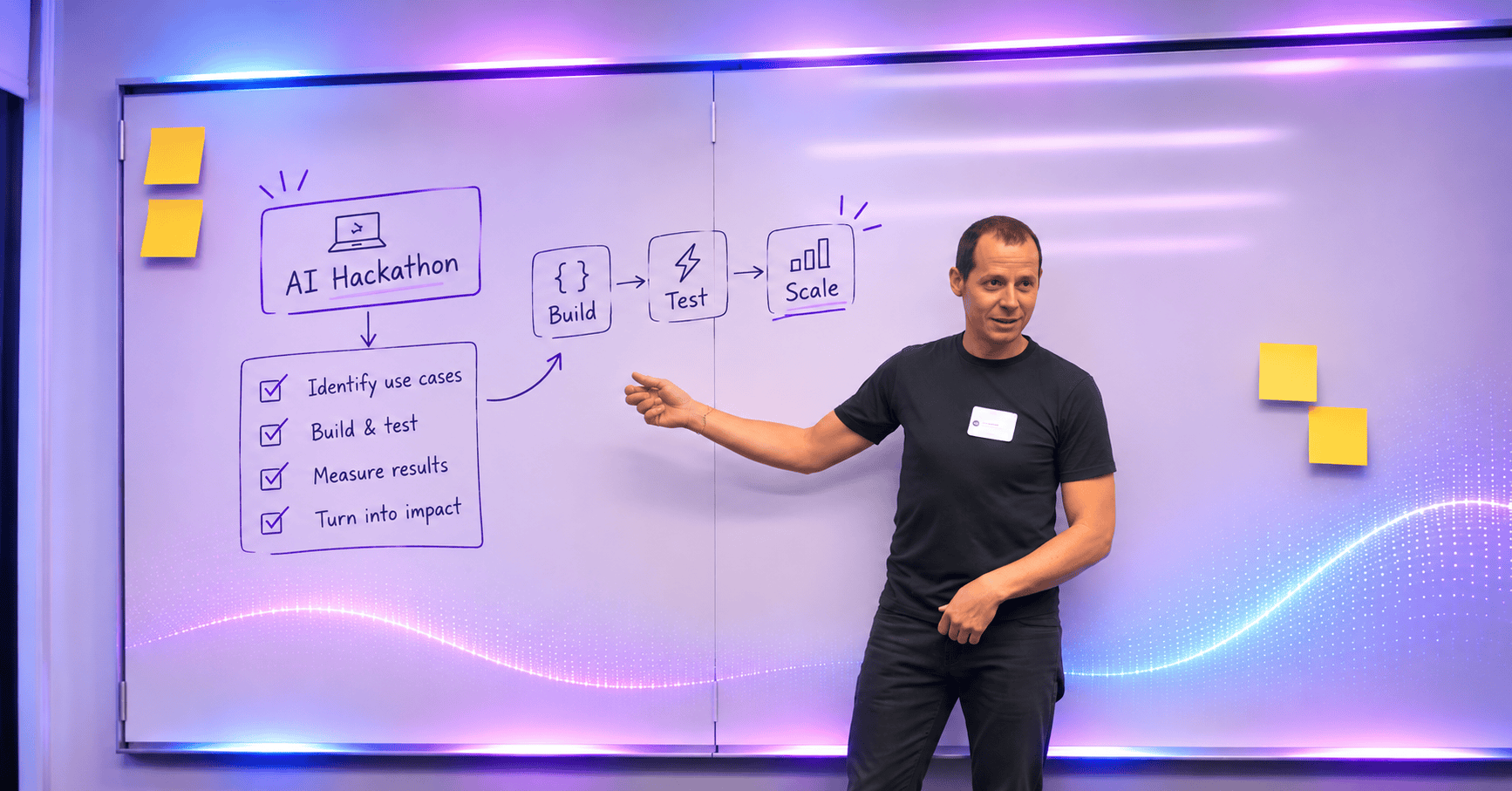
What happens when AI accelerates execution faster than an organization can make decisions? Drawing on his team’s experience building a completely new agentic AI platform and bringing it to Skai’s first beta partners in just 90 days, Yarden Ron shares how they rethought decision-making, business context, and quality to keep pace. The lessons offer a practical framework for marketing and business leaders navigating their own AI transformation.
Key takeaways
- Faster execution exposes new bottlenecks: As AI accelerates work, waiting for decisions, alignment, and approvals can become the biggest obstacle to progress.
- Empower people closest to the work: Clear ownership, defined guardrails, and rapid feedback help teams make decisions without unnecessary delays.
- Make business context accessible: People make better decisions when they understand customer needs, product priorities, and broader business objectives.
- Prioritize quality where customers feel it: Protect dedicated time for customer-facing improvements while maintaining rigorous testing and addressing underlying issues.
When AI Changes the Pace of Work
Earlier this year, ten engineers built a completely new agentic AI platform on top of Skai’s existing data layer, one that lets marketers build agents, orchestrate workflows, and govern how they work together. Ninety days after we started, those capabilities were in the hands of our first beta partners: working, valuable to customers, secured, and ready to scale.
Those 90 days, and the months of working with live customers since, taught us a lot. The hardest part wasn’t the code. It was context. On a platform that had only recently been built, the knowledge behind each decision was being created at the same pace as the code. Without that knowledge, an engineer either waits for someone who has it or makes a guess.
A few weeks ago, I asked an AI assistant to analyze six weeks of my group’s Slack conversations and answer one question: When an engineer stops to wait, what are they waiting for?
Here’s what it found:
- A question one person could answer was usually resolved within minutes.
- A question that required several people to agree on scope took around a day.
- A decision that changed how part of the product should work could take weeks.
During those same six weeks, most of our tasks went from started to done within two days. That gap is the reason for this article. Building got faster. Deciding didn’t.
Over the past several months, we’ve changed how our group works so that decisions keep pace with execution while maintaining the quality of what reaches customers. Here’s what we changed, what it cost us, and what I’d suggest to other teams navigating a similar shift.
Faster Execution Creates a New Bottleneck
Two things made building faster for our team. First, AI coding assistants became part of every engineer’s day, reflecting a broader shift across Skai this year. Second, trying an idea often became faster than writing a detailed specification for it. A working version can settle questions that would otherwise require lengthy discussions and documentation.
When building speeds up like that, the expensive part of the week moves. An hour of waiting used to be small next to a week of implementation. Now it can account for a significant portion of the entire task. So we started asking a different question: How can we reach a good decision faster?
This challenge extends beyond engineering. Imagine a marketing team that can generate a detailed performance analysis across dozens of campaigns in minutes. If it still takes three days to align on the next action, much of the efficiency gained through AI is lost. For us, two things had to move together: the freedom to make decisions and enough context to make them well.
Move Decisions Closer to the Work
The first change was where decisions were made. Most now happen at the keyboard, by the engineer doing the work, and become visible to everyone within a day. That only works with clear guardrails, so we made them explicit:
- Every piece of work has a decision owner. When we hold a kickoff with product, a product manager defines the scope and work begins once the fundamentals are clear. For other tasks, the engineering team owns the process end to end, including defining the scope.
- Every task has a written definition of done. In a sentence or two, we establish what should exist at the end. For team-owned work, the engineer writes this definition and shares it before starting.
- Unexpected decisions are made by the people doing the work. When an engineer encounters an edge case nobody anticipated, even inside a product-owned task, they can usually make the call, keep going, and share it.
- The right people are involved in daily check-ins. Each team’s daily meeting includes product managers and the lead of our other engineering team. A decision shared in a sentence or a quick screen demonstration gets feedback the same day.
Showing a decision gives us an opportunity to catch a wrong turn while it’s still inexpensive to correct. An objection in tomorrow’s meeting might cost a day of work, while the same objection at the end of the week could cost significantly more. Our weekly planning meeting provides another opportunity to review the work in depth, ensuring that a wrong call lasts a week at most.
When a decision does turn out to be wrong, the question we ask is: What context was missing? That question keeps people willing to make decisions.
What We Learned When We First Tried This
The first few weeks were painful. Making decisions independently required a real mindset shift for engineers accustomed to waiting for a detailed specification. The product was still new to most of the team, and the broader business picture wasn’t transparent enough. Some decisions missed the mark. We caught them quickly, usually by the next daily meeting, but they still cost time and created frustration.
Things improved as we found our rhythm. Engineers became more familiar with the product, weekly planning sessions incorporated more business context, and sharing decisions early became a habit. Today, a decision we have to reverse is rare.
Those first weeks taught us that giving people the freedom to decide is only half the equation. They also need the information to make good choices.

Business Context Is Part of the Job
We started treating business and product context as an essential input for engineering. Every weekly planning meeting now includes product priorities and upcoming requirements, updates on where each customer stands, insights from customer conversations, and the broader direction of the platform. These discussions sit alongside detailed demonstrations and next week’s commitments because they influence both.
Some of that context comes firsthand. A forward-deployed engineer works directly with our customers every day, and each week, part of the group focuses on the challenges customers encounter. Engineers who have seen a customer struggle with something make different small decisions about it.
This is especially important when building agentic AI capabilities for marketing. Understanding how marketers actually work, where they encounter friction, and what outcomes matter to them helps us make better decisions about the experiences we build. The same principle applies to marketing teams adopting AI. As people take on more responsibility for directing automated workflows, access to customer knowledge, business priorities, and organizational expectations becomes increasingly valuable.
Invest in Quality Where Customers Feel It
Moving quickly raises a fair question: What happens to quality? Our approach is to be deliberate about where we invest our effort, starting with the places customers interact with the product.
About 20% of our group’s capacity goes toward this every week through dedicated responsibilities. One role owns production, monitoring it and handling issues that come through our support team. Another works alongside our forward-deployed engineer to address challenges customers encounter, with a target of resolving today’s most urgent issue by tomorrow.
Other issues are raised in our daily meetings and tracked. An internal issue that doesn’t affect customers can be monitored without interrupting the work already underway. When several symptoms start pointing to the same area, we investigate the underlying cause and address it in a dedicated session if necessary. Fixing one root cause properly is more valuable than repeatedly patching individual symptoms.
Everything that reaches customers has met its definition of done, been demonstrated to the group, and gone through end-to-end testing and a staging environment before release. That discipline allows us to move quickly while protecting the customer experience.
The Trade-Offs of Moving Faster
There are costs to working this way, and I’d rather name them than pretend they don’t exist. Each one requires a mechanism to keep it manageable.
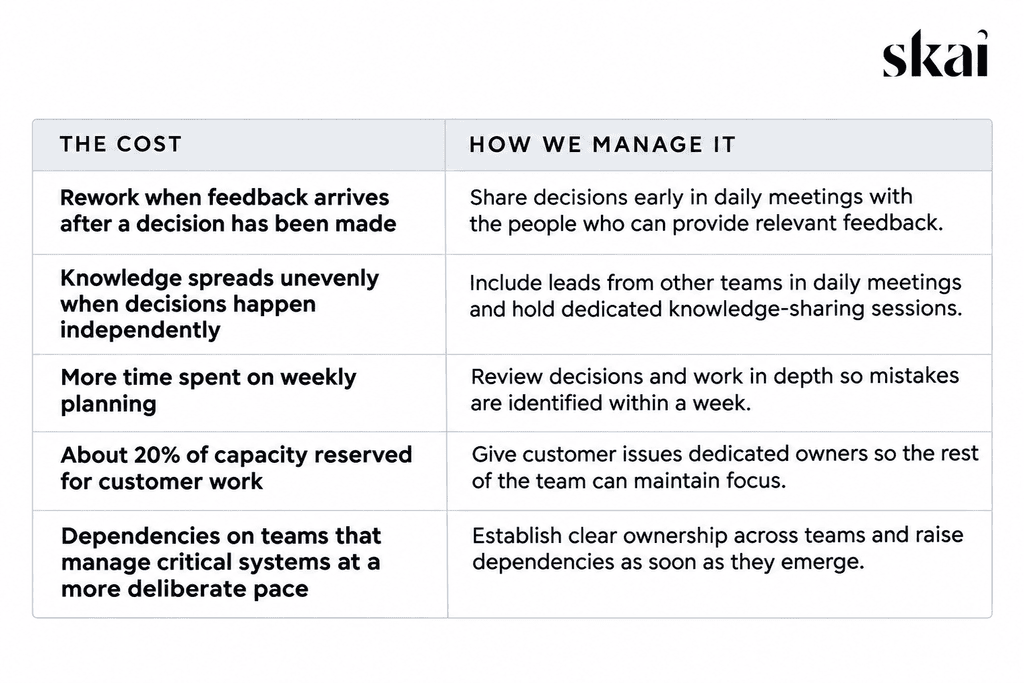
Different parts of an organization operate at different speeds for good reasons. A team responsible for critical infrastructure may need more rigorous review than a team experimenting with a new capability. Clear ownership and communication help those teams work together effectively.
Five Things Your Team Can Try
You can apply these lessons without introducing a new platform or redesigning your entire organization. Whether you’re leading an engineering team or overseeing marketing operations, these are five places to start:
- Measure where your team waits. Ask what people are waiting for and how long those delays last. The answer may not be where you expect.
- Define decision ownership before work begins. Establish who can make which decisions and when additional input is required.
- Create short feedback loops. Bring the relevant stakeholders into regular check-ins so decisions can be reviewed within a day.
- Make business context a standing agenda item. Share customer feedback, business objectives, and upcoming priorities with the people executing the work.
- Decide what needs immediate attention. Prioritize customer-facing issues, track internal challenges, and address underlying causes when patterns emerge.
The Next Challenge Is Keeping Up With AI
As AI continues to accelerate execution, more teams will encounter the challenges we’ve experienced over the past several months. For marketers, this could mean spending less time manually pulling reports, analyzing performance, or implementing campaign changes, and more time determining what those workflows should accomplish and how agents should operate.
Our experience building a completely new agentic AI platform at Skai has shown us how much progress a small team can make when people have the freedom, context, and guardrails to make good decisions. The next opportunity for organizations is to rethink the processes surrounding AI-powered work. Where can decisions happen closer to execution? What information do people need to make them? Which guardrails allow teams to move faster while protecting the outcomes that matter?
AI has changed the pace of work. How much value we get from it will depend on how well we adapt the way we work.
Ready to learn more? Discover how Skai helps marketers build AI agents, orchestrate workflows, and maintain control over execution.
Frequently Asked Questions
AI accelerates execution by reducing the time required to build, analyze, and test ideas. As work gets faster, decision-making, approvals, and alignment can become the biggest bottlenecks. Teams need to rethink how decisions are made, giving people closer to the work greater autonomy while ensuring they have the business context and guardrails to make informed choices.
Teams can accelerate decision-making by establishing clear ownership, defining what success looks like, and creating short feedback loops. At Skai, engineers make many decisions directly and share them during daily meetings so potential issues can be identified quickly. Regular planning sessions, customer feedback, and testing help maintain quality while keeping work moving.
Skai’s experience building a new agentic AI platform in 90 days shows that adopting AI requires more than faster technology. Marketing leaders can apply the same principles by identifying where workflows stall, empowering teams to make decisions, and making customer and business context readily available. The goal is to ensure that organizational processes keep pace with AI-powered execution.
More like this
-

How Liquid Death Killed It on Prime Day with Skai’s Agentic Marketing Platform
-

How to Run a Successful AI Hackathon: A Playbook for Marketing Teams
-
Let Agents Read Before They Act: The First Workflow That Builds Trust
-
Building an Agent Is the Easy Part
-
How Skai Built a Team Brain to Make AI Workflows 10x Faster
-
From Software Engineer to AI Engineer: 8 Lessons From Under the Hood at Skai