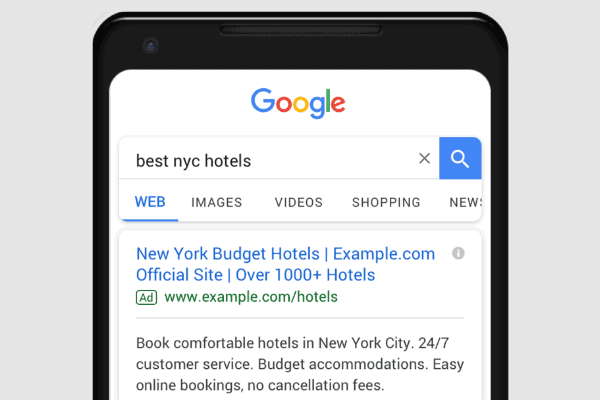
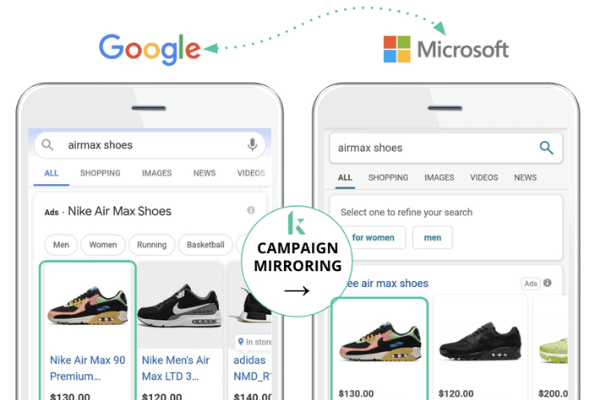
Google serves billions of SERPs (search engine results pages) every day and each one represents valuable real estate for advertisers. Match types enable search marketers to better target their ads and have been an important part of paid search since the beginning of the channel.
In 2021, Google announced new Google ads match types changes.
In summary, the broad match modifiers type is going away and its behavior will be adopted by the new phrase match.
What are Google Ads Keyword Match Types?
Google ads keyword match types are words and phrases that match ads with search terms users search for in Google. Match types are key to a marketer’s search strategy because they dictate how accurately the keyword matches the user’s search query in order to participate in the auction.
There are three types of Google ads match types: Broad match, phrase match, and exact match. Broad match types show searches that relate to a keyword. Phrase match types show searches that include the meaning of a keyword. Exact match types show searches with the same meaning as a keyword. There are also negative keywords, which marketers can use to exclude keywords from showing on searches to improve the returned results.
Goodbye Broad Match Modifier, Hello Updated Google Match Types
In terms of timing, Google offered this guidance:
“We’re phasing out support for broad match modifier. We understand that these changes can mean different things to different businesses, and we want to help minimize any disruption.
That’s why we’re rolling these changes out slowly over several months:
- Starting mid-February, both phrase match and broad match modifier keywords will begin to transition to this new matching behavior. Because this behavior will be applied to both match types, you won’t have to take any immediate action—you’ll keep your performance data and have no need to migrate your keywords.
- In July, once the new behavior has been rolled out globally, you’ll no longer be able to create new broad match modifier keywords. However, existing broad match modifier keywords will continue to serve under the new behavior. That’s why starting now, we recommend creating new keywords in phrase match going forward.”
In Google’s post, it offered the following example of how the immediate changes will work:
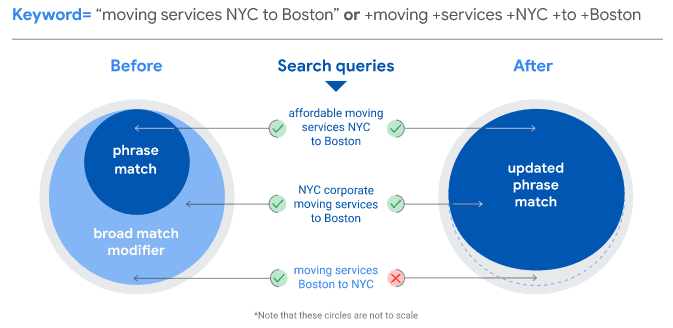
And for further clarity:
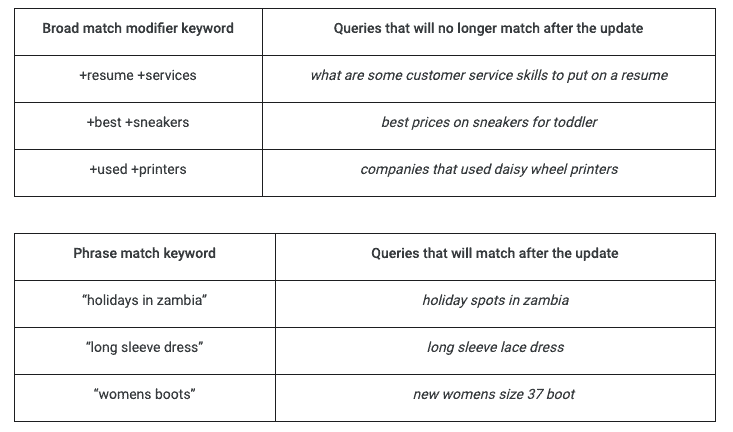
Finally, Google also asserted that “keyword matching is now more predictable: an exact match keyword that is identical to a query is now always preferred as long as it’s eligible to match.”

What these Google ads keyword match type changes mean
While Google’s post outlines the “What” is going to happen and “When” it will take place, you may be wondering about the “Why” and how marketers might interpret these changes in terms of what they could mean for the future of search marketing—and more importantly, how it might impact or benefit them.
At Skai Paid Search, we have a very strong, 15-plus year partner relationship with Google Search Ads, and as an API integrator, we are often building a year or more ahead of its planned changes. It’s safe to say that we follow this channel as closely as anyone in the industry and here’s our two cents about what these Google ads match type changes may indicate.
#1 Google Ads Keyword Match Types Update Takeaway: Specific match type campaigns may not be necessary
Advertisers may no longer need to build large program structures by breaking out campaigns by google match type. Historically this had been recommended as a way to better funnel spend by match type, but as exact match will now always have priority, the need for these elaborate structures is reduced. Of course, there are always exceptions to the rule. If your keyword universe still requires it, you may need to extend that strategy. But we see this as one change that will reduce the size and complexities of search programs.
#2 Google Ads Keyword Match Types Update Takeaway: Smart Bidding becomes more important
As Google continues to simplify and take away controls from advertisers, the utilization of Smart Bidding will become even more important to a program’s success. By combining all google ads match types in one Ad Group, the Smart Bidding algorithms will have increased data signals to make intelligent bidding decisions.
#3 Google Ads Keyword Match Types Update Takeaway: Marketers will slightly change their strategy
Search Query and Negative Keyword management will continue to be important to a program’s success. As the phrase matching behavior loosens, advertisers will want to review search query reports to ensure search terms are relevant. From there, advertisers should add any missing relevant terms as exact match keywords and use negative keywords to prevent ads from showing on non-relevant terms.
#4 Google Ads Keyword Match Types Update Takeaway: Automation is driving this
With the combination of two match types and the update to the exact match preference behavior, we see this as a continued push by Google towards machine learning and automation.
Tips for the New Google Ads Keyword Match Types Transition
Here are some things Google and Skai both recommend would be good tips to follow until the match type changes transition is completed:
- Keep an eye on things. The initial changes are estimated to take several weeks, we’d recommend monitoring your Google match types performance over the next several weeks as they take on the new behavior. We would not recommend changing match types until the changes are fully rolled out.
- Check the Recommendations. Recommendations is a solid tool within the native
Google Ads platform that can be very helpful to offer changes to your accounts.
- Test broad match with Smart Bidding. Broad Match Smart Bidding signals have been improved and advertisers should test running broad match to drive increased reach to relevant searchers.
- Rely on negative keywords. Exclude matches you don’t want with negative keywords.
Skai Paid Search powers some of the biggest brands and agencies in the world
Achieve next-level performance with the award-winning, industry leader in SEM, Skai Paid Search.
To learn more, or to see our innovative features firsthand, please reach out and schedule a brief demo today.